Contents
- 1 How to grow oleander
- 1.1 Oleander cultivation guide
- 1.2 Characteristics of oleander
- 1.3 Where does oleander grow?
- 1.4 Oleander flowers are very beautiful
- 1.5 Oleander watering
- 1.6 Oleander: where to grow it?
- 1.7 Oleander: Propagation and caring
- 1.8 Oleander pruning
- 1.9 Oleander soil and fertilizer
- 1.10 Oleander pests and diseases
- 1.11 Beware with oleander toxicity!!!
How to grow oleander
Oleander cultivation guide
Characteristics of oleander
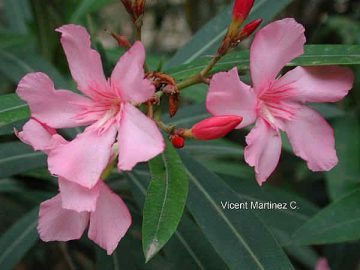
Oleander (Nerium oleander) is a plant of the Dogbane family – Apocynaceae – family reaching up till 4 m. It shows erect stems, plenty of latex.
Lanceolate leaves, similar to those of the sweet bay, opposed, hard to the tact, with short petiole.
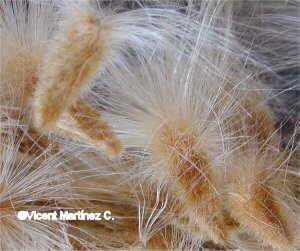
It produces rosy flowers till 4 cm. Its fruits remember those of the beans, but they are much bigger dark brown. Inside these pods they contain seeds provided with feathery plumes.
Where does oleander grow?
It is native from Europe and Asian Middle East, although it can be found like an ornamental plant in many parts of the world. It grows in sandy and
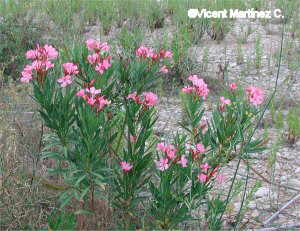
calcareous places with exhibition to full sun, especially in the beds of the Mediterranean riverbeds that remain dry most of the year
It is usually used like an outdoor plant, although it can also be cultivated indoors. In the first case, if it is planted directly on the soil, it can attain 5 m tall, being its habitual height about 1 meter and half. When planted in a pot, it doesn’t usually reach more than half a meter.
Oleander flowers are very beautiful
Along the whole summer it can produce very showy flowers that, in very mild climates can continue until mid autumn.
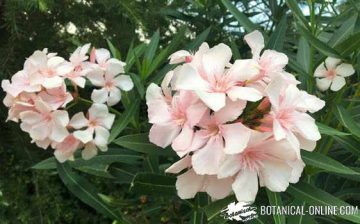
The flowers are very big, funnel shaped, with colors that can vary from the red or rose to the violet, the salmon or the pure white.
They usually have a single line of petals, generally having eight, but we have other species that present two lines.
Oleander watering
Being a plant of Mediterranean origin, it is very resistant to the drought. In its natural atmosphere, it appears in ravines that are practically dry during the summer months. If cultivated outdoors and directly on the floor, except in very dry years, it will have enough with the rain water.
Cultivated in a pot, the best way to water it is to place it above a recipient with water and to leave it to absorb the necessary quantity. In vegetative time – spring and summer – we should not let the floor to become dry completely. In winter, a watering every 15 days will be enough.
For indoor plants is convenient to water more abundantly and to spray it quite frequently. In very dry atmospheres we will have to do it practically all throughout the year.
Oleander: where to grow it?
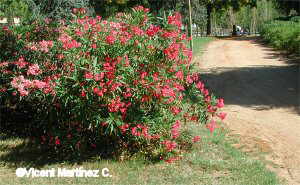
If we plant it in the garden, the ideal place is to place it in a sunny place, with preferable orientation toward the south. We will try that the place do not become flooded because it is a plant that doesn’t tolerate overflowing. In the event of being a place with cold climate, subjected to strong freezes, it will be better not to plant it directly in the floor but in a container that can be taken indoors. In spite of this, we can say that it is a plant very resistant to frost and we have varieties like the ‘Little red’ that can tolerate constant temperatures well below between -6 and -12 ºC.
Cultivated outdoors, it can be used as an isolated bush or to form hedges. A good way is to place it next to the walls to adorn them. As resistant species, it is cultivated in gardens of big cities because it stands contamination very well. We can also find it as ornamental species in the marine boulevards, being a species that tolerates the saline atmospheres.
Cultivated indoors, it requires a lot of light, so that we should place it next to a window. It would be necessary to offer it a fresh location, far from the heating that dries up the atmosphere and doesn’t cause it any benefit. One would also have to keep in mind that the sun doesn’t hit it directly in summer, because the glass, acting as magnifying glass, can burn its leaves. The rest of the year can be located directly behind a glass.
Oleander: Propagation and caring
The best way to spread the oleander is by means of cuttings. They can be planted either in spring or in summer. The best way to do it is the following:
- Cut a branch without flowers of about 15 cm
- Put it in the water until it produces new roots about 3 cm long.
- Plant it in a pot.
- When the plant is well rooted, what will take place in one or two seasons, transplant it to its definitive place.
The new plants will grow very quickly, up to a point that samples propagated by means of cuttings in spring can already produce flowers in the same season.
In general it doesn’t like to be repotted very frequently when full grown. In case of young plants, this can be done when the roots don’t fit in the pot and escape through the inferior holes. It will be taken at the end of winter or beginning of spring.
Oleander pruning
To grow with vigor and to produce abundant flowers these plants require a quite constant pruning. After the bloom, it is very appropriate to execute an intensive pruning, so that the plant is provided with regular growth and doesn’t present an ungraceful form.
It is necessary also to eliminate the dry floral buds to stimulate the new ones. To trim the spring buds from time to time is a good way to prevent that the cochineals attack them.
Oleander soil and fertilizer
It doesn’t require any special soil and it can grow perfectly with a normal garden compost with the condition that it presents a good drainage.
Oleander pests and diseases
Among the most habitual pests we can find:
- Greenflies that usually appear in very dry and warm springs and attack the most tender buds. They are yellow or ocher and feed of the sap from the most tender buds to which they weaken. They convert the areas they attack in sticky spots. The most appropriate treatment is to apply some mineral oil with insecticide.
- Cochineals, in form of scabs, that stick to the leaves and the buds that also become sticky. They will be treated with some specific insecticide.
Beware with oleander toxicity!!!
It is a very poisonous plant that should be manipulated with care.
We should take into account where to place it in case children may access to it.
* See more: Oleander toxicity
 More information about plant cultivation.