Contents
How to grow fig tree (Ficus carica)
Fig tree cultivation guide

The fig tree: Uses and types
We have two types of fig trees:
Fig trees planted in the gardens or fields
They can be planted wherever is desired, leaving them grow freely. Doing like that, a big field or garden will be required, so the tree can achieve a considerable size. Having a smaller garden or field or trying to obtain more fruits, it is convenient to restrain the roots. This is done by planting the tree in a concrete box or a big pot with the bottom covered with stones.
Fig trees in the greenhouse
In this case, it must be proceeded with the method of restraining the roots or planting it in a big pot.
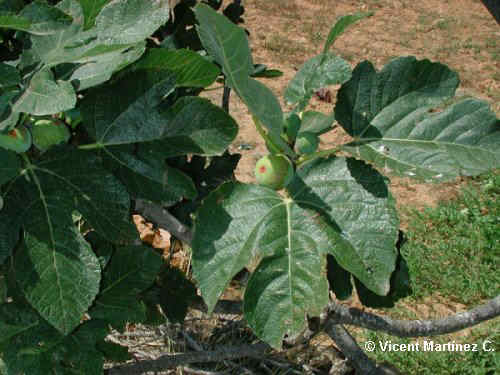

The fig tree: Flowers and fruits
Fig tree is in its bloom from spring to autumn (yellow flowers not visible inside a receptacle that will become the fig later) Fruits, in embryo state, being cultivated in a warm place, will grow and mature next spring (early figs).
When conditions are not so warm, will grow next summer and will mature in September. They should be collected when fully ripe and when the skin has become wrinkled and cracked with the stalk hanging down and better if nectar is flowing from the eye.

The fig tree: Watering
It depends on the type of cultivation
Fig trees planted in a garden or field
They usually stand a wide range of watering. They can be found from sea level up to 2.500 m. and rain fall amount varies from 400 mm or less to 1.200 mm. a year. In the first case, the tree shows a bushy appearance. If conditions are favourable, their size might be very big, specially root length. In case of restraining the roots to avoid excessive growing or increase fruit production, it is advisable to water it frequently.
Fig trees in the greenhouse
They must be watered twice a week and leaves must be sprayed from time to time.
Either in the greenhouse or the open air, fig trees require a dry season for the fruits to get ripe (August-September) and in order to them not to become spoiled.

Fig tree: Location
Fig trees in the garden or field
Although fig trees can stand with a wide range or temperatures, enduring till -7 ºC, the ideal annual temperature average is about 18 ºC, (64 ºF), so it can produce an annual harvest. This is what happens in temperate climates. In colder zones it must be planted in sheltered places facing the sun. In tropical zones it can be harvested three times a year and in subtropical ones, twice.
Fig trees in the greenhouse
In this case temperature should not go down from 12 ºC (53 ºF). Keep the temperature between 15 and 18 º C (59 ºF- 64 ºF) Spray the leaves and air the greenhouse in case the temperature increases.

Fig tree: Growing
Fig trees, no matter if in open air or in the greenhouse), should be planted in winter (from November to March) They can be planted from seeds or graft, but it is recommended to choose nursery trees about two years old. It is convenient to hold them to a post and check the lace every year to assure the trunk is not being strangled.
The cuttings must be done in February. First ones (formative cuttings) will give the structure of the tree. From them on, old branches should be cut every year up to the point where young buds appear.
Trees should be fertilised in spring with a chemical fertiliser and animal manure. In the greenhouse this operation must be done in winter.

The fig tree soil
Fig trees prefer a rich humus soil, humid although with a good drainage. So it is advisable, when planting them, to cover the bottom of the plant hole with a good layer of stones or bricks to avoid plant stagnation.
 More information about fig tree and figs.