Characteristics of Iris family
What is the Iridiaceae family?
The iris family –iridaceae– comprises about 1800 species of bulbous or rhizomatous plants which mainly grow in Africa, America and Mediterranean region.
Because of their importance in floriculture, many of their members can be seen as cultivated species throughout the world.
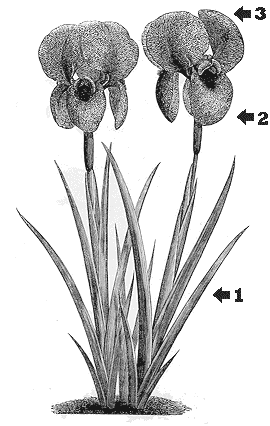
| Leaves (1): basal or stem, glabrous, sword-shaped, embracing the stem below. |
|
| Flowers: | |
| At the end of the stem, solitary or in cymes. | |
| Perianth: Looking like petals (tepals), with 3 segments outside, generally hanging (2) and 3 inside usually straight (standards) (3) | |
| Stamens: 3 with the filaments either joined or free. | |
| Ovary: Inferior | |
| Carpel: 3- celled | |
| Stigmas: 3, petal -like, bending towards the stamens | |
| Fruit: Capsule |
Genera
There are about 70 genera. The most important ones are the following:
CROCUS
GINANDRIRIS
GLADIOLUS
GYNANDRYRUS
IXIA
SISYRINCHIUM
VICIA
 More information on plants
This article was endorsed by Julián Masats - Technical agricultural engineer specialized in horticulture and gardening.