Contents
How to grow droophead tufted airplant or scarlet star (Guzmania lingulata surprise)
Scarlet star care sheet
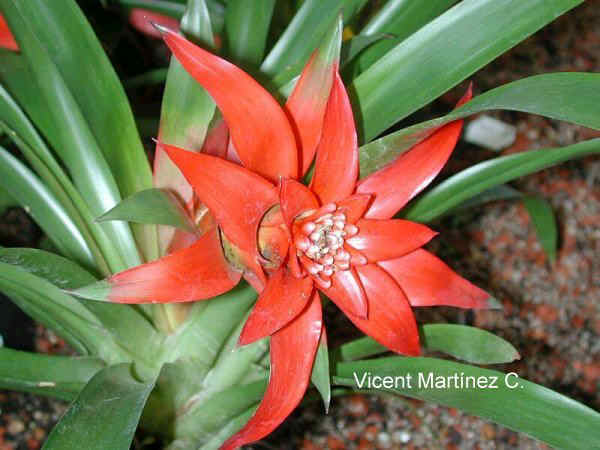
Guzmanias are perennial plants of the bromelia family. They may reach up to 1 m. Lanceolate leaves, bright green, glabrous on both both faces. Flowers located at the end of a long stem of reddish bracts.
 Guzmania (Species)

There are 120 guzmania species approximately, all they born spontaneously in the tropical areas of South America. Being tropical plants, they are very sensitive to frost. Among the most characteristic species we find:
- Guzmania lingulata
- Guzmania monostachia
- Guzmania sanguinea
Guzmania (flowers)

What appears to be a red flower it is in fact a bunch of superimposed bracts that form a long spike about 25 centimetres high. It is green at the beginning and, little by little, it becomes bright red. After a long period, lasting about two years in some cases, flowers are born into a very brief couple of days blooming period. Once the true flowering has taken place, it begins to wither and dies.
Guzmania (Watering)
As in all the bromeliads, the soil of a Guzmania doesn’t need to be specially watered, although it should always be a little humid and, being a plant of tropical climate, it needs a constant moistness so we will pour some water into the glass that its leaves form, in such a way that there will always be a reservoir of 2 cm of water in it. We will preferably use rain water since it doesn’t stand lime, so it is a wise thing to boil it or use a decalcifier. To avoid fungi development we should empty the central cup every 15 days and substitute it with fresh water.
The excess of humidity in the soil is not a good thing since it rots the inferior part of the foliar rosette where black stains appear. In this case, it is better to suspend watering.
Guzmania (Location)

It is an indoor plant that prefers very illuminated places but not being directly placed in the sun. A very dry atmosphere will ruin it, so it is convenient to maintain some water in the foliar recipient, especially in summer. We should not let the soil become completely dry, something that, combined with a low environmental humidity, would make the tips of the leaves to become brown and withers. Whenever this happens, it is convenient to vaporize the plant little every day.
Guzmania (Reproduction)

This plant can be reproduced from new shoots springing from the base of an adult plant. To do this, we will carefully separate the new offspring below the roots that kept it to the main plant and we will plant it in a new pot. It is necessary to maintain it in a warm place and to provide the necessary humidity. After some days, it will have been acclimatized and we will possess a new guzmania sample. This method becomes necessary to perpetuate the species when a plant has definitively flourished and it will begin to dry off in short.
Guzmania (Soil and illnesses)

It prefers a peaty, acid soil. It doesn’t like lime. A mixture of garden soil, peat and sand would be the ideal one.
It is a species that requires a nutritious soil, so it is very wise to fertilize it every 15 days, especially in spring or summer. One can add some universal fertilizer into the water or even some foliar product.
Guzmanias are plants very easy to cultivate and they don’t present many illnesses. The main enemies are lice that leave a sticky layer in their leaves. They reproduce very easily in dry atmospheres. Suspecting the presence of these animals, it is better to apply an appropriate insecticide and to increase watering.
 More information about plant cultivation.