Contents
MEDICINAL PROPERTIES OF SEA HOLLY
Medicinal properties of Eryngium maritimum
Sea holly properties are similar to those of Field eryngo:
Internal use

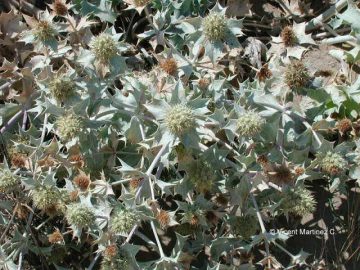
Photo of Eryngium maritimum Depurative: It purifies the blood and combats the inflammations that affect the urinary tracts (kidney stones, painful micturitions, uretritis, chronic prostatitis, etc.) or those of the circulatory apparatus (albuminuria, icterus, etc.) (15 tincture drops three times a day)
- Diuretical: It favours the elimination of corporal liquids, by making the kidneys overwork, being very appropriate in cases of gout, rheumatic and heart illnesses that associate with the accumulation of water in the body. (Decoction of 20 gr. of root in ½ liter of water during 10 minutes. Three glasses a day, after each meal)
- Expectorant: It acts on the mucous of the lungs, favoring expectoration in cases of cold or flu and avoiding the spasms. (The treatment seen before can be suitable to such an end)
- Diaphoretic: It stimulates the perspiration, reason why it favors diuresis and helps to eliminate toxins of the body. (Decoction of the root)
Toxicity of seaside eryngo
There are not studies that point out any possible toxicity. However, in case of abuse, because of its diuretic and diaphoretic properties, it could produce an unbalance of the blood pressure, by decreasing it too much, being the cause of hypotension.
*Related information:
– Characteristics of sea holly
 More information on plants
This article was endorsed by Vicente Martínez Centelles - Founder of the web and director. Teacher of natural sciences, expert in plants, natural remedies and botanical photography.