Contents
Properties of Hydrangea macrophylla
Scientific noun: Hydrangea macrophylla Ser.
Family: Saxifragaceae
Habitat: Species cultivated for gardening, native from Japan
Active components: Hydrangin and saponin
Active parts: The whole plant
PROPERTIES OF HYDRANGEA
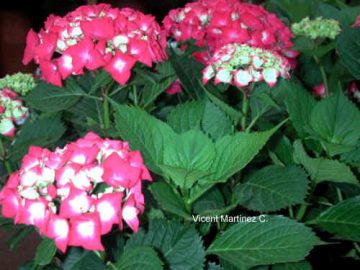
Gardening uses of hydrangea
As a garden plant, hydrangea is a very common one. (More information)
Medicinal uses of hydrangea
As a medicinal plant, decoctions of its dried leaves have been used to treat intestinal disorders, such as gastric ulcer, reflux al ulcerous colitis.
Because of its toxicity, it is not advisable to take homemade medicinal products!!!
Toxicity of hydrangea
Hydrangea macrophylla has a high toxicity. Hydrangin is a cyanogenetic glycoside, that produces intoxications with similar symptoms to those of of the cyanide.
Another glycoside that produces hydrocyanic acid in contact with certain enzymes is amygdaline which appears in the seeds of many plants belonging to the rose family, such as plum tree (Prunus domestica); cherry tree (Prunus avium); apricot (Prunus armeniaca); peach tree (Prunus persica); or almond tree (Prunus dulcis).
Side effects of hydrangea
In minor doses, ingestion of this plant shows the following symptoms:
- Diarrhea
- Vomiting
- Stomachache.
In major doses, which is quite unlikely because hydrangea is a bad tasting plant, the consequences are more severe:
- Asphyxia
- Bad breath
- Increase of heartbeat
- Respiratory failure and death.
Is hydrangea toxic to animals?
Similar symptoms have appeared in horses and cows that have eaten its tender buds.
 More information on plants.