Contents
How to grow tulips
 Tulips: Characteristics of the plant

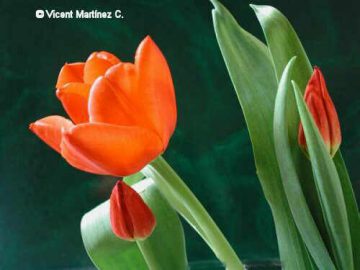
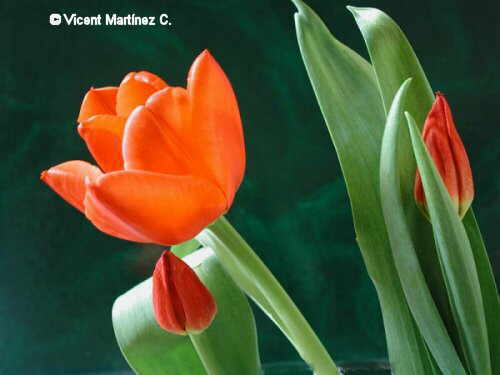
Tulips are plants from the lily family (Liliaceae) that come from central and western Asia. There are about 5000 species approximately, contained in 15 families, most of which are forms cultivated starting from the species Tulipa Gesneriana. With a great variety of sizes and forms, their very attractive flowers are used fundamentally for decoration of parterres or in big containers with the possibility of combining different colors. Lately cultivation has been extended indoors with other bulbous plants as hyacinths or narcissus.
The lily family (Liliaceae)
 The lily family (Liliaceae)
 Tulips (flowers)

They produce very big noticeable flowers, blooming from early to mid spring.
Tulips (Watering)
The land should not be allowed to dry. Watering should be more abundant before the bloom. The bulbs planted in autumn should remain humid during winter.
Tulips (Exposure and emplacement)

In the sun or demi-shade in a warm place. In winter, if they have flourished or sprouted, and if the external conditions are very cold, better to keep in interior. The ideal conditions of temperature, after having flourished, is about between about 13 and 18ºC. They don’t appreciate the currents of air and very dry atmospheres.
Tulips (Reproduction)

From little bulbs in autumn. Although they can be reproduced with bulbs originated by the same plant, it is better to buy bulbs that come from Holland. A good solution is to use the own bulbs together with those bought. The bulbs should be planted at a depth of about 15 or 20 cm and 15 cm apart. (A practical way to calculate the depth is to leave the inferior part of the bulb at a distance corresponding the double of its longitude with regard to the surface)
It is convenient to mix the soil with a good specific fertilizer, to water well and, in the event of being a very cold climate, to cover the earth so that they don’t freeze. (It is better than in winter they stay under cold temperatures to avoid a premature blooming that produces plants of little quality. A temperature of 4º or 5º would be the best. It is not convenient to use the same soil where they have been planted the previous year. It is better to renovate it every year. In winter the soil should not be allowed to dry off.
Tulips (soil, fertilizer and illnesses)

It should be preferably alkaline, with mixture of sand and garden soil, not of manure. Soil should have a good drainage so it should be quite loose, to avoid fungi that will end up rotting the plant.
Fertilize soil mixture before planting or apply it after planting. A general garden fertiliser should be good. When replanting bulbs, fertiliser should be applied immediately after blooming.
Bothytris is responsible of drying leaves and buds in tulips. Some fungal insecitide should be applied to avoid it. Sometimes we obtain good plants but no flowers are developed. This is the result of a bad winter bulb storing in which temperature was to high.
Another of the pests that should be avoided is that of slugs and snails that eat up the plants especially when they are in period of growth. we should apply a repellent of these animals to avoid it.
Tulips (Hydroponics)
Another possibility of cultivating tulips is inside the water, what is known like hydroponics. To carry out this cultivation we will need a special container or any glass jar with a mouth that embraces more or less the inferior quarter of the bulb. In this cultivation type we have to keep in mind the following tips:
- The water should only touch lightly the inferior part of the bulb. It should be changed from time to time so as to avoid the formation of fungi that would rot the plant.
- It is convenient, to avoid a premature growth of the stem and of the leaves and a good development of the roots, to leave the apical area of the bulb in a dark place during 18 months or so, or cover it with some object that doesn’t allow to pass the light. After this period of time we can already place it in an illuminated position.
- We should not place the flourished bulb in in a passing place where there are many currents of air, or near the heating. A location near a window with good light and not directly in the sun would be ideal.
Tulips (Bulb care)
Tulips are vivacious perennial plants, that is to say that they lose the air parts but they conserve the underground stems that are called bulbs. If we want the new plants grow well in the following season we have to keep in mind the following tips:
Before flowers dry off, approximately some three weeks after blooming, we should cut them, but we should leave the stem and the leaves dry off before retiring the bulbs, to incentivize the formation of the little bulbs for the new season. After a month and a half of having cut the flowers, we will extract the bulbs that should be conserved in a cold, dry place. A high temperature in winter is harmful and it can ruin the bulb or make the new plants to be of bad quality. (These conditions are applicable to both types of cultivations, either in soil or in hydroponics)
 More information about plant cultivation.