Contents
MEDICINAL PROPERTIES OF BORAGE
Internal Use of Borage
- Diuretic: It favours the removal of urine of the body, being very interesting to use it, not only in case of obesity, but when one must get rid of toxins through urine such as in the rheumatic, hepatic and cardiac diseases.
It is very influential in this case the fact tha t the plant contains choline, an element which takes part in the vitamin B complex, essential in the fat metabolism, because the lack of it may produce cirrhosis, high blood pressure or renal dissorders..(Infusion for 30 minutes of 15 gr. of dry leaves. Drink a cup after the main meals)
- Sudorific: It increases sweat, so, besides the commented uses, it is particularly interesting to help fighting pectoral diseases: flu,, bronchitis, cold, etc.. (Decoction of an ounce of dry leaves per litre of water. Drink 4 small cups a every day)
- Arthritis: Borage, besides being an excellent vegetable, with well proven diuretic powers, also stands out for its richness in essential fatty acids (EFAs) which are very useful in the treatment of arthritis. 1000 mg of borage oil contain about 240 mg of gamma-linolenic acid (GLA) which is the amount that is typically used in most treatments.
- Sedative: To balance the excess of adrenal hormones that occurs in a stressed situation, in case of anxiety or nervousness (Infusion of a spoonful of dried leaves per cup of water. Take a couple of glasses a day)
- Eczema: (Decoction for 10 minutes of 50 g of the dried plant in a liter of water. Three or four cups a day.)
 |
- Nail fungus: Borago oil can also be used to treat nail fungus. (The usual dose is 1000 mg once daily)
- Alzheimer disease: It is suspected that the lack of fatty acids could be one of the triggers of Alzheimer’s. Analysis in patients with this disease show low levels of fatty acids. Supplement intake of essential fatty acids omega-3 and omega-6 could improve the evolution of the disease. (Take it according to the patient’s leaflet).
- Macular degeneration: Essential fatty acids prevent macular degeneration and help in the formation of vitamin A from carotenes. (Take it according to the patient’s leaflet).
- Breast lumps: It is rich in omega-6 fatty acids so it can complement the properties of evening primrose. The dose was set at 200 mg daily, mixed with food for easy absorption and prevent headaches or stomach problems.
- Anti-prostatic: Especially suitable in case of inflammation of the prostate and prostatitis (decoction of a handful of leaves in a liter of water for 10 minutes. Drink two cups a day)
External use of Borage
- Emollient and tonic: It is beneficial for skin affections l (pimples, pustules, furuncles, herpes, eczema, gingivitis etc.) and tonic effects which increases its strength and appearance.
The presence of nicotinic-acid (niacin) must be fundamental here, to prevent skin maladies besides nervous and gastrointestinal disorders.(Soak a gauze in the infusion of a handful of dry leaves per litre of water. Apply it on the affected area) (Washes with water where it has been added a couple of litres of the same infusion)
Borage contains large amounts of mucilages. Eating boiled borage helps to have the stomach healthy. Borage helps to increase food digestion, preventing stomach ache.
Edible uses of borage:
Tender leaves can be eaten as a boiled vegetable, alone or mixed with another vegetables. In this case it is convenient to drink the broth, containing all the medicinal properties mentioned above.
The leaves can also be eaten raw, in salads. fried, sauté, with cheese, and so on…(it is advised not to leave the cut leaves without cooking for too long since they tend to become rotten very soon)
Flowers can be eaten alone or in salads, to provide them an exotic touch.
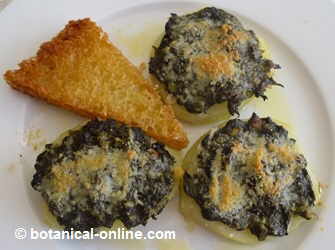
Borage recipe: Baked potatoes with borage leaves grated
Is borage a safe plant?
The presence of alkaloids seems to have a toxic effect in the liver, so it is not advised to use it during long treatments and when it is suspected the existence of a tumor or in case of pregnancy.
Borage present a series of contraindications and side effects that we must know, specially before using it as a medicinal plant.
 More information on borage.