Contents
What is fumitory?
Characteristics of fumitory
Common noun: Fumitory, Common fumitory, Drug fumitory
Scientific noun: Fumaria officinalis L.
Family: Fumitory family – Fumariaceae.
Habitat: In cultivated and bare places of calcareous soils.
Description of fumitory
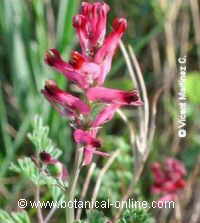
Annual herb of the Fumitory family – Fumariaceae– up to 60 cm. Erect stems, smooth. Composite leaves with lanceolate flat leaflets, till 1 cm. wide. Bracts shorter than the floral stalks. Round fruits with a flat or depressed side.
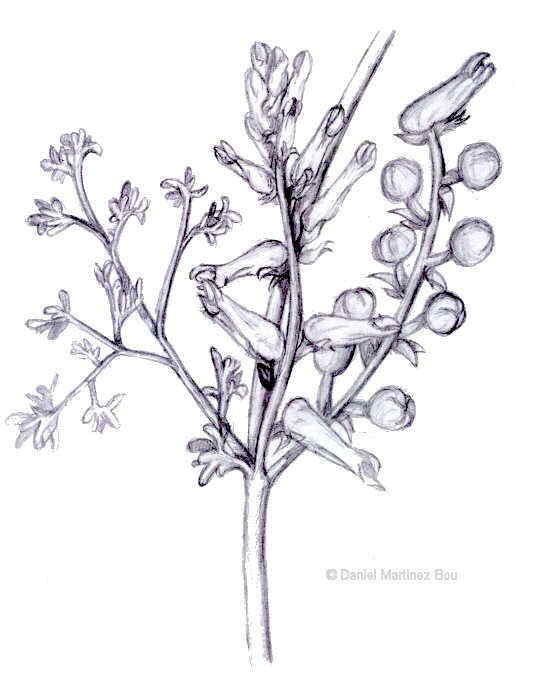
Drawing of fumitory
Composition: Active components of fumitory
- Alkaloids (canadine, protopine -fumarine, fumaricine, fumariline, estilopina, cryptonine, sanguinarine, corydaline…) The main one is fumarine. (See study about toxicity in this plant in the listing below)
- Acids: Caffeic, fumaric, tannic
- Flavonoids
- Mucilage
- Potassium
MEDICINAL PROPERTIES OF COMMON FUMITORY
Fumitory to cure skin diseases
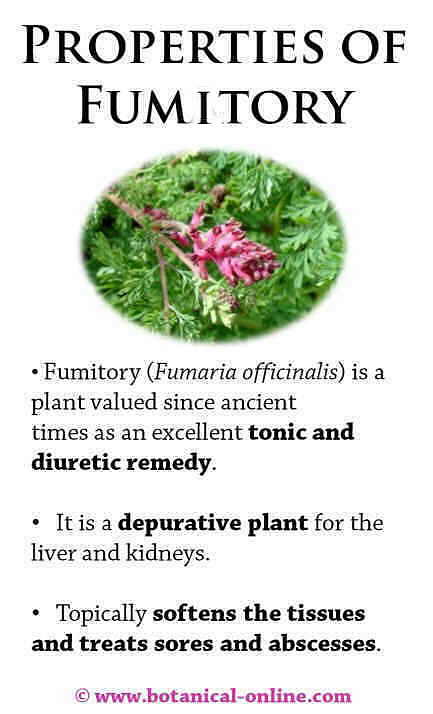
Fumitory has got emollient properties. Whenever we have spots, furuncles, ulcers or any type of injury in the skin, the mucilaginous properties contained in this plant will be used to soften them (Cataplasm of the crushed tender plant on the part of the affected skin)
Traditionally it has been used to fight the diseases of the skin even if they affected the hairy leather, like scabs of the suckling babies, dandruff, to the simple freckles, (An infusion of its leaves can be used to this means). In addition to the mucilages that no doubt take part in this property it must specially contribute the fact that this plant exerts a whole depurative influence in the body, but specially in the liver, kidneys and gallbladder.
Depurative properties of fumitory
 Its depurative power, as we have seen, it is attributed to the property to debug the liver and kidneys, eliminating impurities and fluidify the sanguineous flow. Very suitable for psoriasis, urticaria or jaundice- yellow coloration of the skin.
The influence of the flavonoids in this section is also crucial since they are thought to be hepato-protector and antiviral. (Infusion of half a handful of dry leaves by liter of water, during 15 minutes. Take 3 glasses a day. Do not prolong the treatment more than 10 days)
Its purifying power is very helpful to purify the liver in case of chemical poisoning. (Infusion of half a handful of dried leaves per liter of water for 15 minutes. Take 3 cups a day. Do not extend more than 10 days of treatment.)
*Related information: A plant to clean the liver
Fumitory can increase or decrease body energy
Fumitory can lead to opposite effects according to the treatment duration. It can function as:
- Hypertensive and tonic: The same preparation previously mentioned has a tonic value, when the body is tired, by too much activity or in cases of anemia when increasing the production of red globules.
- Hyposthenic and hypotensive: If we keep on taking the previous preparation for more than 10 days, its properties are reversed, with which, by reducing the red globules, it exerts a slightly hyposthenic function – lost of corporal energy – and hypotensive value – decrease of high blood pressure.
- Cardiotonic: With properties to reinforce heart beat, very useful to treat heart failure and hypotension (Infusion for 15 minutes 4 tablespoons per liter of water. Two cups a day).
Fumaria can help to lose weight
Fumitory is very well-known for its diuretic properties. Its potassium wealth confers it the property to increase the urine production reason why it is very suitable in cases of obesity or water retention (Infusion of 40 gr. of dry flowers by ¾ of liter of water. Drink 2 cups every day during one week.)
Fumitory for Intestinal inflammation:
In case of intestinal inflammation fumaria infusions can help to diminish bloating (Infusion of a handful of dry flowers by half a liter of water during 5 minutes. Drink a glass before going to bed during 5 days)
Main curative properties of fumitory
OTHER PROPERTIES OF COMMON FUMITORY
Cosmetic properties of fumitory
Because of its emollient properties, it is very used in cosmetics. Facial tonics: by means of boiling a handful of dry leaves in a liter of water, we can elaborate a decoction to soak bandages in, that applied on the face constitutes a good facial tonic.
Industrial properties of fumitory
It has been used a a wool dyer.
Picking-up and storing fumitory
Spring is the best season to collect the flowers. Leaves must be gathered when in full bloom. Both of them must be stored in an dry, air-tigh container.
 More information about fumitory.