Contents
Medicinal properties of Rosa gallica L.
PROPERTIES OF ROSA GALLICA
Common noun: Officinal rose, Apothecary rose, Hungarian rose, French rose
Scientific noun: Rosa gallica L.
– Synonyms: Rosa gallica var. gallica L. = Rosa gallica var. officinalis Thory = Rosa austriaca Crantz = Rosa gallica var. versicolor L.
Family. Rose Family – Rosaceae
Habitat: We find it in woods, hedges, by the side of the roads.
Characteristics of Rosa gallica
Perennial shrub shorter than dog rose (Rosa canina L.) up to 1 m. tall. Differently to this one, it’s got straight stems with bigger prickles. Leaflets glandular beneath. Flowers are generally solitary and very big, 7-l 9 cm. wide, pink or purple. Very hairy fruit.
Picking and storing: Roots must be picked at the beginning of Spring. Leaves when in late Spring. Petals before the flower bloom – They must be air dried on a piece of cloth and kept in airtight containers in a dry spot.
MEDICINAL PROPERTIES OF OFFICINAL ROSE
Rosa gallica medicinal properties
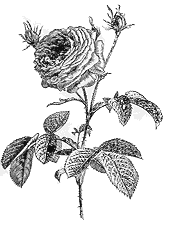
As a whole it has the same properties than the dog rose, so it is not worth mentioning them again. (Do not eat the hips!!!!)
However it must be said that Rosa gallica together with Rosa centifolia, commonly know as Provence rose, and Rosa damascena, known as Alexandria rose, besides Rosa canina are the roses with more medicinal properties.
The three first are mainly used to produce the water of roses.
Water of roses
It is an essence obtained by petals distillation. It is a very strong concentration, unbearable unless dissolved in small quantities with water. Bulgaria is the first producer country in the world.
Properties of water of roses: It is a natural tonic used to clean the skin.
Making water of roses at home: Boil 150 gr. of petals in a litter of water. Cool the infusion during 5 minutes. Filter with a cloth and keep it in a clean airtight container.
*See:
 More information about natural medicine.