Contents
What are spurges?
Characteristics of spurges (Euphorbia spp.)
Scientific and common nouns of the main spurges:
– Euphorbia helioscopia L. (Sun spurge)
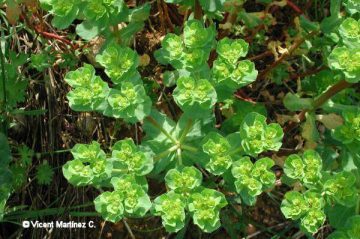
– Euphorbia charachias L. (Mediterranean Spurge, Albanian spurge)
– Euphorbia Lathyris L. (Caper spurge)
– Euphorbia paralias L. (Sea spurge)
– Euphorbia peplus L (Petty spurge)
– Euphorbia pinea L (Pine Spurge)
– Euphorbia hirsuta (Hairy spurge)
– Euphorbia falcata
– Euphorbia pulcherrima L. (Poinsettia)
– Euphorbia milii L. (Crown of thorns)
– Euphorbia dendroides (Tree spurge)
– Etc
Family: Spurge family – Euphorbiaceae
Habitat: In waste lands, sunny fields, country roads, etc.
Active principles of spurges
- Alkaloids: euphorbine,
- Citric and malic acid
- Dihidro-xicoumarin
- Diperten sters
Active parts: The whole plant, specially the latex.
Medicinal uses of Euphorbia
- Herbal remedies with spurges: They have been used in home-made medicine to eliminate the callosities or the warts, applying the latex on the affected area. Later on, this use has been left and substituted by other safer plants and remedies as the one that consists on applying fig sap.
The seeds and the powder of the roots have been used as laxatives or, in higher dose, as purgative to treat constipation.
Given the toxicity of its components, its use is dissuaded in home-made preparations.
 More information on plants

20 August, 2026