Contents
HOW TO GROW OAK TREES
Oak cultivation guide
How is a Quercus robur like?
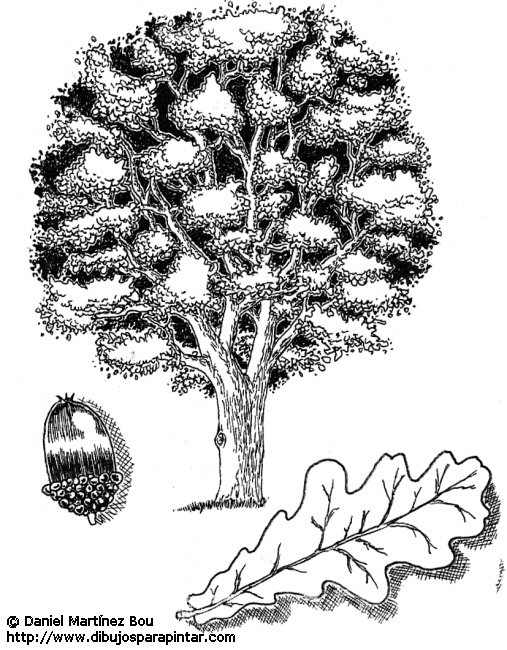
Oak drawing with an acorn and a leaf
Evergreen tree of the Fagaceae family up to 45 m in height.
Erect stems with the bark full of cracks and wrinkles, light gray in youth and darker as the tree gets older.
Leaves alternate, lobed, sessile, with rounded lobes and very short petioles, provided with two auricles at the base larger than the petiole up to about 12 cm.
Flowers in catkins, yellow-green color.
Fruit in nut (acorns), gathered in groups of 1-3 on the same stalk.
 Oak irrigation and moisture
 Oak irrigation and moisture
Quercus robur needs to have adequate soil moisture. It prefers places with a rainfall about 600 and 1000 liters per year. However, it does not support flooded soils.
It does not like too dry summers and low humidity environments, but it resists drought if well adapted.
It prefers wetlands and places where there is moisture in the air, for this reason, it can be found in the slopes of the forest with other trees that can retain soil moisture. It is unusual to see it growing in gullies along the waterways.
Oak: Use, varieties and species
 Oak: Use, varieties and species
Oaks are trees that are mainly used for timber. The English oak wood has a lot of quality and it is fit for carpentry and furniture making. It has also been traditionally used to make tools. Its bark and leaves have medicinal properties.
* For more information on these issues see the listing below, where a detailed study of their use, species of oak and therapeutic uses of this plant is offered.
In gardening, this plant is used as a tree for squares and large gardens. It has a very large size which can reach 40 meters and produces a wide crown so you need space. The set of roots is very long and very powerful and can damage buildings when planted next to them.
Oak: Temperature and exposure
 Oak: Temperature and exposure
Oaks prefer a sunny exposure when developed, although, when they are very young, some shade can be better. They dislike too hot areas in summer because temperatures above 25 ° C are not suitable for them.
It is quite resistant to cold and can withstand up to -15 ° C., although its ideal temperature is between 18 and 20 ° C. It can be planted in locations where high winds occur, although it does not support saline sea winds.
Oaks: Reproduction. Planting and pruning
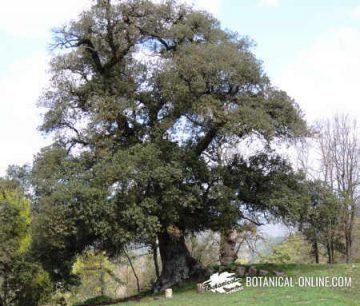
Oaks can be obtained from seed in late winter. Seeds of these trees should not let it dry quickly not to lose their germination power. It is best to plant them fresh directly at the final location.
Although it can be planted in the nursery, its main root is so deep that it prefers to be transplanted quickly. It should not be allowed to grow out of its final location over two years. It is a type of tree that should not be transplanted because it is very difficult not to harm its long roots which determines that, in most cases, it can not be adapted to the new locations.
If you prefer to plant it in a container, it is best to choose deep ones, at least 10 cm deep. The soil should be well loose so that the seed can be inserted a few centimeters, then it should be covered with soil and a little manure.
The plant will be watered well and left in a place where the temperature moves between 12 and 15 ° C. To attain this, the container should have to be placed in the greenhouse or in a box covered with a crystal garden in most cases.
In order that oak seeds seeds can germinate better, they should be scarified. Scarification in this case involves making a small incision with a razor blade or a knife to allow moisture to penetrate into the inside of it and start the germination process.
Oaks should not be pruned more than just enough to remove those branches that are damaged.
Oaks: Types of soil and fertilizers
 Oaks: Types of soil and fertilizers
They prefer deep, moist, well drained soils. They should not be planted in shallow soil.
They also prefers clay soils or calcareous soil and do not like acidic soil rich in peat.
 More information on oak.