Contents
(Euphorbia)
CHARACTERISTICS OF SPURGES
Scientific and common nouns of the main spurges:
– Euphorbia helioscopia L. (Sun spurge)
– Euphorbia charachias L. (Mediterranean Spurge, Albanian spurge)
– Euphorbia Lathyris L. (Caper spurge)
– Euphorbia paralias L. (Sea spurge)
– Euphorbia peplus L (Petty spurge)
– Euphorbia pinea L (Pine Spurge)
– Euphorbia hirsuta (Hairy spurge)
– Euphorbia falcata
– Euphorbia pulcherrima L. (Poinsettia)
– Euphorbia milii L. (Crown of thorns)
– Euphorbia dendroides (Tree spurge)
– Etc
Family: Spurge family – Euphorbiaceae
Habitat: In waste lands, sunny fields, country roads, etc.
Active principles of spurges
– Alkaloids: euphorbine,
– Citric and malic acid
– Dihidro-xicoumarin
– Diperten sters
Active parts: The whole plant, specially the latex.
PROPERTIES OF SPURGES
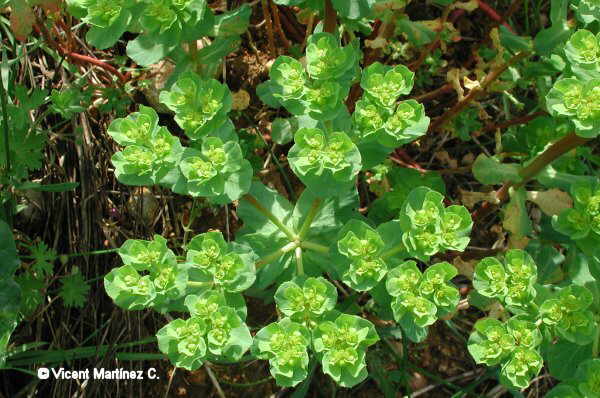
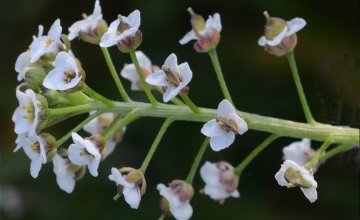
Photo of sun purge (Euphorbia helioscopia)
Medicinal uses of Euphorbia
– Herbal remedies with spurges: They have been used in home-made medicine to eliminate the callosities or the warts, applying the latex on the affected area. Later on, this use has been left and substituted by other safer plants and remedies as the one that consists on applying fig sap.
The seeds and the powder of the roots have been used as laxatives or, in higher dose, as purgative to treat constipation.
Given the toxicity of its components, its use is dissuaded in home-made preparations
Toxicity of spurges
Toxicity of spurges is high. It affects mainly to the digestive apparatus, to the kidneys and the liver, producing considerable irritations in people that ingest the latex, being able to be deadly if the ingested quantity is high.
The contact of the latex with the skin produces a very strong reddening in the skin (rubefacient) with strong appearance of bladders (vesicant), properties that were considered as advantageous to externally treat rheumatic pains of all type.
Side effects of spurges
Poisoning with this plant shows the following symptoms:
– Internal remedies: Internal preparations with spurges leads to digestive disorders, such as stomachache, nausea, vomiting that can go together with blood, diarrhea, breathing difficulty and heart failure.
– External use remedies: The contact of some preparation from spurges with the skin can produce dermatitis as a result of being in contact with the plant or because of prolonged exposure to the sun after having been in contact with the juice, so its latex should be avoided, specially to the eyes to avoid ocular irritations, even blindness.
Medical treatment of spurge poisoning consists on: Emetics, gastric lavage and emollients administration.
Are spurges toxic to animals?
There have been some cases of animals being intoxicated when eating grass that contained dry spurge. Recent investigations suggest that there are possible indications that animals that have been fed with forage containing plants of the gender ” Euphorbia ” can bear a risk of transmitting possible tumors to the humans that feed on them, because of diperten toxicity.
 More information about plants.