Contents
Medicinal properties of Paris quadrifolia
CHARACTERISTICS OF HERB PARIS
Scientific noun: Paris quadrifolia L.
Common noun:: Herb-Paris.
Family: Lily family – Liliaceae
Habitat: Deciduous woods of usually calcareous soil in Europe and Asia.
Description of herb Paris
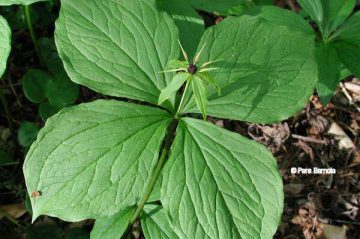
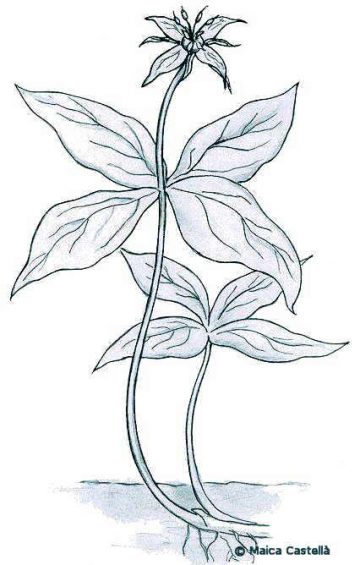
Paris quadrifolia is a perennial herb of the Lily family – Liliaceae– up to 40 cm.
Erect stems, springing from a crawling rhizome.
Every stem has at the top a whorl of usually 4 sessile leaves, till 12 cm.
The flower stands at the end of a long peduncle, having 4 exterior tepals, pale-greenish, and 4 interior ones very narrow and yellowish. 6-10 protruding stamens.
The fruit is a berry, black-bluish.
Active principles of herb Paris
- Saponins: paridin, paristyphnin, pennogenin
- Citric -acid
- Paridol
- Ecdysterone
Active parts: Fruits and rhizomes
PROPERTIES OF HERB PARIS
Medicinal uses of Paris quadrifolia
Herb Paris has been used as a cardiac sedative in cases of palpitations. As external vulnerary it has been applied in the treatment of wounds that wouldn’t usually heal with other medications, specially ulcerous wounds.
I is also used as component in preparations that are used to combat headaches, backache, fever, tremors, vertigo, excessive perspiration, pains in the chest, inflammations of the eyes, etc.
Given the toxicity of its components its use is dissuaded in home-made preparations!!!
- Toxicity of herb Paris
- Toxicity of Paris quadrifolia is high. Especially in the ingestion of its fruits, although, fortunately, in most cases can be detected on time, given the slow absorption of the components.
On the other hand, the fact that they are very unpleasant to taste, makes that, the possible victim usually spits the content of the mouth quickly. It is mortal for the animals that ingest it, either mammals or fish.
Side effects of herb Paris
In minor intoxications, it presents the following symptoms:
- Stomachache
- Nausea
- Vomits
- Diarrhea
- Headache
- In strong intoxications: cardiorespiratory failure and death.
Is herb Paris toxic to animals?
Paris quadrifolia is deadly for animals if they ingest it, no matter if they are mammals or fish.

 More information about plants.