Contents
How to grow raspberries
Raspberry care
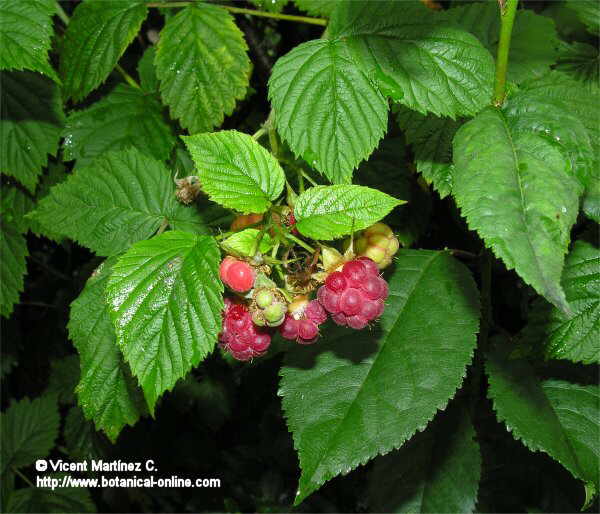
Photo of raspberry
 Characteristics of raspberries
 Characteristics of raspberries
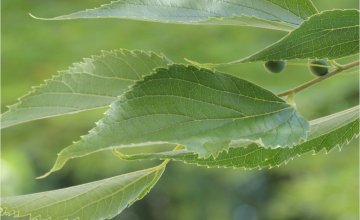
Red raspberries are perennial shrubs that reach 2 to 3 meters and an approximately similar. They have woody, rounded, erect, reddish stems and overhanging branches provided with thin and straight thorns, much less resistant than blackberries. Its leaves are pinnate and have 3 to 7 serrated leaflets, fluffy on the back. Flowers 1 cm in diameter, white and grouped in inflorescences up to 10 flowers each. The fruit is an aggregate of different berries (drupetum), called raspberry, of a non-bright red color and soft texture, that matures in summer or autumn.
They are mainly cultivated for its fruits, berries, and also to form hedges and screens for gardens or patios.
Raspberries. Irrigation and humidity
 Raspberries. Irrigation and humidity
Raspberries need high humidity to be really productive. (Between 800 and 900 liters per year) Hence, during the summers and especially if summers are dry, they should be provided with adequate irrigation. This is necessary in summer because this is the time when new shoots or stems of these plants produce flowers and fruits. Raspberries need a minimum of 350 liters of rainfall during this season.
Although they need much water, they do not like flooding because it can cause rotting of the fruits and the occurrence of many diseases. We must provide them a good drainage. They need enough ventilation to avoid moisture accumulation on the leaves and fruits, which can easily cause mildew.
Raspberries. Temperature and exposure
 Raspberries. Temperature and exposure
Although they can stand some shade, raspberries prefer sunny exposures, protected from wind and frost. They need sheltered places but at the same time, well ventilated to avoid the appearance of numerous fungal diseases.
They do not like hot summers, because hot weather lowers the fruit quality. It prefers cool winters, not too cold, even though they are frost resistant, provided that freezing does not take place too late. Spring frosts under – 0.7 º C damage the fruits and flowers.
How to plant raspberries?
 How to plant raspberries?
There are different techniques to plant raspberries. Among them we will mention:
– By stratified seeds: The stratification consists on keeping the seeds at a temperature between 3 and 6 º C since they are collected in autumn until they are planted in spring. To do this, we will place the seeds within a seedbed with peat and we leave them outdoors when the outdoor temperature does not exceed 6 º C. With higher temperatures, they will be put into a plastic bag in the freezer.
When spring comes, they will be planted in a well protected seedbed in a mixture of peat and garden soil. Allow them to grow for winter and plant them the following winter in its final place. This planting method is very laborious and may not provide adequate production by failing to ensure the genetic wealth of the parents.
– By layering: In this case, from mid to late summer, we will take a tender branch and bury the tip of it about 6 cm into the soil. The new branch will produce roots and a new plant will grow. This can be separated after a year in spring to plant it in its proper place. This method ensures the genetic wealth of the parents.
– By shoots: It is the most common method. In this case, raspberries are planted in early winter. We plant new shoots. (Raspberry shoots are tender stems that are born during the first year). Although the shoots of these plants can get established, we should better buy them in specialized places to ensure that they are completely healthy.
The shoots are planted directly in the ground, taking into account that the roots must be placed in the ground about 5 cm deep at a distance of about 60 cm in the same row. We will leave between 160 and 300 cm from a row and another. Subsequently, we will prune them about 60 cm above the ground or we will lower them until 6 to 10 cm from the roots. In the first case, the plants can produce fruits the first year, but his subsequent productions will be lower, so it is more convenient to cut the shoots shorter even though they do not to produce during the first year.
It is advisable to water them well throughout the summer.
Raspberries. Maintenance and harvesting
Raspberries need support so as not to bend and so they can grow well and resist the force of the winds. At the same time, these allow us to distribute the plants so that harvest can be performed more easily. The method used is that of the fence with stakes. To do this, first, we will plant stakes about 2 meters high on the ground and separated about 3 meters each other. Then. we will place at different heights parallel wires that connect the stakes. The first of these could be placed about 80 cm from the ground level, the second about 120 cm and the third at about 160 cm. Later we will tie the shoots to the wires.
Once planted, and as they get older, we need to perform some maintenance. Firstly, it is important to perform a routine cleaning of the soil, so that the field can be weed free. Plowing must be superficial and not more than a foot deep to avoid damaging the roots.
We will keep the soil always moist but not waterlogged and we will prevent birds to eat the fruits, which usually occurs in summer. To avoid this problem, it is important to place a mesh over the plants, something which is usually not necessary with the summer-autumn raspberries.
The padding or mulching is a technique well suited to conserve soil moisture. This is done by adding straw, wood chips or sawdust on the floor, covering it with a layer about 15 cm in order to diminish water evaporation. This should be done every year to achieve a higher production and a better fruit quality.
Winter pruning is carried out after danger of frost, during the month of February or March. It is important to make a pruning to clean every plant, so as to remove any material that may be in poor condition. The stems should be cut or dug up for planting elsewhere.
We will remove branches that have already yielded some fruit and the stems that are designed for production (between 6 and 12). This has to be done at different heights to produce fruit at different levels, although the minimum height should not be less than 90 or 100 cm to avoid the fruits to be to close to the ground which could them to be spoiled by excessive moisture. Buds should also be pruned if we want the plant to produce less but bigger fruits.
After fruits harvesting, it is important to prune the plants. With varieties of summer this will take place at ground level, while varieties of summer – autumn require less drastic pruning. In this case, we will leave about 20 cm from the ground.
Fruit harvesting is done when the fruits have reached their proper degree of sweetness. They must have a bright color and proper ripening. They can not be too soft.
We will know they are ready, if they do not sink easily when pressing a little on them with the thumb and index finger. At the same time, they should be separated easily from the plant with a little tug. Their consistency will allow them to be transported and sold in appropriate conditions. The fruits which are too soft are not suitable for the market and may only be used for private use, especially for jams. Given that all the fruit ripening does not occur uniformly, harvesting should be done at different days.
Raspberries. Types of soil and fertilizer.
 Raspberries. Types of soil and fertilizer.
Raspberries like a dense soil, rich in organic matter, with the capacity to retain moisture but at the same time, it must not become stagnant. Raspberries prefer soils with a pH between 5 and 6.7. They do not stand very limestone soils although they can live on sandy, granite or slaty ones. The best soil is the sandy loamy one or deep sandy, located on a hillside or slope to achieve the best drainage possible. Clayey soils found in depressions subject to periodic flooding are not suitable.
Raspberries need to have adequate levels of nitrogen, phosphorus and potassium to grow properly and produce abundant fruit. Fertilizing the soil before planting and adding fertilizer in alternate years is a necessary measure to keep the crop in good condition.
Before planting, it is convenient to prepare the soil to a depth of 50 cm. We will add a good amount of manure or compost at a rate of about 20 t / ha which will be mixed with the natural soil. Among the fertilizers that may be suitable, we will include:
- Calcium superphosphate (250-500 kg / ha)
- Potassium sulfate
- Magnesium
- Ammonium sulfate (325 kg / ha in areas with rainfall exceeding 325 mm / year or 650 kg / ha with lower rainfall)
 More information on raspberries.