Contents
PROPERTIES OF SERENOA REPENS
Common name: Saw palmetto, Serenoa
Scientific name: Serenoa repens, Serenoa serrulata Bentham
Family: Arecaceae
Habitat: Native from the southeastern U.S. and Caribbean, in the zone along the coast of the Gulf of Mexico. It forms large masses of vegetation that resist drought very well and provide habitat for many species that seek the shelter of their leaves. It can be found naturalized in California or as a garden plant in Mediterranean climate locations.
Characteristics/description of Serenoa
Perennial shrub of the Arecaceae family up to 3 meters high, but usually it does not exceed 90 cm. Leaves blue-green or silver fan-shaped, formed with about 20 segments. Leaf stems erect, armed with sharp spines on their edges. Creamy white flowers. The fruit is a egg-shaped drupe, blue-black when fully ripe.
SAW PALMETTO (SERENOA REPENS)
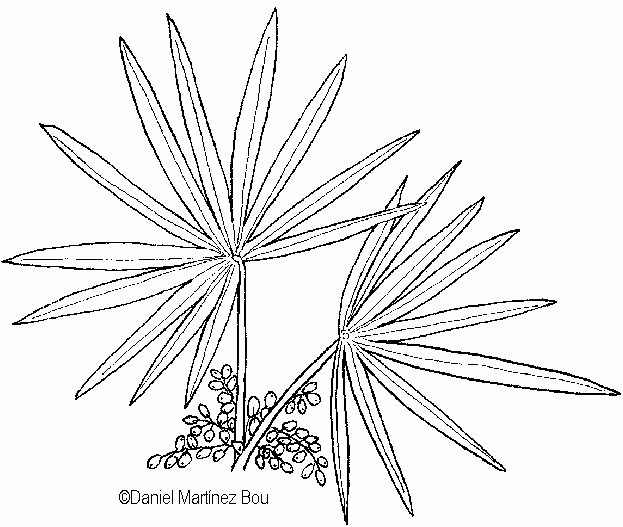 Drawing of saw palmetto (Serenoa repens)
Components of palmetto
Acids: capric, caprylic, ferulic (Fruits) stearic, palmitic, myristic, lauric and oleic (Seeds), vanillic (stems)
– Beta-carotene (Fruit)
– Beta-sitosterol (Fruit)
– Mannitol (Fruits)
– Arabinose (Fruits)
– Lipase (Fruits)
– Tannins (root and stem)
– Fat (Fruits)
– Minerals: magnesium, calcium, potassium (fruits)
Traditional use Serenoa rapens
Saw palmetto has been traditionally used as food by Seminola native tribes that inhabited Florida. This food, because of its high fat content, provides a lot of energy, but at the same time, for its diuretic properties, helps remove body fluids. so urinary tract is kept in good condition, avoiding infections or bladder inflammations.
First settlers were probably those who realized that saw palmetto fruits could be useful in cases of inflammation of the prostate, an anomaly that compels to perform abundant urination, makes a constant urine flow difficult or produces quite a lot of burning while urinating.
MEDICINAL PROPERTIES OF SAW PALMETTO
Internal use
A plant for treating prostate problems
– Prostatitis: Numerous studies have demonstrated the ability of this plant to lower the inflammation of the prostate which can be used in cases of prostatitis. Many of these swellings are caused by bacteria which are eliminated by the components of this plant. The daily intake of 320 mg saw palmetto extract diluted in water and divided into two doses helps fight inflammation of the body and prevent future urinary tract infections.
– Growth of the prostate (benign prostatic hypertrophy or hyperplasia = BPH) Many studies on the properties of this plant have been conducted on the treatment of non-cancerous enlargement of the prostate in the last 50 years. BPH usually occurs in men producing prostate enlargement, which, pressing the urethra, causes problems with urination (in short, we can say that this anomaly prevents complete emptying of the bladder forcing frequent urination, decreased urine stream power and causes discomfort or pain when urinating).
There are numerous medications to treat this disease, but it has been shown that administration of the extract of Serenoa repens is more effective without the side effects normally associated with the administration of other drugs. First, the effects are usually prior to the drug and usually occur within a month and a half or three months in most patients, whereas traditional drugs often act after half or one year. Moreover, saw palmetto extract has practically no side effects, while drugs sometimes produce breast enlargement or impotence problems.
It is assumed that prostate enlargement is rooted in hormonal factors. It appears that the enzyme alpha-reductase-5-testosterone converts testosterone into dihydrotestosterone. It is believed that this transformation is responsible for prostate enlargement. This plant prevents the enzyme from acting, so it does not allow the process to take place.
We must clarify that this plant extract does not reduce prostate size previously enlarged, but prevents further growth and improves its symptoms, making the patient feel better by making urination more abundant, not so frequent and avoiding the feeling of fullness. (The usual dose is 320 mg of extract divided into two daily doses)
– Prostate cancer: There are current studies on the possibility that the extract of Serenoa may be appropriate for the prevention of prostate cancer.
A plant for treating women’s problems
Besides the treatment of the problems of the prostate in the man, the use of this plant is being analyzed for the treatment of anomalies of the female body, especially in regard to problems caused by hormonal imbalances. There are not proven indications that it could be useful in cases such as:
– Excess of hair (hirsutism): The ability of this plant to act on hormones is being used to treat excessive growth of hair on the body.
– Breasts growth: Much less demonstrated than the previous application is the administration of these extracts with the aim of enhancing the breasts in women.
Other applications:
– Stimulant: Read more.
– Baldness: this plant inhibits the enzymes which transform testosterone into dihydrotestosterone responsible for cases of androgenic alopecia.
Contraindications and toxicity
The administration of this plant must be done with a previous consultation with the doctor. In case of symptoms that may induce to think about an enlarged prostate, consult a specialist to rule out the possible prior existence of a prostate cancer that may have the same symptoms.
In case of opting for this treatment, it must be carried out through standardized extracts that are sold in pharmacies and health food stores by means of capsules, tincture, tablets and gelatin capsules. It is not appropriate the administration of fresh or dried herb because it has not proved effective, because it is not possible the administration of the required number of principles by other way than extracts.
Not properly managed, it has virtually no side effects except for some minor problems such as vomiting, dizziness, abdominal pain.
In very rare cases it can cause breast enlargement or allergic reactions. If these reactions occur, ingestion should be quickly stopped.
Consumption should be avoided in the following cases:
– Patients with prostate cancer.
– Pregnant women.
– Women who take birth control pills.
– Women who take estrogens.
– People receiving treatment with testosterone or steroids
– People who are taking any medications.
 More information on medicinal plants.