Contents
- 1 How to grow poinsettia
- 1.1 Characteristics of Euphorbia (Poinsettia) pulcherrima
- 1.2 Poinsettia (Flowers)
- 1.3 Poinsettia (Watering)
- 1.4 Poinsettia (Exposure y and emplacement)
- 1.5 Poinsettia (Propagation and caring tips)
- 1.6 How to make poinsettias bloom again?
- 1.7 Poinsettia (soil, fertilizer and illnesses)
- 1.8 Is poinsettia poisonous?
How to grow poinsettia
Characteristics of Euphorbia (Poinsettia) pulcherrima
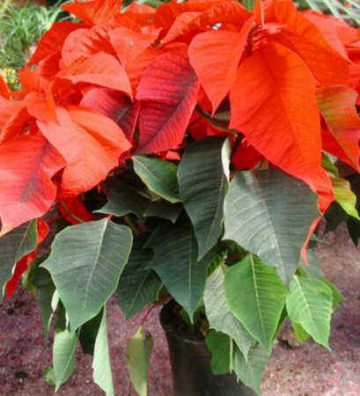
The poinsettia is a deciduous shrub of the spurge family – Euphorbiaceae – up to 3,5 m in its natural habitat. Entire leaves, ovolanceolate, with a couple of lateral tooth and another one at the apex. Its branches end in a cluster of tiny yellow flowers, surrounded by wide red bracts, which provide the complex the resemblance of a unique flower.
Native from Mexico, it was introduced in Europe at the end of XIX century and it is cultivated in all the regions of North hemisphere,where it has become a symbol of Christmas. Many cultivars have been obtained from the native species, showing not only red bracts but pink, yellow or cream, too.
It is normally used as an indoor plant, although it can also be planted outdoors in warm climate. In the first case it generally attains 80 or 90 cm. When planted in the ground, if climate is favorable, it can reach about 3’5 m.
Poinsettia (Flowers)
Although one thinks that the flowers are the red color “leaves”, in fact the real flowers are yellow, very tiny and not very attractive. These are surrounded by some sort of a leaves, usually red that are, in fact, the bracts.
Its flowers appear at the end of November and they prolong their bloom until half April, although they have their maximum bloom in Christmas, reason why the plant is known as Christmas Star or Christmas flower.
Because it flourishes till the end of April, it is also called Easter Flower.
Its scientific name Pulcherrima is due to the fact that it was supposed to be one of the most beautiful plants (Pulcher in Latin means, the tidiest, the most beautiful). It is also known as poinsettia because it was introduced in United States by Joel Robert Poinsett in 1825. It is one of most appreciated plant in United States, so that December 12 is known as the National Day of Poinsettia.
Poinsettia (Watering)
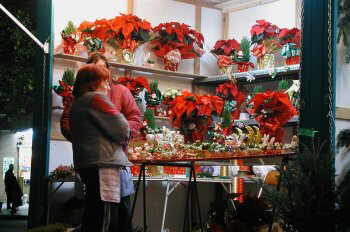
Poinsettias are usually found in many florists during Christmas. See more information about Christmas plants.
To maintain an appropriate watering is the most delicate task in the maintenance of this plant. The dryness of the land, together with the lack of environmental humidity, makes the leaves begin to yellow at the tips and, later, they end up drying off and falling. On the other hand, an excess of humidity makes the plant to rot.
The best thing is to provide it a high environmental humidity, so we will avoid to the maximum the stoves or the heatings. If this is not possible, we will humidify the room with a vaporizer, always avoiding not to humidify the leaves, what would favor the appearance of fungi. A very convenient trick is to place a bowl of water on the stove or near the radiator so that its evaporation increases the environmental humidity.
As for the soil, we will avoid to flood the plant to avoid rotting. The most convenient thing would be to carry out more habitual waterings and in smaller quantity while the sample is in vegetative growth. It is convenient to allow the soil dry between watering and watering.
If we have the plant inside a bowl, we will avoid the water to arrive to the pot. A good solution consists on putting a layer of river stones and place the pot on them. Then, we will pour some water without surpassing the stones. By doing this, the plant will absorb humidity without the roots becoming ruined.
A wrong watering is the main cause of the death of most of the samples. If we see that the leaves present a blackish aspect with rottenness signs, we will abandon watering, we will prune it very well and we will leave it in a somber place, hoping the next season sprouts again.
Poinsettia (Exposure y and emplacement)
It is a plant that prefers a luminous and warm location. Since it comes from the Mexican warm climate, it prefers a non-cool atmosphere. The ideal temperature would be located around the 18 ºC while it is in bloom. When the leaves have fallen, if we want to maintain it so that the next season flourishes, we will keep it in a fresher place that, in any event, should not come down under 15 ºC.
It doesn’t support direct sun, except in winter. While it is growing, it is important to take it away from the direct rays of the sun that will burn its leaves. A location with a lot of light, although not a direct one, would be at this time the most convenient thing.
If we place it in a dark place, the lack of light makes the leaves to lose color and the plant looks like “washed out”. Neither he likes the air currents and the abrupt change of temperatures as well as the location changes that usually end up with the plant dropping the leaves.
If we have a sample in growing period, a good trick to force the bloom is to limit the quantity of light it receives. So, in autumn it should not receive more than 10 daily hours of light. We can perform it if we cover the plant with some paper bag – not a plastic one because it would not breathe well.
Poinsettia (Propagation and caring tips)
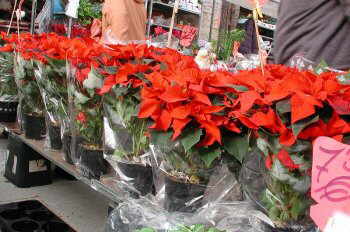
It is very wise, when buying poinsettias, to look for for plants with bright vivid bracts. Also we must chose those whose real, tiny, yellow flowers are half -opened.
New samples can be obtained from cuttings, although this method is usually not very successful, so the best thing to do is to buy samples produced in greenhouses
Although in many cases we usually discard them after they have lost their bracts, we can make these plants to grow again and to flourish at the next season.
How to make poinsettias bloom again?
To achieve it, the first thing to do, after they drop their first bracts, we will prune them completely, leaving the stems about 10 cm long. Then, we will place them in a fresher, luminous place, and we will water it very little.
Past the winter, with the arrival of the spring, we will transplant them to bigger pots and we will water them well so that they can produce new buds.
Every 15 days we will add some liquid fertilizer, and, when the new stems have reached about 9 cm, we will cut the old ones.
In autumn, we can apply the general cares, besides forcing the growth with the control of the light, just as it has been explained previously. We will hope that, by doing this, they will flourish again.
Poinsettia (soil, fertilizer and illnesses)
It prefers a rich humus soil with a pH around the 5,5. A garden soil with some peat could be a good one. The fertilizer will be limited to the growing period, in we want to maintain a plant for the next season. If so, we will add every 15 days a small quantity of liquid fertilizer in the waterings from mid spring to the end of summer. If we don’t want to maintain it won’t be necessary to add fertilizer at all.
It is a very resistant plant to the illnesses. The main danger are the fungi that develope when the watering conditions are not the appropriate ones.
Is poinsettia poisonous?
The possible toxicity of poinsettia has been very discussed a lot. It was thought to be a very poisonous plant, whose juice was very poisonous in contact with the human skin. This negative legend has been lately debunked and its toxicity is lower that it was supposed (Toxicity of poinsettia)
 More information on plant cultivation.