Garlic benefits
(Internal use preparations with garlic)
Garlic is one of the best remedies for blood circulation
The presence of sulphurous components, together with alliin and ajoene, make it very important by giving it anti-thrombotic properties (No formation of blood clots) being very interesting to make blood more fluid and help to fight against circulatory diseases: heart attack, arteriosclerosis, cholesterol, hypertension, angina pectoris and some other ones related with bad circulation, such as hemorrhoids, chilblains or hearing loss
(Half a gram of tincture everyday.) (Eat garlic raw in salads) (Maceration of 100 gr. of garlic with with 400 ml of wine alcohol. Take half a teaspoon before going to bed)
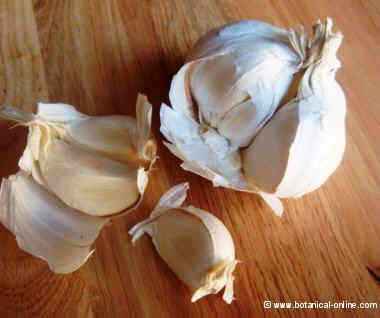
Photo of garlic
Garlic favors body liquids diuresis
Allium is a good diuretic, that’s to say, it helps to get rid of body liquids, a very useful resource in case of rheumatism, gout, arthritis, hydropsy, edemas… (Decoction 4 cloves of garlic in a liter of water. Take 2 glasses per day) (6 drops a day of liquid extract)
Natural antibiotic: Garlic is a good remedy to fight bacteria
Garlic is considered a very good natural antibiotic: Having such a richness in Sulphur-containing components, this plant, together with onion, becomes of the best natural remedies to cure infectious processes of respiratory tract.(Influenza, swine flu, bronchitis, pharyngitis, sinusitis, cough, earache, otitis, wheezing, etc..) digestive tract diseases (intestine putrefactions and diarrhea) (Raw in salads) (7 drops of essential oil a day)
It is very famous the story of the “Four thieves vinegar” telling us that in 1721 four men who were sentenced to death were give the opportunity to become free on condition that they buried people dead by pest in Marseilles. It seems that they never got infected because they drank wine, with garlic macerated in it.
Garlic is the food with the highest content of vitamin B6 or pyridoxine, a vitamin that improves immune function.
Being one of best natural antibiotics, the habitual ingestion of garlic can prevent the bacterial infections or many inflammations of the urinary system (cystitis, nephritis, etc.). It can be useful in the treatment of gonorrhea.
In the same way, the antibacterial properties of garlic can be used to combat or prevent food poisoning. Eating garlic in foods protect us against possible poisoning. For people who can not tolerate or do not support the garlic smell, there are garlic capsules in pharmacies and herbalists
Garlic eases digestion
Garlic is considered a good digestive: It eases digestion by stimulating the liver, the gall bladder and the pancreas although its use should be avoided when existing hyperchlorhydria (stomach acidity) and also when having frail stomachs (Eat it raw or crushed and mixed with butter.)
- Intestinal worms: Sulfurous components of garlic may be useful to eliminate tapeworms (Make an enema with liquid from the decoction for 15 minutes of 3 g of garlic cloves per liter of water.)
- Altitude sickness: Garlic is one of the best antiplatelet plants. Maintaining a diet rich in garlic helps to improve the symptoms of altitude sickness or prevent its onset.
Last trends: Garlic protects us against cancer
Garlic is an anticancerous remedy. More recent studies seem to relate the consumption of garlic with cancer inhibition. Sulphurous components are believed to be responsible to avoid the developing of cancerous cells in stomach, liver, etc.. Flavonoid quercetin, being a good antioxidant, is also believed to play the same role.
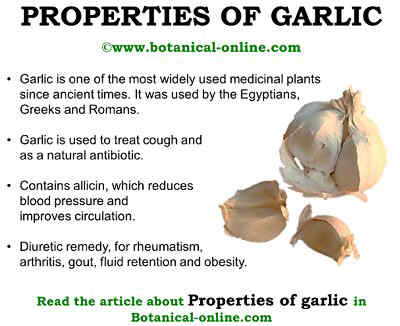
Main curative properties of garlic
External use preparations with garlic:
Garlic is a good skin disinfectant
- Insect bites, fungi or skin diseases: Its bactericide properties make it a good disinfectant against animal bites or stings especially from insects. Also very useful for skin diseases, mainly infectious ones, such as fungi, ulcers, cuts, wounds, blisters..( Moisten the affected zone with a compress, soaked in garlic tincture or simply rub with the juice of a tender clove of garlic.
It can also be use to fight scabies (Rub the affected zone with an smashed onion in olive oil. Do not apply on the rest of the skin, since it can produce a sore on the skin)
- Warts or corns (Cataplasm of a clove of garlic mixed with parsley only on the corn, not on the surrounding skin) (In external use, garlic can produce dermatitis to some people) The bactericide properties of garlic were conclusively proved in the last Second World Wars, when the juice of this plant was used to disinfect the soldiers’ wounds.
| Important note: Warts or cons treatment with garlic is a very aggressive treatment because the abrasive nature of garlic. So, it is important to apply only to the affected part of the skin, protecting the rest of the same product scope.Once the treatment applied, you should cover the affected area with a gauze and tape, preventing the contents reach the healthy parts surrounding the affected area. These treatments should not be used with children or people sensitive to those who may cause ulcerations. |
- Nail fungus: An effective and very simple remedy is to rub a clove of garlic on your nails. Garlic is one of the best bactericidal.
- Tinnitus, otitis or Meniere’s disease: Because of its bactericidal properties, it is particularly appropriate for otitis and ringing in the ear, especially when tinnitus responds to an infection in the middle ear. (Carefully provide a couple of drops of diluted oil of these plants inside the ear with a piece of cotton)
- Vaginal infections: Garlic is one of the best antibiotics. It has bactericidal and fungicidal properties, able to kill or inhibit the growth of microorganisms that could be responsible for infections that cause vaginal irritation, vaginitis or vaginal flow. (Make a suppository placing a garlic in a gauze and insert it into the vagina) (Eat plenty of garlic)
Edible properties of garlic
– Garlic is a food that should never be absent from meals. It should be eaten raw, because cooking destroys its essential components. It is advised to eat it raw in salads (*See: garlic recipes, black garlic)
Is garlic a safe remedy?
Considering the blood fluidification power of garlic, some precautions should be considered:
- Disorder of blood bleeding of blood clotting.
- Diabetes
- Pregnancy
- Medicine intake, specially those used to control sugar contents in blood and some anti-inflammatories.
- Garlic, in external use, can produce dermatitis. It must be used cautiously. It is never recommended for the skin of young children.
In any case it is convenient to consult the doctor, chemist or dietician to avoid possible contraindications. By no means, one should take different preparations of the same product (capsules, tinctures, extracts… etc.)
In order to attain a safer use it is better to take this product as a food, without any further preparation.
VIDEO ABOUT GARLIC PROPERTIES
Nutritional composition of garlic
| Composition of raw garlic per 100 g | |
| Water (g) | 59 |
| Calories (kcal) | 149 |
| Lipids (g) | 0,5 |
| Carbohydrates (g) | 33,07 |
| Fiber (g) | 2,1 |
| Manganese (mg) | 1672 |
| Potassium (mg) | 401 |
| Sulphur (mg) | 70 |
| Calcium (mg) | 181 |
| Phosphorus (mg) | 153 |
| Magnesium (mg) | 25 |
| Sodium (mg) | 17 |
| Vitamin B6 (mg) | 1235 |
| Vitamin C (mg) | 31 |
| Glutamic acid (g) | 0. 805 |
| Arginine (g) | 0, 634 |
| Aspartic acid (g) | 0, 489 |
| Leucine (g) | 0, 308 |
| Lysine (g) | 0, 273 |
= High content
 More information about garlic.