The information given is informative. In case of doubt, consult the doctor. "Botanical" is not responsible for damages caused by self-medication


PASSIFLORA CAEURULEA

PASSION FLOWER
Ver foto y ficha botánica

A  detail o the flower in close-up

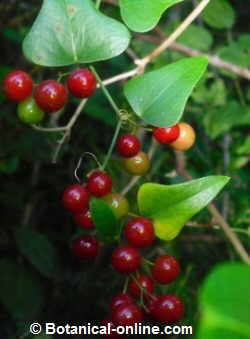
Detail of the leaves, flower and fruit.


BACK TO MEDICINAL PLANTS

 Common noun :Passion flower, Maypop 
Scientific noun: Passiflora caeurulea
 
Family . Passifloraceae 
Habitat:Native from Central America, it can be found in many gardens as a cultivated plant. 

Characteristics: Perennial plant of the Passifloraceae family up to 9 m. Climbing stems with tendrils, ligneous. Alternate leaves, trilobed, dark green; new buds reddish. Creamy flowers with pink shades. Edible fruits, egg-shaped.


Components:

Alkaloids : harmalol, harmine, harmol

Essential oil

Flavonoids: quercetol, apigenol, luteolol

- saponarol, isovitexol, vitexol, isoorientin

Passiflorine

Gynocardin


Internal use

Passionflower constitutes one of the best remedies against all type of nervous manifestations. Contrary to other treatments, this plant doesn't present contraindications. Most of the tranquilizers, especially those of chemical nature, have an immediate effect but they produce non desirable effects as the habituation, what requires every time bigger doses, or the drowsiness, so that they should be used with wisdom in activities in which we should be very wakeful as driving vehicles or working with dangerous machines. This plant, because of the action of the flavonoids, exercises a sedative effect on the nervous system without creating depressive effects in it. Among the main properties, all them related with the nervous system, we can mention the following ones:


Sedative: It calms the nerves and it relaxes the organism. It is very appropriate in those stressing situations when we are very nervous and excited, because of personal or work problems. Specially interesting when the situation of anxiety doesn't allow us to sleep well and we suffer of insomnia. You can also use with the children or with the grown-ups, even with prolonged treatments, which will allow them to rest better at night. Very profitable to help those people that are following a treatment against the depression or those who have tendency to be sad or depressed, in situations like unemployment, the death of some relative, the nervous problems related with the menopause. Also very useful to calm the nerves in those stressing situations such as an exposition in front of an audience , exams, etc.

(Infusion of a couple of spoonfuls of the dry plant in half a liter of water. Drink a couple of small cups a day) (Macerate the dry plant with the same quantity of alcohol during one week. Filter it and take about 25 drops a day)

Painkiller: It calms the pain, especially when it is related with problems of the nervous system, and it favours the disappearance of a series of physical symptoms that have their origin in emotional problems. It will be very appropriate to take some of the previous treatments in those situations when frequent headaches are presented (migraines), once the doctor has discarded that their origins don't come from other more serious organic causes. When another series of physical manifestations arising from tested nervous origin exist (the need of urinating very frequently at night , what is known as night enuresis, palpitations and heart arrhythmias, problems in the speech that impede a fluent speech - stammering problems -) nauseas, breathing problems of nervous character, well-known as nervous dyspnoea -) etc.

Spasmolytic: The infusions or pasiflora dyes are appropriate to avoid the involuntary spasms taken place by a nervous system subjected to stress. We should use these remedies in intestinal spasms (" stomach cramps " ) when we know that they have a nervous character. Very useful to combat the pains of the menstruation or the muscular spasms.


Circulatory system : The use of this plant diminishes the arterial pressure so it is recommended use it in cases of arterial hypertension. (Take some of the preparations previously seen during 15 days. In this case it is recommended not to overcome the established quantities to avoid it to be toxic)


Other uses:

Edible properties: Passionflowers, also called granadillas because the fruits look similar to those of pomegranate - " granada " in Spanish - produce eatable fruits, provided that they should be eaten raw to avoid being toxic ( see toxicity below ). All they have some similar medicinal properties to the one studied above. Coming from South America they have been exported to the tropical regions of Africa and Asia. There are about 500 species of this gender in their origin place. All they are eatable, although there are some that are more appropriate as food than others.

- Passiflora incarnata, it produces a fruit that sometimes reaches the size of a melon . It is generally consumed in marmalades in some southern states of USA It was already used by the old Aztecs to treat the bites of the snakes, reason why is was known as " Tongue of snake" and the first Indian natives used it like a food and as disinfectant. ( Image and information about this species)

- Passionaria vitifolia: Native of central America and South America. It presents very big flowers that can reach 10 cm. Its eatable fruits taste to strawberry.

- From the Passiflora Edulis, coming from Brazil, we have two variants: The Passiflora edulis edulis, called purple passion , with very aromatic meat which remembers to the apricot. It combines very well with salads, yoghourts, and other fruits . Its fruit is called maracuya, although the real maracuya is obtained from the yellow passion flower ( Passionaria edulis flavicarpa ) The cultivation of this last species is more extended that that of the purple species, since it can be in most of South American countries where it is much more appreciated that the first one. Both are very exported to Europe where it is considered an exotic fruit. In both cases, the juice is obtained smashing the pulp and filtering the liquid to separate it from the seeds. The maracuya, besides being eaten raw, can be drunk as a juice, being a very sweet and refreshing drink, quite rich in minerals, as the calcium, the iron and the phosphorous. It fundamentally contains vitamins of the type A , B and C and a great amount of niacin that is very appropriate for the treatment of the cholesterol and the perfect state of the nerves. Its low fatty contents makes it very appropriate for weigh loss diets. As the rest of the parts of the plant, it presents sedative and detoxicant properties , not only because of its content in vitamin C and niacin, but also as result of its high contents in riboflavin and the vitamin A which is transformed into beta carotene . All these elements seem to grant it anticancerous properties .

- Passiflora quadrangularis: With an oblong very flavourful fruit, having medicinal properties for the treatment of the cholesterol. The root is poisonous and it is used to eliminate the intestinal worms. In its composition serotonin has been discovered , a potent neurotransmitter, necessary for the good state of the nervous system and whose deficiencies are responsible for pathologies like the depression, certain types of obesity, obsessive behaviors, insomnia, migraines, etc. It is the plant that contains the highest quantity in niacina.

- Passiflora antioquiensis: Native from Colombia with elliptic yellow fruits and leaves till 15 cm long

- Passionaria mollissima: It produces very early and copious fruits. Its content in sugar is lower than in the rest of the passionflowers

- Passiflora laurifolia: Native from Colombia and Peru, with yellow fruit till 8 cm long and flowers with reddish petals on one side and greenish in the other one. As in Passiflora quadrangularis, are roots are good to carry out decoctions to eliminate intestinal worms.


The fruit of the flower of the blue passionflower (Passiflora caeurulea) are not so exploited commercially as those previously seen, but it is also eatable and it presents the same medicinal properties of the other ones.


Toxicity

The presence of uterotoxic alkaloids doesn't make it appropriate to use it during the pregnancy or the nursing. It doesn't be administered to children under 3 years and the quantity given to those until 12 years old should be proportional to their weight. Equally, with youths and adults , the doses should not be superior to the recommended ones. The reason is that passionflowers possess passiflorine and gynocardin, that are two cyanogenetic components , that is to say able to produce cyanide in combination with the corporal enzymes. The intoxications are fundamentally manifested in form of adverse stomach reactions. Other reactions with higher doses are the narcosis, or feeling of unconsciousness or drowsiness and the hallucinations taken place by their alkaloids that can be considered psychotropic and hallucinogen.


Curiosities: The name of Passionflower was granted by the likeness of the interior drawing of the corolla with the crown of thorns of Jesus Christ. The quantity of stamens also remembers the 5 wounds in his body, the three styles, to the three nails with he was nailed the the cross and the petals represent the apostles.


Cultivation tips: Cultivo


Copyright ©1999-2008 Botanical-online SL. All rights reserved.