Characteristics of mastic tree or lentisc (Pistacia lentiscus L.)
What is a lentisc plant?
Common noun: Lentisc, Mastic tree, Pistachier Lentisque
Scientific noun: Pistacia lentiscus L.
Family: Cashew family -Anacardiaceae
Habitat: Where does mastic tree grow?
In woods by the side of the holm oak inland or with the carob tree and palmetto at the seaside. It doesn’t like cold places.
A typical Mediterranean forest plant, widely distributed throughout the Iberian Peninsula. It grows from the coast up to altitudes of 1,200 meters. It is found all along the coast: the Balearic Islands, Catalonia, the Valencian Community, Murcia, and Andalusia, above all. It is less common in northern Spain and in inland areas, where temperatures are very cold in winter.
Description of mastic tree
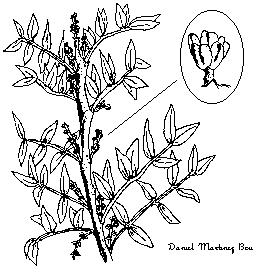
Perennial bush of the till 2 meters tall (It is not generally found so many big samples because of the fires or some other human aggressions)
Leaves are formed with 3 to 6 pairs of elliptical coriaceous leaflets.
Male flowers without petals, female ones darker.
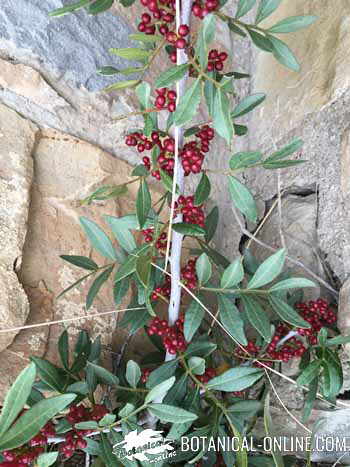
The fruit is a drupe of about 8 mm, which being green at the beginning, changes to red and becomes black in ripening fruits.
Picking and storing of the mastic tree
It is better to pick the tender stems and the leaves in Spring, but since we are talking about a perennial plant, one can collect its parts when necessary.
We can easily spot the mastic tree in summer, because it’s one of the shrubs that stays green and very fragrant, while other herbs have already dried out. Its resinous and fresh scent makes it very characteristic.
Parts of the plant that are used
Obtaining the mastic resin
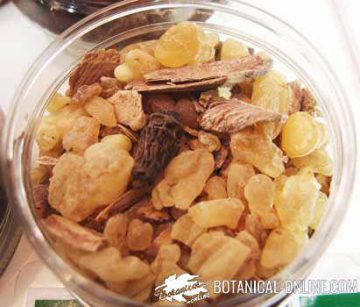
The resin of the lentisc or mastic resin is obtained by making small incisions in the trunk and branches of arboreal mastic trees.
Components of mastic gum
Mastic gum is a inherit; translucent, yellowish, and slightly aromatic resin. It contains a high proportion of hydrocarbons and a small proportion of keto acids. It is the most flexible of resins and is soluble in aromatic hydrocarbons, turpentine, petroleum spirits, and alcohol.
Uses of mastic tree
A mastic tree is a wild plant that is also used as:
- Ornamental plant: It is planted in some parks or gardens in Mediterranean areas.
- For its non-edible fruits: They are used for the production of a non-edible oil, formerly used for lighting.
- For its resin: Large specimens produce an aromatic resin with industrial, aromatic, culinary, and medicinal properties. This resin is used, for example, to make varnishes or to flavor liqueurs. It is also used in the production of chewing gum.
- For their leaves: They have been traditionally used to tan hides.
- As a medicinal plant
 More information on medicinal plants