Contents
What is castor oil?
Characteristics of the castor oil plant (Ricinus communis)
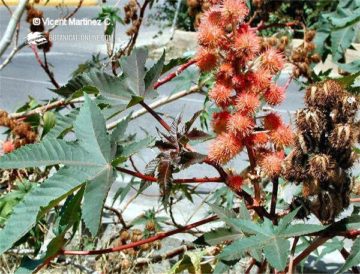
Photo of castor oil plant
Common English name: Castor oil plant, castor bean
Scientific name: Ricinus communis L.
Family: Euphorbiaceae
Habitat: Native to central Africa, it appears as an ornamental plant in all regions of the tropical or subtropical zone.
Also cultivated for the production of industrial oils in several countries around the world, including Europe, Asia and Africa, especially in Brazil and India.
It was used as a medicinal plant for quite some time.
 Description of the castor bean plant

A perennial or annual tree or shrub of the Euphorbiaceae family that can reach 12 m in height in tropical or subtropical climates, but normally remains a simple shrub or annual herb of about 2.5 to 3 m when found in temperate climates.
Very showy leaves of large size, up to 80 cm, petiolate, reddish and palmate.
Flowers grouped in panicles, the upper ones, female, with reddish stigmas and the lower ones, male, with greenish-yellow stigmas.
The fruit is a capsule with or without spines. Native to central Africa, it is cultivated in many warm climates and is also naturalized or used as a garden plant.
It blooms in the middle of summer.
Poisonous components of castor oil
The main toxic component is ricin (a protein).
Which parts of the castor bean are toxic?
The whole plant, especially the seeds.
Uses of castor beans
- As fuel: To light oil lamps
- As a medicinal plant
 More information on castor oil