Contents
- 1 How to grow bougainvilleas
- 1.1 Bougainvillea cultivation guide
- 1.2 Characteristics of bougainvilleas
- 1.3 Bougainvilleas origin
- 1.4 Species and varieties of bougainvilleas
- 1.5 Uses of bougainvilleas
- 1.6 Bougainvillea flowers
- 1.7 How to water bougainvilleas
- 1.8 Where to place bougainvilleas
- 1.9 Bougainvillea (Propagation and care)
- 1.10 How to prune bougainvilleas
- 1.11 When and how to prune bougainvilleas?
- 1.12 Soil and fertilizers for bougainvilleas
- 1.13 Pests and diseases of bougainvilleas
- 1.14 Other problems of bougainvilleas
How to grow bougainvilleas
Bougainvillea cultivation guide
Characteristics of bougainvilleas
Bougainvilleas (Bougainvillea Sp) are climbing shrubs of Nyctaginaceae family up to 15 m (normally when grown outside their place of origin they usually reach 4 meters, with a possible annual growth of half a meter). Woody branches provided with spines.
Leaves bright green, heart-shaped, glabrous.
Small yellow flowers surrounded by showy bracts wide variety of colors ranging from red to purple, white, fuchsia, etc.
Bougainvilleas origin
Native to tropical or subtropical America, they were discovered by the French navigator Louis de Bouganinville, hence its name.
In humid tropical climates, they are evergreen, but, when grown in other non so warm or so wet areas, they become deciduous plants because cooling or excessive heat causes their leaves to fall.
Similarly, in their place of origin, they tend to flourish in the driest periods. In other temperate areas, they usually have their peak flowering in summer and autumn.
They are climbing plants that produce long stems bearing thorns with which they help themselves to cling to a climbing surface.
Species and varieties of bougainvilleas
There are approximately 14 species of bougainvillea. Of these the 4 most commonly used in landscaping are:
- Bougainvillea glabra: It is the most commonly used in gardening. It comes from Brazil. It grows to 9 feet. Its stems are thin, with recurved prickles and leaves covered with small hairs. It produces abundant flowers with white and purple bracts. There are many varieties with different colors: red, orange, yellow, violet, etc.
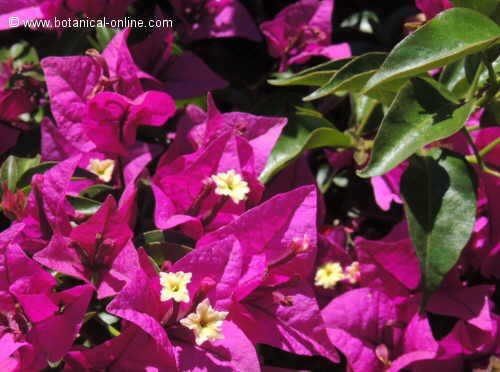
- Bougainvillea peruviana: Coming from Peru, Ecuador and Colombia, it is characterized as having less vigorous and less green woody stems. Its leaves are glabrousa and its bracts are smaller and purplish pink.
- Bougainvillea x buttiana: A cross between Bougainvillea glabra and Bougainvillea peruviana. It possess extremely vigorous, dark green leaves. Among the many varieties we have, “Orange Queen” (= Louis Wathen) with orange bracts that turn pink or “Hawaiian Gold” with golden orange bracts that become more pink over time.
- Bougainvillea spectabilis: It is another widely used species from Brazil. It grows to 6 feet. Its leaves are darker than the rest of bougainvilleas, with hairy leaves, covered with very prominent hairs on the underside. It flowers during summer and its bracts are bright red or purple.
Other hybrid varieties are: Red San Diego or Helen Johnson.
Uses of bougainvilleas
Bougainvilleas are climbing plants that can be used to decorate walls, fences, gates, hedges, etc. Although they are equipped with prickles that help them to grasp on surfaces, as they grow and gain weight and size, they require to be fixed properly so they can climb. Otherwise, the branches tend to bend and hang to the floor.
Besides covering vertical surfaces, bougainvillea can grow horizontally when they do not find the vertical surface to grip. This makes them very useful for covering more or less horizontal or steep surfaces, especially for slopes.
Bougainvilleas can take on the appearance of trees if given some kind of support and proper pruning. Generally for this use small specimens in pots are often used. A similar use to this one, though much more controlled, is attained when they are used as bonsai.

Bougainvillea flowers
Bougainvilleas bloom mainly in spring, but they can flourish throughout the year if conditions are favorable. With more or less profusion, you can see flowers on this shrub at any time of year, although blooming reaches its peak in spring.
Usually, blooming begins with warm temperatures during the month of May, is at its best during June and lasts until late September.
In fact, the “real” flowers are very small and yellow. Since they are very little showy, the plant has developed some special leaves (bracts) surrounding the flowers. Bracts are what really attract insects because they look like petals in flowers.
The bracts of bougainvillea can have very different colors (red, pink, fuchsia, orange, etc).
How to water bougainvilleas
Bougainvilleas should be watered regularly. Watering should be very abundant during the growing season. (About 3 times a week). When temperatures begin to cool, you should diminish watering. They should not be watered in winter. The best thing to do is to apply a little watering from the month of November, if it starts to get cold. Stop watering when leaves begin to fall.
It is very convenient to spray bougainvilleas in spring and summer, but we must take into account not to wet the flowers to avoid these to rot and fall.
Potted specimens can be placed in a garden bowl provided with some stones at the bottom so that water does not touch the plants.
Excessive irrigation or lack of proper drainage makes bougainvillea leaves turn yellow.

Where to place bougainvilleas
Bougainvilleas should be planted in the sun on a warm place, with maximum temperatures of about 22 º C. They need to be planted in a warm climate where there is no frost, and they should be placed in full sun (The best place will be against a wall in the sun, where they can climb)
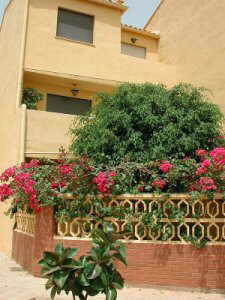
Bougainvilleas should be protected in winter in cold places. In these cases it is best to be planted in a container that can be taken indoors. They can withstand up to 5 º C in winter if this temperature is not prolonged for many days and that the earth is dry.
If planted in shady places, leaves fall and they do not produce any flowers, these are very small or fail to open completely.
If grown indoors, they should be placed in a lighted and well- ventilated area. The lack of these two conditions produces yellow leaves. Specimens grown in pots indoors should be carried out when summer comes and placed in a warm sheltered site in the sun or in bright position. When it starts to get cold (in the late summer or early fall), they should be taken back because it’s best to keep them indoors.
Very high temperatures, dry spots and lack of ventilation causes the leaves to dry, flowers to fall, leaving only the bracts on the plants. To solve this problem we must put the specimen in a cooler, better ventilated place. At the same time, we will apply it a spray to add moisture.

Bougainvillea (Propagation and care)
They can be reproduced by means of layering, which involves inserting a branch into the ground and hold it until it produces roots. Once rooted, the new branch is separated from the mother plant and planted in its final location.
It can also be obtained by means of cuttings, a reproductive technique which consists on planting a piece of branch on the soil. Whether you use one way or another, the reproduction must take place in spring.
How to prune bougainvilleas
These plants grow very quickly so their growth must be controlled by means of pruning. Pruning has to be carried out between February and March. For plants cultivated in pots, pruning has to be very severe.
Planted in the ground, bougainvilleas can grow several meters (up to 50). So, it is desirable to prune the young shoots during the first two or three years so as the plant can branch properly. Pruning is also aimed to avoid this shrubs to grow too large, something that will be responsible of producing few flowers.
Pruning also renews the vitality of the plant, produces samples with a more compact form and increases the quantity and quality of flowers. Therefore, in the case of bougainvilleas, it is absolutely necessary if we want a clean plant, strong and with a lot of flowers.
Pruning is more necessary for potted specimens. If these are not pruned, we will soon have a weak potted plant consisting of a few spindly branches, and with no flowers.
When and how to prune bougainvilleas?
Bougainvilleas should be pruned from late January until late March or early April. We must remember to use disinfected sharp tools to cause clear cuts and prevent damage and infection.
Pruning must be performed on branches that are too long or those that are in poor condition, trying to give the whole plant a more compact and uniform aspect. Ideally, cut above a bud or leaf, leaving only about four fingers of each young shoot born from each main branch.
In addition to proper cutting, I you want a bougainvillea to grow vigorously, you must provide it some adequate support, especially when grown in a container.

Soil and fertilizers for bougainvilleas
Bougainvilleas need a rich soil. A mixture of humus and peat with a good drainage and loose texture would be desirable . Stagnant soils or too compact ones will produce stunted or ungainly samples.
Bougainvilleas should be fertilized very frequently. During the growing season you will apply every 8 or 10 day a fertilizer rich in potassium, phosphorus and nitrogen. Poor soils are responsible for bougainvilleas with small leaves.

Pests and diseases of bougainvilleas
Among the most common pests and diseases we can consider:
- Cochineal insects : They produce sticky leaves, as a result of the secretions excreted by wart-shaped insects that stick to the leaves. With their long beaks, they suck sap from infected plants. In addition to slow the plant growth, they make the leaves fall.
The main causes that promote the development of these insects are the heat and the lack of moisture, so a frequent watering with a spray from time to time will be the best way to prevent its occurrence.
However, once the plant is infected, insects must be removed with a cloth dipped in alcohol. A fairly effective solution is to attack them in their larval stage, applying a specific insecticide.
- Red mites: They make yellow spots appear on leaves, causing them to fall. This disease is brought about by a greenish-yellow spider – red orange in summer – belonging to different species, although the more usual one is the Tetranychus urticae, which attacks the plants inside and outside the home during summer.
These insects attain less than 1 mm, they have 8 legs and are visible to the naked eye. Red mites develop during the summer in very dry environments
The solution is to spray the leaves on the underside and, if possible, to use humidifiers to provide moisture to avoid these insects to appear. You have to clean the garden to prevent their rapid reproduction and apply a specific miticide, trying to wet the underside of leaves. A natural method is to clean the leaves with liquid from the infusion of dried nettle or horsetail.
- Blight: A disease caused by a fungus, which penetrates the tissues causing white spots, soft to the touch. This can special occur during humid days, so it is desirable to place these plants in a well-ventilated spot.
The solution consists on cutting the affected parts and treating them with fungicide. The infected debris must be completely removed by burning it and the tools used must be disinfected, in order to prevent further infections. A wise move is to perform a preventive spraying in spring and another one in summer to avoid infection.
Other problems of bougainvilleas
- Bougainvillea with dry leaves: If the leaves of our bougainvillea dry out and fall, this can be a problem originated by too much heat and low humidity. Place the plant in a ventilated place and water it.
- Bougainvillea leaves fall: Some specimens of bougainvilleas are deciduous, so they lose their leaves in the fall. In evergreen specimens, if the leaves do not dry, but they fall, this will be probably due to a lack of light in summer or a lack of heat in colder times. Find the most suitable place in each season.
- My bougainvillea leaves are small: This is probably due to lack of fertilizer during the growing season. Provide additional fertilizer every 7 to 10 days in summer.
- My bougainvillea not blooming: This is quite common in plants growing inside. It may be that the plant has low light, it is poorly ventilated or it has been watered too much. Place your plant in a lighted and ventilated spot and control irrigation and drainage of the pot by changing the plant to another pot with a new soil that can drain better.
- The leaves of my bougainvillea turn yellow: This is generally due to over watering accompanied by a problem of stagnant water. Do not water until the soil is dry, and improve drainage changing the plant in a pot with new looser soil.
- My bougainvillea is looking awkward and gangly: Sometimes this bad resemblance is accompanied by lack of flowers. This poor condition is a symptom of lack of pruning or drainage problems. Prune properly and change the potting soil.
 More information on plants