Contents
- 1 Benefits of mastic tree
- 1.1 Medicinal properties of mastic tree
- 1.2 Mastic leaves to stimulate the appetite
- 1.3 Uses of mastic infusions
- 1.4 External use of mastic leaves
- 1.5 Dental properties of the mastic tree
- 1.6 Mastic gum in food
- 1.7 Other uses of the mastic tree, the mastic resin and the wood of this plant
- 1.8 Contraindications of mastic
Benefits of mastic tree
Medicinal properties of mastic tree
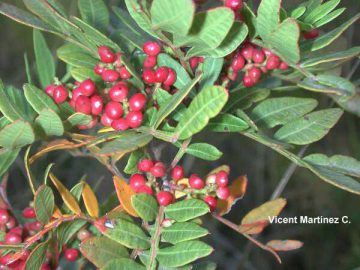
The mastic tree (Pistacia lentiscus L.) is a Mediterranean shrub that is very common throughout Spain, with a wide variety of uses. From a medicinal point of view, the leaves and mastic resin are used.
Mastic leaves to stimulate the appetite
The mastic tree has always been considered a plant to whet the appetite. It is said that, in the past, mastic leaves were soaked in a glass of water for a few hours (without boiling the water). Before lunchtime, the family would gather and drink this “vermouth”, which, according to grandmothers, had the property of making people hungry. This was done especially when there were children with a poor appetite or convalescent people at home.
Uses of mastic infusions

Mastic tree with some fruits Astringent: The infusion of leaves and tender stems is a good remedy to cure diarrhea.
- Dental cements: Mastic is used by dentists to prepare dental cements. It was previously used as a chewing gum because it gave good scent to our breath and fortified our gums. Very useful for bleeding gums.
- Snakebites: In the past, fresh, crushed leaves drunk with wine were recommended as a remedy for snakebites. It was also used for bites from dogs, scorpions, and other animals. (First aid for bites)
External use of mastic leaves
Toothache: Rinses are made with an infusion of mastic leaves and flowers.
Dental properties of the mastic tree
Mastic resin is used by dentists to make dental foundations. It was also formerly widely used as chewing gum because it perfumed breath and fortified gums, reducing bleeding.
Mastic gum in food
Mastic gum has been used as chewing gum since ancient times, in ancient Greece. It is also used to flavor food. In Greece, a mastic-flavored liqueur called mastika or mastichato is very popular. It is often served with desserts as a digestif. It is said that its flavor is reminiscent of licorice.
Other uses of the mastic tree, the mastic resin and the wood of this plant
The mastic tree belongs to the Anacardiaceae family, the same family as the longleaf peppertree (Schinus longifolius) and the Chinese lacquer tree (Toxicodendron vernicifluum). Like many plants in this family, the mastic tree has a resin that makes it usable for industrial purposes:
- In ancient times, a type of oil was made from the fruit of the mastic tree, which was used for lighting.
- The pinkish wood was used in cabinetmaking for the manufacture of furniture and household utensils. It is also used by lumberjacks and charcoal makers (broadleaf wood).
- Lentisc trees were used to make sheaves which, together with kermes oaks, were used as fuel to power lime kilns, ceramic companies and tile factories, especially in the Valencian Community area (Spain).
- Bundles of roots and thick stems of the plant were used in homes to make embers , as the charcoal from the mastic tree has the characteristic of staying lit until it has burned completely.
- Mastic is used in the varnish and paint industries . It has been employed in the preparation of binders for painting techniques and in the manufacture of transparent and elastic varnishes, especially during the 16th-19th centuries (although it yellows and becomes insoluble over time). Chios turpentine, from the island of Chios in Greece, is very famous. There, most of this substance is obtained by exploiting a variety of local mastic tree (Pistacia lentiscus chia).
- Ornamental uses: It is grown as a shrub or garden tree, and is also used as a plant for bouquets and garlands, in florists and for Christmas decorations.
- Animals that feed on mastic trees: The fruits, which are small red berries, are not edible for humans, but they do feed a wide variety of forest birds, which is why these plants are of great ecological importance (In addition, trees provide other benefits to the ecosystem, such as erosion control. In particular, thrushes are one of the birds that most like mastic fruits.
Contraindications of mastic
Because of the ability of tannins to inhibit iron absorption, it should not be used by people suffering from anemia.
 More information about medicinal plants.