Contents
Pumpkin for health (Cucurbita pepo )
Internal use preparations with leaves and seeds of pumpkin
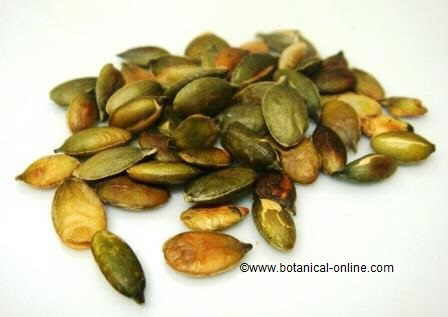
- Vermifuge and taenifuge: (To get rid off intestinal parasites, such as pinworms and, for a long time, widely used to extract taenias or tapeworms from the human body (In the first case, it is advised to eat peeled seeds in the desired amount In the second case, it is recommended to do the following procedure: Smash 50 gr. of fresh seeds; mix them with sugar or honey.
Eat the mixture as the only food for a day in the main meals. After some hours, try to make a deposition and see if the parasite has been expelled. On the contrary, this process can be repeated on another occasion.
- Fever: The decoction of leaves of pumpkin reduce fever. (Boil a handful and a half of pumpkin leaves perliter of water for 10 minutes. Let stand for half an hour. Take four cups a day.)
- Laxative: It favours the intestinal transit, being specially interesting the fact that it does not t irritate the intestinal tract (Look at the pumpkin as an edible fruit)
- Anti-prostatic: Recent studies seem to suggest it is very effective, when combined with the lipophilic extract of the palm ” Serenoa repens ” for the treatment of benign prostate hyperplasia. By decreasing the inflammation, this gland doesn’t make so much pressure on the urethra, which makes easier the expulsion of urine.
- Enuresis: Pumpkin seeds have a slightly diuretic function, helping to increase urine production, while they are sedated. Eat pumpkin seeds in the morning may help to produce urine that he or she can handle to learn how to use the muscles of the bladder.
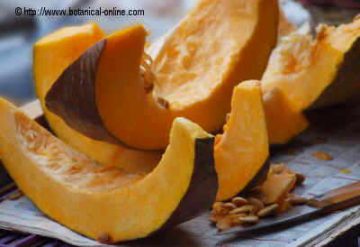
External use preparations with pumpkin pulp
- Emollient: To soften the skin dryness or roughness, pimples, spots, freckles,..Etc. (Apply a facepack made with the pulp of this fruit)
- Burns: By applying the previous treatment on a burn, you favor its healing.
PUMPKIN AS FOOD
Pumpkins are high in fiber and vitamin A
We are talking about an edible fruit, with diuretic properties, being so rich in fibers and having poor caloric contents, which make it very suitable to treat obesity and constipation.
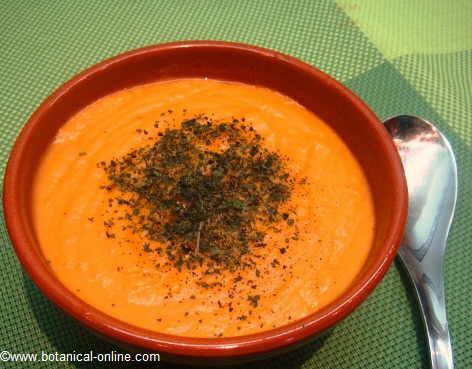
Pumpkin soup. The pumpkin or fruit of the gourd is a vegetable with large food-medicine properties. Pumpkin cream has healthy qualities for skin, immunity, cardiovascular system and the body in general.
It’s got a great amount of vitamin A and it also contains vitamin C. With a big charge of amino-acids, that may contribute to good health in the following ways:
The presence of alanine help to the synthesis of proteins. Arginine plays a good part in the development of muscles and scar healing. Aspartic-acid is very useful to wipe out ammonium. Glycine helps immune system. Histidine is a stimulant. Isoleucine is necessary to a proper body growth and lysine enters also in the growing process and in the formation of hormones and antibodies.
It can be eaten in many ways: as confiture (Not very advised during low-caloric diets) it can be mixed with another vegetables, or cooked in the oven, in puré…etc. It is also very valuable to eat courgettes, considering they contain a lot of vitamin A and potassium.
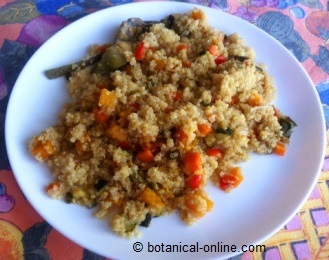
Nutritional composition of pumpkin
| Edible value of pumpkin per 100 gr. | |
| Calories | 24 gr. |
| Carbohydrates | 5,5 gr. |
| Proteins | 1,2 gr. |
| Fats | 0,25 gr. |
| Fiber | 0,46 gr. |
How to grow pumpkin: Gardening: 
 More information about pumpkin.