Contents
MEDICINAL PROPERTIES OF GLOBULARIA
What is globularia?
Common noun: Globularia
Scientific noun: Globularia alypum L.
Family: Globularia family – globulariaceae.
Habitat: In dry and rocky places.
Characteristics of Globularia
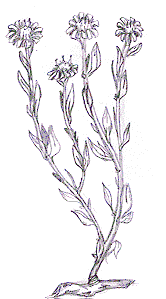
Perennial bushy plant of the globularia family – globulariaceae – up to 60 cm. Stems erect and ligneous. Leaves short-stalked, lanceolate ending in a spine. Bluish flowers, in heads till 2,5 cm in diameter. Very perceptible bracts, imbricate.

Picking-up and storing Globularia
Leaves should be collected at the end of Winter or early Spring. They should be dried and stored in a dry air tight container.
Properties of Globularia
Globularia as a medicinal plant
- Purgative: In cases of constipation this plant can be used as a soft laxative (Decoction of 50 gr. of dry leaves per litre of water. 2 cups a day)
- Antirheumatic and antidiabetic: In case of sugar, articular and muscular pains, and gout (A cup in the morning of the decoction previously seen)
- Antiacid: Against stomach acidity (Infusion of 30 gr. of dry leaves per litre of water. A glass before meals.)
 More information about medicinal plants.
This article was endorsed by Vicente Martínez Centelles - Founder of the web and director. Teacher of natural sciences, expert in plants, natural remedies and botanical photography.