Contents
- 1 Medicinal properties of nettle (Urtica dioica L.)
- 1.1 Nettle for the digestive system
- 1.2 Nettle for circulatory disorders
- 1.3 Nettle is a suitable plant for some metabolism problems
- 1.4 Other medicinal properties of nettle
- 1.5 Nettle to cake care of skin health
- 1.6 Nettles for hair treatment
- 1.7 Nettles for sciatica
- 1.8 Main curative properties of nettle
- 2 EDIBLE PROPERTIES OF NETTLES
Medicinal properties of nettle (Urtica dioica L.)
Medicinal preparations with nettle for internal use
Nettle for the digestive system
Nettle is a good digestive tract stimulant and a good anti-diarrheic. It protects the liver and helps it to recover in case of hepatic disease. It favour the biliary function – Caffeic, linoleic and oleic acids take an active part protecting the liver- Increasing the secretions, it contributes to peristaltism, which eases digestion by helping the stomach.
At the same time it can be considered a soft laxative. (Infusion of two teaspoons of dry leaves per litre of water. Take three times a day before meals.)
On the other hand we can obtain the opposite effect if we make use of its root. Its richness in tannins, mainly the root, makes it suitable for the treatment of diarrhea (Decoction of dry root for 10 minutes. Drink 3 cups a day)
*More information: Digestive properties of nettles
Nettle for circulatory disorders
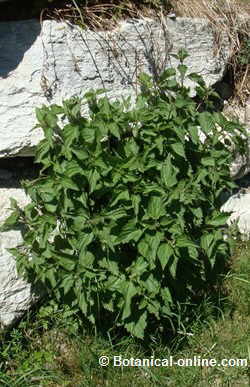 Nettle plant Nettle plant |
– Hemostatic: It stops bleeding and prevents the uncontrolled flowing of blood. Very suitable to treat nose bleeding, hemophilia and menopause. (Juice of fresh plant, obtained by crashing the plant and filtering the pulp. The same liquid can be bought in a health food shop or herbalist.
– Metrorrhagia: The juice of the fresh plant, obtained crushing the plant and sifting the pulp is very suitable for metrorrhagia (vaginal hemorrhage in periods that do not correspond the menstruation). The same can be obtained by buying it directly from herbalist’s or health food stores. Take half a cup a day, divided into morning and evening)
– Premenstrual syndrome: Anxiety and nervousness during menopause, as well as many other side effects typical of premenstrual syndrome (headaches, stomach, breasts, abdomen swelling, skin irritation, redness, etc..) can be alleviated with the use of this plant. (Infusion of half a teaspoon of this plant with half a teaspoon of chamomile. 3 cups daily).
– Eye diseases: In can improve blood circulation, so it helps facilitate the arrival of components suitable for eye health. Besides, it also posses anti-inflammatory properties that are very adequate to reduce eye strain in eye conditions such as hypermetropia or astigmatism (Infusion of a teaspoonful per cup of water. Drink 2 cups daily.) (Decoction of 60 g of dried plant per liter of water. Apply a wet towel over your eyes)
– Anti-atherosclerotic: Being so rich in Chlorophyll, it is very useful for the treatment of a arteriosclerosis and for blood circulation (The previous juice treatment its good in this sense.) Other vascular problems related with a bad peripheral blood flow, such as chilblains, can be treated in the same way.
Nettle is a suitable plant for some metabolism problems
– Anti-diabetic: It diminished the sugar level in blood and prevents from diabetes (Boil a handful of fresh nettles in water and drink 3 cups a day.)
| NETTLE TO GET RID OF BODY LIQUIDSNettle is one of the best diuretics, together with dandelion and equisetum. Diuretics help the body to get rid of water, which becomes very interesting on only for the treatment of obesity, but in all these maladies that improve by the riddance of water and toxins Among all the problems that can be treated with this plant we have: circulatory diseases, hepatic diseases, jaundice, gout, arthritis, osteoarthritis, rheumatism, kidney stones, gallstones, nephritis, kidney failure, acne, eczema, etc (Decoction of dry root for 10 minutes. Drink 3 cups a day) (Infusion of 2 teaspoons of dry leaves in a liter of water. 3 times a day before meals.) |
– Anti-prostatic: Infusions of dried nettle leaves are a very important diuretic remedy. Steroids extract from the roots act directly on benign prostatic hypertrophy by increasing the amount of daily urination, relax the bladder and inhibit the growth of this gland .(Decoction of five tablespoons of dried plant per liter of water. Taking a couple of cups a day)(The dose is estimated at 240 mg daily divided into two doses)
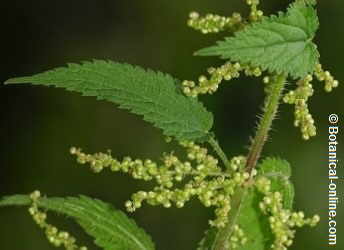 Nettle plant Nettle plant |
– Jaundice: Nettle ability to eliminate toxins, along with their properties to stimulate the liver and biliary function makes it very suitable as a remedy for jaundice, liver both as posthepatic.
– Enuresis: Nettle is a good diuretic and a good tonic for the urinary tract. (Infusion of a spoonful of dried plant per cup of water. Take a couple of cups a day, preferably in the morning. Try to keep the liquid in the bladder to strengthen it and learn to use the urinary muscles)
– Cellulite: Being a diuretic it is very suitable to treat cellulite (Infusion of a spoonful of dried plant per cup of water 4 cups a day)
Other medicinal properties of nettle
– Anti-anemic: Because of its high iron contents, it is ideal to cure anemia. (Drink vegetal broth, made with nettles and other vegetables)
– Galactagogue: It increments the flowing of milk in lactating women (Take vegetable broth, made with nettles and other vegetables)
– Alzheimer disease: It favors the formation of estrogens that enhance the mental state of Alzheimer’s disease. The ingestion of these herbs as vegetable can benefit the performance and reduce depressive episodes of these patients. (Take vegetable broth, made with nettles and other vegetables)
Medicinal preparations with nettle for external use
Nettle to cake care of skin health
Nettles posess vulnerary and cosmetic properties. They are very beneficial for the skin care, giving it a fine texture by getting rid of imperfections such as: pimples, eczema, herpes, acne,etc. Among all the treatments we can point out the following:
– Pour a handful of stinging nettles in the water of the bath.
– Decoction of a handful of dry nettles in a Liter of water. 2 or 3 cups a day.
– Eat them as a vegetable, boiled together with spinach.
– Drink nettle juice
Nettles for hair treatment
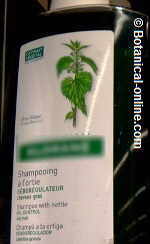 In the pharmacies you can buy shampoo with nettle extract In the pharmacies you can buy shampoo with nettle extract |
It has been tested its regenerating power for hair-skin, as well as its capacity to fight dandruff and seborrhea and other disorders related with hair loss.
Because of this, although it can not be considered a miraculous elixir against baldness, it can help prevent it or other hair problems, such as dandruff, seborrhea or dry hair, (Maceration of 100 g of nettle and 100 g of rosemary in 1 liter of dried anise for 15 days. Rub your scalp in the morning and before bedtime).
Nettle can be use to prepare natural shampoos that can keep your hair in very good state.
Nettles for sciatica
Taking a bath where you have added a litter of nettle infusion, will relax the sciatic nerve and decrease pain. Another more drastic solution for sciatica, although effective, is to rub the painful area with a sprig of fresh nettles in order that the stinging principles of this plant can produce a reaction in the body, that will mask the sciatic pain and will reduce the inlammation of the affected area for a few days.
The application must be done very carefully a couple of times a day on the legs and arms. To lessen the irritant effect, talc may be sprinkled on the area of application.
Main curative properties of nettle
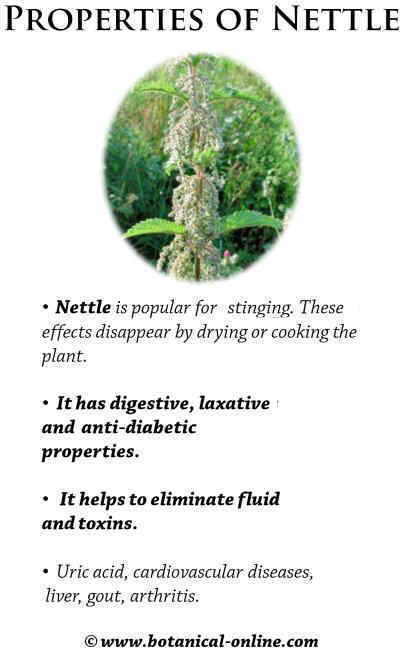
EDIBLE PROPERTIES OF NETTLES
How to prepare nettles to avoid them the stinging effect?
Nettles constitute an excellent food when prepared as a vegetable or in combination with other vegetables, such as potatoes or spinach.
To be edible they must be picked and left to rest for half a day. Then, after being cooked, they are not hot at all, because formic acid has been eliminated.
They are very good when boiled or fried as omelette. No matter how they are prepared, we can enjoy them and they give us all their medicinal properties.
Dangers of nettle. Risks using nettles
One should not abuse of this plant because sometimes it can produce stomachic reactions. Being a plant that generally lives on organic refusal, it tends to accumulate big quantities of nitrates, so, unless taken with moderation, it may become harmful.
There has been reported skin reactions and urination problems. In contact with the skin its stinging hairs are responsible for strong pain.
 More information about nettles toxicity.