Contents
Medicinal plant preparations for low blood pressure
Phytotherapy. Herbal tea remedies to treat hypotension
Among all the curative herbs for hypotension, we can point out the following:
- Ginseng

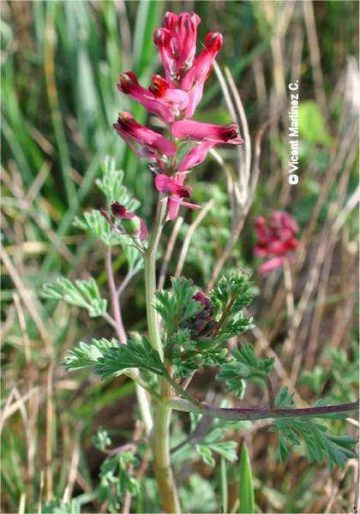
Fumitory photo (Eleutherococcus senticosus, Panax quinquefolium) American ginseng or Siberian ginseng have been proved to be able to stabilize blood pressure levels, making it useful both in cases of hypertension and hypotension. (More information about them in the different studies of each plant)
- Fumitory (Fumaria officinalis) With properties to reinforce heart beat, very useful to treat heart failure and hypotension (Infusion for 15 minutes of 4 tablespoons per liter of water. Two cups a day)
- Attention! If we keep on taking the previous preparation for more than 10 days, its properties are reversed, with which, by reducing the red globules, it exerts a slightly hyposthenic function – lost of corporal energy – and hypotensive value – it decreases blood pressure.
- Linden (Tilia spp.) Linden sapwood has hypertensive properties so its use could be used for the treatment of hypotension. (Decoction of a teaspoon of dry sapwood of lime per cup of water for 1 / 4 hour. Take a couple of cups a day) (Take 90 drops of tincture of sapwood per day divided into three portions. On sale in pharmacies and stores)
- Gentian (Gentiana Lutea) (Infusion of one teaspoon per cup of dried root. Two cups a day.) The use of this plant in patients with gastritis or peptic ulcer is not advised. High doses of this plant can cause vomiting, indigestion or headache. Not for use with children under 2 years old. In case of pregnancy or hypertension it can only be taken under prescription.
Hawthorn is suitable for hypertension as well as for hypotension
- Hawthorn (Crataegus monogyna, Crataegus Oxyacantha) Hawthorn has been used for a considerable time to care for heart and arteries. This plant helps prevent many diseases of the heart. In Europe, it was already used by the Greeks and the ancient American natives for this purpose.
Hawthorn possesses vasodilator properties of the coronary arteries which encourages blood circulation. Flavonoids (quercetin, rutin, and catechin vitexin) some minerals (potassium, magnesium and calcium), the neurotransmitter dopamine and the purine adenine are the most responsible for this property.
In addition to dilating the major artery of the heart, hawthorn has cardiotonic properties helping the body to pump blood harder. These properties allow to solve problems that affect heart rhythm or a lack of cardiac weakness, poor circulation, hypotension, fluid accumulation by heart problems, etc.
This same plant, as we saw earlier, also helps It can be considered as regulatory in cases of hypertension and hypotension. (Infusion of a spoonful of dried flowers, two or three times a day. It can be taken without time limit.)
Administered in adequate doses, it generally presents no contraindication. In high doses it can convey decreased heart rate, arrhythmia, respiratory depression and hypotension..
It can produce unpleasant effects on people with allergies to the Rosaceae.
Do not give to pregnant or lactating women.
Using this plant, combined with stress or medications for heart, can intensify their effects too much, so that the physician should assess the suitability of its application and the appropriate dose.
Being a plant that affects an organ as delicate as the heart, it is best to consult with your doctor before starting treatment.
Some other remedies for hypotension
They that can only be taken with a medical prescription because they are dangerous or very poisonous:
– Monkshood/ aconite (Aconitum napellus)
– Hellebore (Helleborus phoetidus)
– Lily of the valley (Convallaria majalis)
 More information about low blood pressure.