Contents
What is an Aleppo pine?
Characteristics of the Aleppo pine (Pinus halepensis)
Common name: Aleppo pine, Jerusalem pine
– Spanish / Español: Pino, pino carrasco, pino blanco, pino de Alepo
Scientific noun: Pinus halepensis Mill = Pinus maritima Mill.= Pinus hispanica J. Cook = Pinus maritima Mill. =
Family: Pinaceae
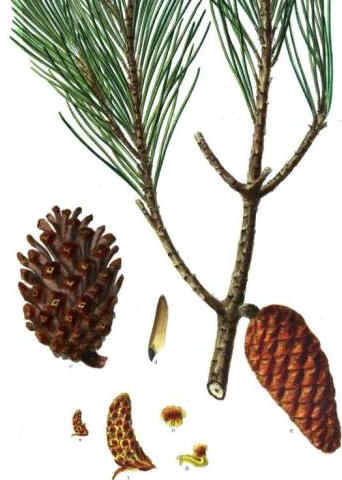
Drawing of the leaves and flowers and pine cones
Habitat: It can be found throughout the Mediterranean area from sea level to about 200 m altitude, reaching 1000 meters in the south of the peninsula and even 1,700 meters in mountainous areas of Morocco and Algeria. It extends from North Africa, southern Europe and Turkey to the Black Sea.
It has been planted as an ornamental in other places of the world like California and southern Australia, were it has become a naturalized plant.
Aleppo pine is the wild tree par excellence of all the lower area of the Mediterranean. Probably it was not as widespread in the past, when many lands, where they are living today, were occupied by forests of oaks. Degeneration of these areas and the large repopulation with this species has resulted in this tree becoming the most widespread and abundant in the lowlands of the Mediterranean area.
It is the most planted tree for timber production in this area. It supports very well the heat and high temperatures. It is a disputed species because of its richness in resins enhances combustion so it is very conducive to suffer fires.
* Related information: Aleppo pine cultivation
Description of Aleppo pine
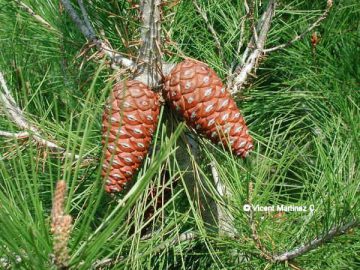
Evergreen tree of the Pinaceae family up to 20 m, but usually less tall.
Stems with silvery whitish bark in youth, but darker and red tones when it reaches maturity. Bark cracks over the years.
Leaves between 5 and 12 cm, needle shaped, with one millimeter thick. Generally in pairs, sometimes three. Pine cones up to 12 cm long and 4 cm wide, clearly conical, with curved stems.
The seeds (pine nuts) are NOT edible. It differs mainly from the rest of the pines by its narrow leaves and by the curvature of the stems of pine cones.
 More information on pine nuts and pines