Contents
What is a chicory plant?
Characteristics of chicory (Cichorium intybus)
Common noun: Chicory, Radicchio, Succory, Witloof
Scientific noun: Cichorium intybus L.
Family: Daisy family (Compositae)
Habitat: By the side of paths, roadsides and dry lands.
Botanical description of chicory
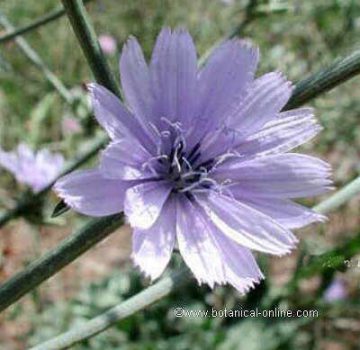
Perennial plant of the Daisy family – compositae – up to 1 m.
Erect stems, glabrous o bristly, very irregularly branched.
Basal leaves in rosette, toothed; upper ones very small, with smaller teeth.
Flowers till 4 cm., blue.
Picking-up and storing chicory
Its leaves will be picked up in summer. They should be dried in the shade and stored in a dry and somber place inside sacks or glass containers.
Its roots can be picked up in spring or summer.
They will dried in the sun and stored under similar conditions as leaves.
Components of chicory
- Acids: ascorbic, chicoric, clorogenic, isoclorogenic, linoleic, alpha-linoleic, stearic, myristic, palmitic
- Inulin (leaves)
- Cichoriin (flowers)
- Lactucin (root)
- Lactucopricin (root)
- Amino-acids: Threonine, Arginine, tryptophan, lysine, valine, (leaves)
- Fiber (plant)
- Minerals: Potassium, phosphorus, calcium, iron, magnesium (leaves)
Uses of chicory
Chicory is a plant from the aster family that is used as:
- Edible plant: Its leaves are eaten in salads and as a vegetable. The root can also be used as a vegetable. The roots are used as animal feed due to their high protein content, making this plant a good substitute for oats.
- For making beverages: Chicory root is used to make a coffee substitute. Chicory extract is used in some alcoholic beverages.
- As a sweetener: Due to its high inulin content, this species is used as a sweetener.
- As an insecticide: The infusion of this plant has been used as an insecticide for animals.
- As a medicinal plant
 More information on chicory