Contents
- 1 Horsetail health benefits (Equisetum arvense L.)
- 2 Medicinal properties of horsetail
- 2.1 Internal use remedies with horsetail
- 2.2 Horsetail is a diuretic plant
- 2.3 Horsetail to stop hemorrhages
- 2.4 Horsetail for osteoporosis
- 2.5 Horsetail for skin, nails and hair
- 2.6 External use preparations of horsetail
- 2.7 OTHER USES OF HORSETAIL
- 2.8 Contraindications of Horsetail
- 2.9 Toxicity of Horsetail
Horsetail health benefits (Equisetum arvense L.)
Medicinal properties of horsetail
Internal use remedies with horsetail
Horsetail is a diuretic plant
- Metabolism: The horsetail constitutes one of the most diuretic species in all the plants. That is to say that it possesses a great capacity to eliminate water from the body, in such a point to increase urination up to 30% more than what is habitual.
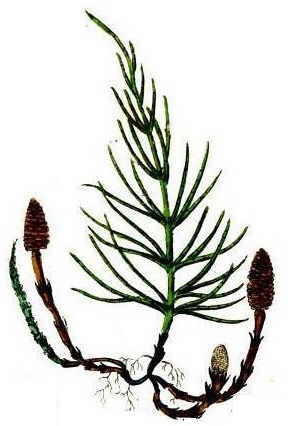
This fact makes that its scientific name Equisetum arvense generally appears in the composition of most of products that habitually are sold to reduce weight. This property is due to the action of several components, among which it is necessary to highlight equisetonin and potassium, but there are another ones that also take part such as calcium, magnesium, ascorbic acid and caffeic acid.
Altogether this is the reason why this plant has traditionally been used in illnesses related with the problems of retention of liquids. In this Sense you can consider the horsetail like one of the best purifiers that you can use for the treatment of the following illnesses or metabolic problems:
- In diabetes treatment.
- In the obesity or dropsy.
- In swollen eyes
- In cellulite.
- In the excess of uric acid.
- In rheumatic illnesses, as the arthritis or gout.
- In illnesses of the urinary apparatus, especially when little urine production takes place, what is known medically as oliguria, with the probability of developing of gallstones or kidney stones (calculous), illnesses of the urinary bladder (cystitis), prostate problems (prostatitis), etc.
(Decoction during 30 minutes of 100 gr. of the dry plant for a liter of water. Take a couple of cups a day) (2 spoonfuls of fresh juice diluted in water every day) or (3 gr. of extract fluid every day. It is sold in pharmacies and herbalists)
Horsetail to stop hemorrhages
Hemorrhages: Horsetail is a good remedy to stop hemorrhages since the pectic and gallic gallic constitute good homeostatics that stop bleeding.
Therefore its use will be suitable in situations where blood leakage is more abundant than the usual: excess of blood in menstruation uterine hemorrhage, blood from the nose, bloody sputa, blood in the urine, bleeding varicose veins etc (Take three cups a day of the previous preparation or 6 gr. of extract fluid)
Horsetail for osteoporosis
- Horsetail is a remedy for bones: Because of its content in silica, this plant is recommended when it is necessary for the body to repair bony tissues that are in not well condition, as a result of some traumatism or because of the own corporal decalcification.
Silica helps to fix calcium, so that the body can store more quantity of this mineral and it is able to form stronger bones or tendons. It will be very interesting to use this plant when some fracture, distention or dislocation has taken place in some bone or ligament. Equally, it will be advisable in those cases when an abnormal calcium intake or a bad fixation of it takes places, just as it happens in osteoporosis.
Horsetail for skin, nails and hair
- Hair care: For its content in silica is also appropriate to maintain the hair health helping in the prevention of, dry hair, baldness, seborrhea or dandruff. (Infusion of a spoonful of dry plant for cup of water. Take a cup a day)
- Fingernails care: Equally this element strengthens the fragile or brittle fingernails and prevents them to break up so easily. (Infusion of a spoonful of dry plant for cup of a water. Take a cup a day)
- Acne: Its depurative properties makes it ideal for the treatment of acne. (Decoction for 30 minutes of a handful of dried plant in a liter of water. Take 3 cups a day)
External use preparations of horsetail
- Skin diseases: Used externally it possesses astringent properties, useful in the treatment of illnesses of the skin, as pimples, eczemas, or in wounds difficult to cure. (Clean affected area with the infusion of a spoonful of dry leaves for a cup of water) In the case of buccal ulcers, carry out mouthwashes with the previous preparation.
This same property can be used to treat inflamed or aching eyes, or to combat the irritation or the itching that ocular affections generate, as in conjuntivitis or styes (Apply with a gauze the liquid of the infusion)
Because its anti-inflammatory properties, it is adequate to reduce eye strain in eye conditions such as glaucoma or eye floaters and delay the onset of presbyopia, myopia, astigmatism, and hypermetropia or prevent eyes deterioration, such as in macular degeneration. (Make eye baths with towels soaked in the liquid from the decoction for 10 minutes of 100 grams of dried plant in a liter of water)
- Stretch marks: Being rich in silicon, horsetail treatments are effective in the treatment of stretch marks, especially those of newer generation. Silicon helps regenerate the skin making the stretch marks disappear in many cases or giving them a smoother appearance. (Maceration of 100 g of horsetail with 8 drops of lemon juice in one liter of alcohol at 40 º for 1 month. Dilute with water to 50% and massage the affected areas twice a day)
- Brittle nails: For its silica content, horsetail fortifies and prevents them from breaking so easily. (Infusion of a spoonful of dried plant per cup of water. Take one cup a day)
- Nail ridges: Horsetail helps nails to grow more uniformly avoiding defects. (Decoction of 3 tablespoons per liter of water. A couple of cups a day)
- Hair care: Horse tail contains much silicon that helps protect hair against dandruff or seborrhea. You can take this plant in infusion to strengthen your hair in order to prevent baldness, but horsetail can also be used externally for the production of natural shampoos to clean and maintain a strong and healthy hair.
- Food odor: Infusion with a handful of dried plant in a pint of water Pour the liquid into a bowl and add water until it is warm. Take a foot bath for about 20 minutes a couple of times daily if you need it. Don’t forget to rinse your feet with cold water thoroughly dry and sprinkle talcum powder on them.)
- Female genital apparatus: These healing properties in external use can be an advantage to alleviate the inflammations or infections of the vulva and of the vagina (vulvitis, vulvovaginitis, vaginitis) (Carry out a vulva or vagina washing with the decoction of 60 gr. of dry plant for a liter of water)
- Hemorrhoids: The same previous preparation can be used to treat hemorrhoids externally, especially those that bleed. (Cleansing with the decoction of 60 gr. of dry plant for liter of a water) This preparation is also suitable for external varicose veins treatment.
- Blood from the nose: Apart from using it internally, just as it has seen before, it is convenient to reinforce the capillars of the nose externally to impede their break. To make it possible we will introduce it in the bleeding nasal hole a piece of wet cotton with some juice of the tender plant.
- Pyorrhea: (Mouthwashes with the infusion of the dry plant)
OTHER USES OF HORSETAIL
- Ecological insecticide: The resulting liquid of very concentrated decoctions of horsetail can be used to combat pests in an ecological way. To do this, a decoction should be carried out with a 10% of the plant with which garden plants, vegetables, fruit-bearing trees, etc. will be fumigated.
Its power to eliminate fungi and insects increases if it is 50 % combined with a concentrated tea of nettles. (To carry out this special tea of nettles we will allow about 200 gr. of nettles to rest in a liter of water during 4 days. We will take part of the resulting liquid and we will add a 80 or 90% more than their weight in water.)
Contraindications of Horsetail
Being a plant with so strong diuretic properties, its internal use can produce problems in blood pressure. On the other hand, because of the presence of certain components, its prolonged used can be toxic. Before using, it is recommended to consult the doctor. It should not be administered during pregnancy neither or nursing. (See toxicity details)
Toxicity of Horsetail
Having a series of substances potentially toxic is the reason why many professionals consider this grass too dangerous for its use as medicinal plant. Among the noxious substances we have the following ones:
- Silicates that can produce digestive problems, especially when used for long.
- Alkaloids: Although they don’t appear in strong concentrations, a prolonged use, can take place by accumulating them in the organism which may facilitate premature childbirth, nervous disorders, headaches, lost of appetite, swallowing problems, etc.
- Enzymes: Its content in Thiaminases can produce a decrease of vitamin B1 (thiamine) that is necessary for the conversion of carbohydrates in glucose. Shortage of this vitamin produces nervousness, depression, lack of appetite, muscular weakness, gastrointestinal problems, weakness or acceleration of the pulse, arrhythmia, coordination lack, etc.
In human beings these intoxications have not been registered if ingesting Equisetum arvense, but there has been some cases of toxicity when consuming the species Equisetum telmateia that presents higher proportions of toxicity. Cases of intoxication can be easy because Equisetum arvense can be confused with Equisetum palustre whose content in alkaloids, especially palustrine, is much higher.
In animals all horsetail species are very toxic and they produce an intoxication called equisetosis that, in the case of the horses, it is very frequent and which can produce the animal’s death. Sheep, oxen and cows are also affected by this plant. The most characteristic symptoms are breathing disorders and digestive problems or fever. milk in females becomes bitter and less abundant. Because of the oxytocic properties of the alkaloids, females can lose their breeding, something that can also happen in human females.
These intoxications force to a treatment that restores the thiamine deficiency, although in the case of the animals, they are no longer recoverable in many occasions.
 More information about plants.