Health benefits of greater plantain (Plantago major L.)
MEDICINAL PROPERTIES OF GREATER PLANTAIN
Internal use
Greater plantain for the respiratory tract
Because of its content in mucilages, greater plantain performs emollient properties, that’s to say it soothes the respiratory mucous membrane, so it is used to cure sore throat of sores in the mouth, caused by infections. Also very suitable to treat aphonia or coarse voice. (Apply mouthwashes with the liquid of an infusion on a teaspoon of dry leaves in a cup of water. This liquid can be swallowed.)
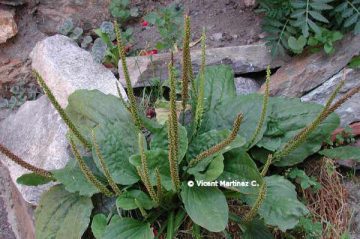
At the same time, the antibacterial properties of this plant can be profited to eliminate microorganisms produced by respiratory tract diseases. Taking into account its decongestive and expectorant properties to open the respiratory tracts and help to expel mucus that can develop there.
By combining these three properties, this plant can be used for a wide range of respiratory diseases:
- Cough,
- Pharyngitis,
- Laryngitis,
- Bronchitis,
- Aphonia,
- Tuberculosis, etc.
Syrup of the fresh plant. How to do it?
Mash the plant, filter the liquid. Mix it with sugar in the same proportion, diluting it previously by putting the pot in hot water. Take three spoonfuls a day. Bactericide properties of this plant are spoiled by heating it, so it is better to prepare a cold infusion to treat bacterial infections. As emollient, an infusion of a teaspoon of dry leaves for a cup of water can be made. Take three cups a day.
Astringent properties of greater plantain
- Astringent properties: Being very rich in tannins, it has got astringent properties, very adequate to stop diarrhea. (Infusion of a teaspoon of dry leaves for a cup of water. Drink 3 cups a day)
This infusion is suitable for irritable colon, colon inflammation (colitis), intestinal inflammation (enterocolitis). A couple of spoonfuls a day of this syrup helps to diminish pain caused by a stomach ulcer.
Plantago seeds for constipation
- Constipation: The seeds of plantain, very rich in mucilages, can be used to treat constipation. As a matter of fact, the mixed seeds of some varieties of plantains are used to produce psyllium, a complement widely used to avoid constipation. (Take from 1 to 3 spoonfuls of seeds a day with a lot of water. A couple of liters of water as minimum. Otherwise, it may produce intestine occlusions. Do not take it if you suffer allergic reactions to the plant.)
Other properties of greater plantain
- Diuretic: The juice of plantain, prepared as we have seen before, exerts a diuretic function so that it seems profitable in slimming diets (Infusion of a teaspoon of dry leaves in a cup of water. Drink a cup everyday)
- Hemostatic: Plantain has been proved to be a good hemostatic plant, that’s to say it favors blood coagulation in wounds. This property can be very appropriate not only to treat wounds produced in the outer part of the body, resulting from a cut or a traumatism, but also to those internal ones which are produced when little veins or capillaries are broken.
Among many others applications, we could mention anal bleeding produced by hemorrhoids. In the same way, it can stop urination hemorrhages as a consequence of little injuries in the urinary bladder. It may also help healing anal fistulas. (Infusion of a teaspoon of dry plant in a cup of water. Drink 3 cups a day)
External use
- Vulnerary: The fresh leaves of plantain are one of the best vulneraries. They help the body to heal wounds, cuts, scratches, etc and promote scar formation. This property is attributed so much to their content in tannins as well as alantolin. Tannins function as hemostatic and cicatrizant. It is a substance that stimulates epidermis cell growing and replaces those cells that were injured, so it produces their regeneration.
This is the reason why this component is used by the cosmetics industry for the composition of skin creams. Leaving apart the complexity of those types of creams, a simple well-washed fresh leaf of this plant can be applied on a scar to stop bleeding. By doing this, it will help to cicatrize and prevent the risk of infection.
- Gums bleeding: (mouthwashes with the juice of the tender leaves.)
- Otitis, earache , Meniere’s disease and tinnitus: Because its inflammatory and bactericide properties it is suitable to fight earache. (Crush a tender leaf and pour some drops of its juice inside)
- Burns or sunburns: By applying a plaster, made with some crushed fresh leaves, it will diminish pain and help the burn to regenerate.
- Insect bites: The juice of the fresh plants aids to diminish swelling. It can be used for many insects, such as bees, wasps, mosquitoes, fleas, etc. It the same way this juice can be useful to alleviate the extreme itching produced by the sting of nettles.
- Eyes: An eyewash is a good remedy for the relief of tired, tired eyes, reddened or inflamed eyes (Wash the eyes with the liquid resulting from an infusion of 5 spoonfuls of dry leaves in a liter of water for a quarter on an hour)
 More information about medicinal plants.