Contents
How to grow tiger nuts
Tiger nut cultivation guide
 Plant description

Plant name: Yellow nutsedge
Scientific name: Cyperus esculentus
Botanical family: Cyperaceae
Perennial plant that produces edible tubers that are used in food.
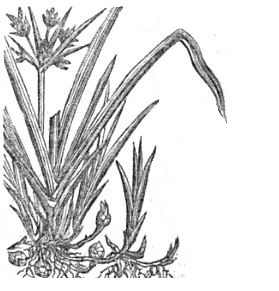
Rounded or ovoid tubers, 10-25 mm long by 8-12 mm wide. Its surface is rough, with transverse rings and light brown in color.
Triangular, smooth and glabrous stems, which can reach 0.6-1m high.
Lanceolate leaves.
Tiny, golden or reddish flowers, achlamydeous, arranged in flower spikes, composed of tiny reddish and golden flowers.
The plant blooms in summer.
Anemophilous pollination.
Fruit in a trigonous achene, 1.5-2mm in length.
Vegetative cycle of tiger nuts
Climate

– It occurs in tropical and subtropical climates, being a common weed in humid places, native to muddy soils or with seasonal flooding, shallow waters, peat bogs, near lakes, deltas, etc.
– It also grows as a weed in irrigated and semi-dryland crops, becoming a real pest that is difficult to eradicate in some areas of North America.
– Warm and humid climates, high average temperatures with warm seasons between 13 and 25ºC.
– Exposure to full sun.
– The plants can withstand frosts down to -15ºC.
Soil

– Humid sandy loam soil, a few meters above sea level.
– Rich in organic matter.
– Damp terrain, with poor soil drainage and in peat bogs.
– Loose soil to allow the growth of the tubers.
– Acidic or neutral pH, between 5 and 7.
Ground preparation

– Preparing the ground before planting yellow nutsedge involves soil work to aerate it and achieve a loose and level texture, which allows the plant’s tubers to grow in quantity and quality.
– In large areas of crops, lightweight machinery should be used to avoid soil compaction problems.
– Weed the ground.
Propagation by tubers

It is the most widely used method in agriculture.
– Planting density is important, as it determines the yield and quality of the tuber.
– The optimal planting density is 120-135 kg/ha. This density should not be exceeded, as there is a risk of producing tubers that are too small or of the plants becoming weak and lodging prematurely.
– The planting is done in soil in good condition, with little moisture, which allows the soil to be worked.
– Mechanically, rows of furrows are formed with a depth of between 15 – 20cm.
– Place the tubers in the ground at a depth of 5-9cm, with a separation of 12cm between them. Water.
Cultural practices, fertilizers and fertilize application

- The first irrigation is carried out 1 month after planting, approximately in mid-May, and periodically every 10 days. During the dry months of July and August , watering should be done every 8 days.
- In October, space out watering every 12-15 days. The number of waterings per year depends on the type of climate, although in general, between 10 and 15 waterings are carried out in spring and summer.
- Fertilizer of organic matter, nitrogen, phosphorus and potassium, although fertilizers are generally not used in this type of cultivation.
- Weeding the soil to remove weeds. This can be done mechanically, manually, or with herbicides. Herbicides are generally not needed in this type of crop.
- Tubers are very attractive to mice and require protection from them in winter.
Harvest
– It is carried out in autumn, between November and December. In some cases, it is postponed until January, depending on the incidence of rainfall. At that time, the plant’s leaves are completely dry.
Prior to harvesting, the aerial parts of the plant are removed so they don’t obstruct the machine that will later extract the tubers from the ground. The harvester cuts off pieces of soil, which are then shredded and deposited in a separator that removes the soil from the tubers, or tiger nuts.
Commercialization process
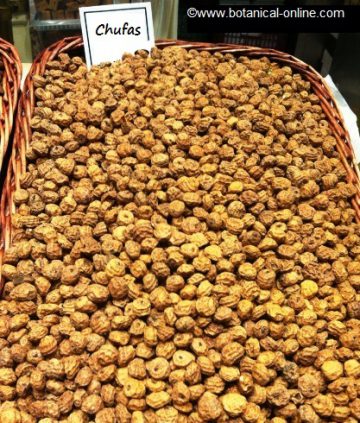
- Washing: after harvesting. The roots are removed, the skin of the tubers is cleaned of any remaining soil in several baths, and the damaged tubers are set aside.
- Drying and ripening: tiger nuts are dried for the maturation of the tubers, in which they acquire their flavor characteristics that make them unique. Drying is usually carried out in drying chambers for 3 months, while they are periodically removed for homogeneous drying. During this process, the moisture content of the tubers drops from 50% to 10%.
- Cleaning and sorting the tiger nuts suitable for trade are selected, according to their size and appearance.
Pests and diseases

In general, it is not common for this type of crop to present pests or diseases. On the contrary, it is very resistant and has become one of the most difficult weeds to eradicate in the U.S.
The possible problems that can affect the crop are the following:
- Tiger nut borers (Bactra lanceolana and Bactra furfurana ): lepidopteran insects that attack the plant stem during the larval stage. Snout moths (Pyralidae spp.) have also been found.
- Rodents: they can cause damage to the plant, in its aerial part or to the tubers.
- Fungi (Rosellinia spp., Rhizoctonia spp.): they cause diseases in the rhizome, although in general, the plant is not very vulnerable to these attacks.
 More information on tiger nuts