Contents
What is the yellow nutsedge plant?
Characteristics of yellow nutsedge (Cyperus esculentus)
Common name: yellow nutsedge, chufa sedge, earth almond, tiger nut, rush nut, ground almond, northern nutgrass…
Scientific name: Cyperus esculentus L.
* See: Yellow nutsedge in other languages
Other taxonomic names: Cyperus hydra Kunth.
Family: Cyperaceae
Origin: Native plant to the Mediterranean Basin. It is believed to be native to Egypt and spread throughout North Africa. It was brought to Spain by the Arabs and the rest of Southern Europe.
Habitat: It is native to temperate and subtropical climates. It is found in muddy soils, shallow waters, peat bogs, near lakes, deltas, ponds, etc. It also grows as a weed in agricultural fields in southern Europe.
Where do grow?
Yellow nutsedges spread from Egypt throughout North Africa, where they are appreciated. It was the Arabs who introduced it to Europe through the Iberian Peninsula.
In particular, yellow nutsedges are widely consumed in the Valencian orchards, the eastern part of Spain, where the mild Mediterranean climate has produced sweet, exquisitely flavored tiger nuts.
From the historical tradition of yellow nutsedge cultivation and the artisanal production of horchata (tiger nut drink), the Denomination of Origin for tiger nuts was approved in Valencia in 1989. In fact, Valencia is the most important Spanish province producing tiger nuts and horchata, and of reputed quality.
In Europe, it occurs in the southernmost part, which includes Portugal, Spain, France, Italy and, less frequently, some northern areas of Germany and the Netherlands.
This crop has become naturalized in North America, where it has become an invasive weed in fields that is difficult to eradicate.
Physical characteristics of a yellow nutsedge
A yellow nutsedge (Cyperus esculentus) is a perennial plant with roots and tubers that are used in food.
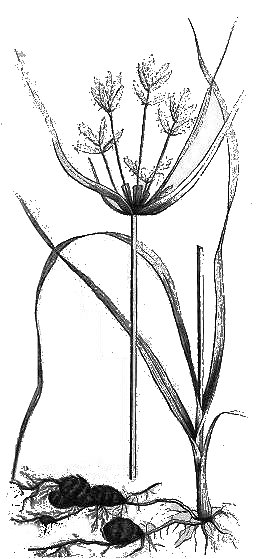
This plant has taken on special importance in food due to the popularity of horchata de chufa (tiger nut milk), typically produced in the Valencian Community (Spain).
The plant consists of smooth, glabrous, triangular-sectioned stems, which can reach 0.6-1m in height.
The leaves are parallel-veined and long, between 40-50cm in length. They are narrow and lanceolate, reminiscent of grass leaves.
The inflorescence is a pedicellate floral spikelet, composed of tiny reddish and golden flowers. The flowers are arranged in rows of overlapping scales with obtuse apex.
The flower spike measures between 6-12mm in length, and is generally embraced by 2-4 leaves, which are longer than the spikes.
Often, several spikes are arranged together on the same stem, forming a structure that may be reminiscent of umbels of plants such as angelica, although in this case, they are of irregular sizes.
The plant flowers in summer. Its pollination is anemophilous (by wind).
The fruit is a trigonal achene, 1.5-2 mm long, oblong, shiny, and with an obtuse apex. The plant’s vegetative cycle ends in autumn, when its stems become senescent.
The tubers are rounded or more typically ovoid, 10-25 mm long by 8-12 mm wide. The surface is rough, with transverse rings and light brown in color.
Parts used
- Tubers, leaves and oil.
Uses of tiger nuts
- Food: The tubers, known as tiger nuts, are used which have a size and flavor similar to hazelnuts. These tubers are dried for preservation. They are eaten raw or roasted to add to soups.
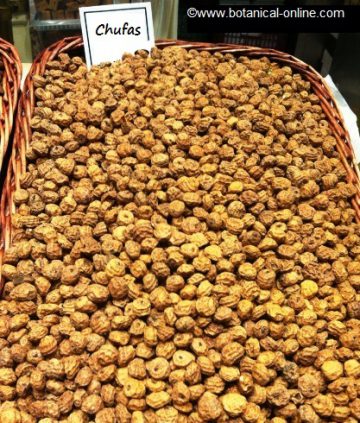
The taste of tiger nuts is similar to that of walnuts, but much sweeter.
Tiger nuts are used to make horchata de chufa (tiger nut milk), composed of tiger nuts, sugar, and water, similar to other vegetable drinks. Sometimes cinnamon or lemon is added.
*More information about Horchata de chufa in the list below.
In confectionery, the tubers are cooked in oat drink and a sweet and delicious dessert is achieved.
Sometimes tiger nut flour is prepared, which is used to make tiger nut bread.
- The tender shoots of the plant are used in salads.
- Coffee substitute: coffee substitutes are prepared from the roasted tuber. This beverage had some importance in the last century, although over time it was displaced by other alternatives, such as chicory coffee and coffee made from other roots.
- Oil: From the tuber, which contains up to 36% oil, oil can be extracted, of a quality similar to olive oil. This oil is used for cooking in Italy and Egypt, as well as for making soaps. It is also being studied as a potential source for biodiesel production.
- Animal feed: Fresh tubers are a feed for pigs and cattle. In particular, tiger nuts are used for such purpose in countries where they have become a pest of crops, such as Cuba and the USA.
- The leaves can be used to weave hats and blinds.
- In Egypt, ancient papyrus was made from a species of Cyperus (C. papyrus), a plant native to the banks of the Nile River.
- Fishing bait: In the UK, hydrated tubers, thoroughly cooked and fermented for 48 hours, are used as bait for carp fishing. These are a popular bait, although improper preparation or raw tubers can poison and kill fish.
- Other uses: It is being studied as a plant to absorb excess nutrients and toxic metals from the soil, in drainage systems or old mines, for example.
Composition of tiger nuts
- Carbohydrates: Mainly starch granules. In smaller amounts, simple carbohydrates (known as sugars), among which sucrose stands out, and traces of reducing sugars.
- Proteins: They contain arginine, aspartic acid, and glutamic acid. They are deficient in the amino acid valine, so it must be combined with high biological value proteins.
- Fats: They stand out for their high content of oleic acid (21% of total fat), palmitic acid (4%) and linoleic acid (3%).
- Fiber: Pectins
- Enzymes: Catalase, peroxidase, sucrase, amylase, lipase and phosphatase (Bustinza, 1928).
- Vitamins: Bitamin B1, vitamin E and vitamin C.
- Minerals: Good potassium intake, as well as calcium, phosphorus, magnesium, iron and zinc, mainly.
| Composition of tiger nuts in % of dry weight | |
Nutrient | Content |
| Carbohydrates | 30.5% |
| Sugars | 17.4% |
| Proteins | 5.1% |
| Fats | 25.5% |
| Fiber | 9.6% |
| Composition of tiger nuts per 100g of dry matter | |
Nutrient | Content |
| Potassium (mg.) | 655 |
| Calcium (mg.) | 250 |
| Phosphorus (mg.) | 240 |
| Magnesium (mg.) | 70 |
| Iron (mg.) | 5 |
| Zinc (mg.) | 2.5 |
Source: Peyró and Serra (1984) | |
Botanical classification
| Botanical classification | |
| Kingdom | Plantae – Plants |
| Subkingdom | Tracheobionta Vascular plants |
| Superdivision | Spermatophyta Seed plants |
| Division | Magnoliophyta or Angiosperms Flowering Plants |
| Class | Liliopsida or Monocotyledons |
| Order | Poales |
| Family | Cyperaceae or Sedges |
| Gender | Cyperus |
| Species | C. esculentus |
 More information about tiger nuts and horchata.