Contents
MEDICINAL PROPERTIES OF CABBAGE
INTERNAL USE PREPARATIONS WITH CABBAGE LEAVES AND JUICE
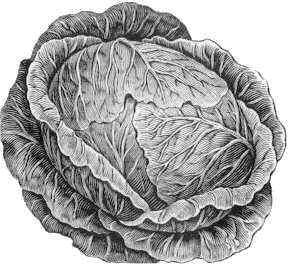
Illustration of a cabbage |
- Diuretic: It aids to eliminate the accumulated liquids in the body, reason why it is effective in diabetes, obesity, uric acid, arthritis, and diseases often associated to the retention of liquids.
In this sense it is related to other foods that fulfill the same assignment, like onion, or celery (Decoction of half an hour with a mixture of tender leaves of cabbage, tender onion and tender celery. Drink the broth at discretion several times a day)
- Stomach ulcer: Cabbage is anti- ulceric because of its glutamine content. Cabbage is one of the best natural antacid and some of the best remedies for healing gastrointestinal ulcers. (Crush some leaves or grind them in a blender and drink ten tablespoons a day of fresh cabbage juice, divided in 4 or 5 times. It can be sweetened to make it more enjoyable)
- Anti-diarrheic: In cases of diarrhea it is suggested to take some cups of the preparation mentioned below.
- Bronchitis: It is anti-bronchial. In order to alleviate bronchitis make a decoction of a cabbage leaf in glass of milk during 15 minutes. Take distributed throughout the meals of the day) the same decoction is useful in influenza, common cold,etc. (4 tablespoons daily of cabbage juice produced by pressing the plant)
- Hoarseness: Like onion juice, tender cabbage juice can be used to combat hoarseness, making the voice more clear and pleasant. (Drink half a glass of cabbage juice with a teaspoon of honey before breakfast).
- Diverticulitis and diverticulosis: Cabbage is rich in arginine (essential in the repair of tissue and muscle), with anti-inflammatory and antacid properties. It has a high content of vitamin C. All this may help prevent infection of the diverticula or lower for infection and inflammation. (100 g of mashed cabbage and drink by mixing the juice with water) (Cabbage juice can be mixed with carrot juice to increase its healing power)
- Hyperthyroidism: It has caffeic and chlorogenic acids, which give it anti-thyroidal properties. The juice squeezed from the plant can help reduce thyroid hormone production. (Squeeze a couple of cabbage leaves and take the juice mixed with a few tablespoons of lemon juice)
- Osteoporosis: for its boron content, it prevents the loss of estrogen that helps set the calcium in bones.
- Anti-cancer: Because of the presence of antioxidants components, it protect the digestive system from cancer. The protective role of these vegetables against cancer is due to its content of sulfur compounds (glucosinolates), which are responsible for the strong odor and pungent taste of these vegetables.
The body breaks down into indole glucosinolates (isothiocyanates). Indoles are involved in the regulation of estrogen and help prevent breast cancer. Scientific studies show that eating cruciferous vegetables frequently protects against various cancers, including lung, stomach, colon, rectum and prostate.
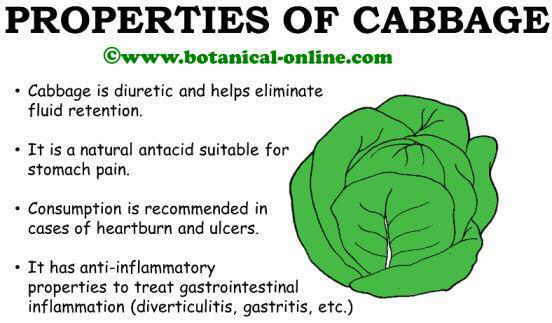
Summary of the main benefits of cabbage.
EXTERNAL USE PREPARATIONS WITH CABBAGE LEAVES AND JUICE
- Emollient: For the affections of the skin; pimples, pustules, blisters, burns, sunburns, cabbage exerts a recovering effect on the skin, specially when it is mixed with just a little bit of olive oil (crush the fresh leaves and apply them in form of plaster on the affected zone of the skin). It can be considered an alternative method to get rid of acne scarring.
- Anti-inflammatory: Cabbage has anti-inflammatory properties. Applied externally it can relieve pain, such as osteoarthritis, joint pain, sciatica, etc (Heat a cabbage leaf and apply it on the painful joint)
The external use of cabbage leaves relieves the pain in the breasts when it responds to inflammation by breastfeeding. (Crush a cabbage leaf without midrib and apply it over the painful area)
- Warts: (Apply the cabbage juice to the wart.)
- Hematomas: (Poultice made with leaves of raw grated cabbage)
 More information about cabbage.