Contents
- 1 Health benefits of laurel (Laurus nobilis L.)
- 1.1 MEDICINAL PROPERTIES OF SWEET BAY
- 1.2 INTERNAL USE PREPARATIONS WITH SWEET BAY LEAVES
- 1.3 Infusions of dry bay leaves are very suitable for the digestive system
- 1.4 Sweet bay for respiratory diseases
- 1.5 Sweet bay for circulatory problems
- 1.6 Other curative properties of sweet bay
- 1.7 EXTERNAL USES OF SWEET BAY ESSENTIAL OIL AND OTHER PREPARATIONS
- 1.8 How to apply sweet bay remedies on the skin?
- 1.9 OTHER USES OF SWEET BAY ESSENTIAL OIL
- 1.10 Cosmetic and curative uses of sweet bay
- 1.11 EDIBLE USES OF SWEET BAY
- 1.12 Sweet bay as a spice
- 1.13 How to use sweet bay leaves a a spice?
- 1.14 Nutritional composition of sweet bay leaves
- 1.15 Symbolic uses of sweet bay
- 1.16 Veterinary uses of sweet bay
- 1.17 Is sweet bay a safe plant?
Health benefits of laurel (Laurus nobilis L.)
MEDICINAL PROPERTIES OF SWEET BAY
INTERNAL USE PREPARATIONS WITH SWEET BAY LEAVES
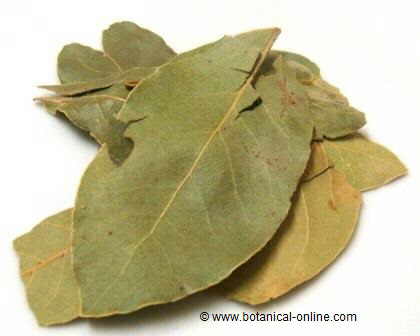
Dry sweet bay leaves
Infusions of dry bay leaves are very suitable for the digestive system
Sweet bay has digestive tract stimulant, antispasmodic, hepatic and carminative properties.
It increases secretions and favours peristalsis, contributing to digestion, helping the stomach and liver and preventing, flatulence, aerophagia, gastritis, heartburn, hiatal hernia and intestinal spasms.
Eugenol is fundamental because of its carminative, antiulcerous and hepatoprotective properties. (Infusion of a couple of leaves in a cup of water for 10 minutes. Take 4 cups a day).
Sweet bay for respiratory diseases
Sweet bay has expectorant, bronchial and anti-flu properties.
In case of respiratory diseases it offers a beneficial effect against flu, bronchitis, cough and respiratory tract illnesses in general (pharyngitis, laryngitis, etc.)
Cineol, present in essential oil, plays an important role considering its antibacterial, antitussive and antibronchitic properties.
But, besides cineol, there are many other components working in the same sense, such as acetic acid, alpha-pinene and camphene.
(The same infusion seen above can be suitable for this purpose) ( You can also take 4 drops of essential oil tree times a day)
Sweet bay for circulatory problems
Sweet bay has antiarteriosclerotic effects.
Linoleic, oleic and lauric acids bestow it circulatory properties for the treatment of arteriosclerosis and the improvement of blood circulation.
This can be useful for the treatment of vascular problems related with a bad peripheral blood flow, such as chilblains
(The previous treatments are appropriate)
Other curative properties of sweet bay
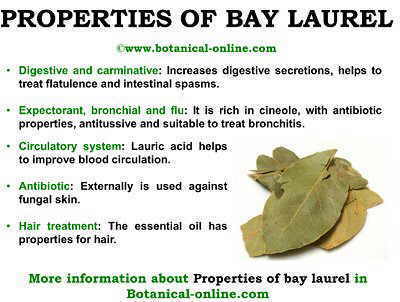
Main curative properties of sweet bay
- Antirheumatic: It helps to fight rheumatic diseases, alleviating pain and relieving inflammation of affected joints (4 drops of essential oil 3 times a day)
- Diuretic: It favours liquid elimination of the body, being very interesting, not only for obesity treatment, but also in all those maladies which improve when water is drained from the body together with toxins, such as, cellulite, uric acid, gout, arthritis, rheumatism, etc. (Infusion of two leaves in a cup of water for 10 minutes, Take 4 cups a day)
- Amenorrhea: Useful for amenorrhea or lack of temporary menstruation (Infusion of a teaspoon of dry leaves crumbled by water cup. Take during 7 days before the menstruation 2 cups every day)
EXTERNAL USES OF SWEET BAY ESSENTIAL OIL AND OTHER PREPARATIONS
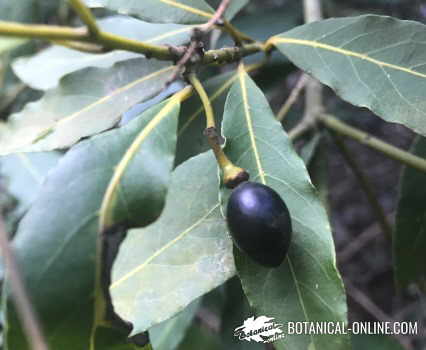
Black bay of laurel. Laurel bays can be used to make remedies for skin diseases
- Antirheumatic: Sweet bay helps to diminish rheumatic pain in illnesses like arthritis by applying the anti-inflammatory properties of alpha-pinene and beta- pinene on the affected articulation. (Ointment of essential oil, extracted from the fruits)
- Skin: It is suitable for the external treatment of skin illnesses caused by fungi – acetic acid has fungicide properties- besides lumps, ulcers, burns, acne, etc. The same treatment can be useful for eczema.
Applied on the skin lesions, it exerts bacteriostatic and renewing functions on the epidermis. So, it avoids lesions to become infections and favors healing.
How to apply sweet bay remedies on the skin?
- Macerate during 15 days a handful of berries in 250 gr. of olive oil.
- Filter it and apply with a bandage the resulting liquid on the affected part of the skin
or:
- Pour some dry leaves into the water of the bath, some minutes before taking it
OTHER USES OF SWEET BAY ESSENTIAL OIL
Cosmetic and curative uses of sweet bay
- Essential oil of sweet bay to make perfumes: considering its flavour richness, the essential oil of sweet bay is present in the composition of many perfume industry products, which elaborates creams and lotions with it, not only because of flavorous qualities but its beneficial properties for skin, too.
- Essential oil of sweet bay for hair treatment: It seems that it exerts a regenerating effect on scalp, together with a big efficiency to fight dandruff, dry hair and seborrhea and some other disturbances related with hair fall. So, it can help preventing baldness or delaying it.
(Massages with the essential oil on the scalp before going to bed and in the morning may be advantageous)
EDIBLE USES OF SWEET BAY
Sweet bay as a spice
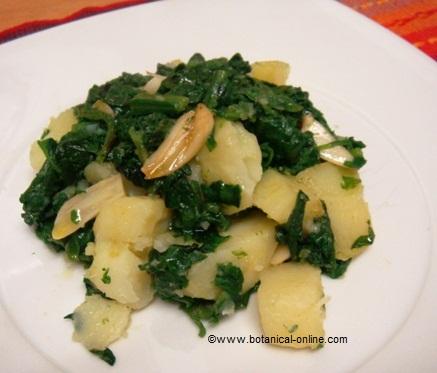 Spinach with boiled potatoes. Garlic and laurel were added to spice it
Sweet bay has been used as a spice in cookery to flavour diverse dishes, such as meat, soups, etc.
Also in racy preparations by the side of little onions and peppers.
How to use sweet bay leaves a a spice?
The whole leave can be placed inside the stew or smash it to powder the meal.
Do not serve the leave to the guest, since it can cut his mouth easily.
Nutritional composition of sweet bay leaves
The food composition of sweet bay for every 100 gr. is the following:
| Composition of bay leaves per 100g | |
| Water | 5.5gr. |
| Calories | 313 kcal |
| Lipids | 8.3 gr. |
| Carbohydrates | 74.97 gr. |
| Fiber | 26.3 gr. |
| Calcium | 834 mg. |
| Potassium | 529 mg. |
| Magnesium | 120 mg. |
| Phosphorus | 113 mg. |
| Vitamin C | 46.5 mg. |
| Niacin | 2000 mg. |
| Vitamin B-6 | 1000 mg. |
| Folic acid | 180 mcg. |
= High content
Symbolic uses of sweet bay
Traditionally it is a plant that has symbolised victory.
It was used by The Greeks and Romans to make crowns with which winners were rewarded, either in games or in the battle field.
It is a symbol which generally glittered in the heads of poets and emperors.
It was supposed this tree could never be reached by lightenings. This is the reason why many Roman people place some branches in their houses. They generally took then in their hands during thunderstorms so as not to be caught by a lightening.
Veterinary uses of sweet bay
Traditionally a paste has been elaborated from its fruits in order to fight parasites.
Is sweet bay a safe plant?
It is not very appropriate to take large doses of this plant, since it can result harmful to people with frail stomachs, to whom it may produce vomiting by overstimulation of digestive tract.
Being in contact with the skin, it can also produce foto-sensibility – adverse dermatologic reactions derived from big light exposures – in people allergic to this plant, who should refrain from taking this plant even when cooked.
 More information on sweet bay.