Contents
Health benefits of willow (Salix alba L.)
Characteristics of willow
Common noun: White willow, Golden willow
Scientific noun: Salix alba L.
Family. Willow family – Salicaceae
Habitat: By the side of the rivers, channels and woods of humid climate.
Description of willow
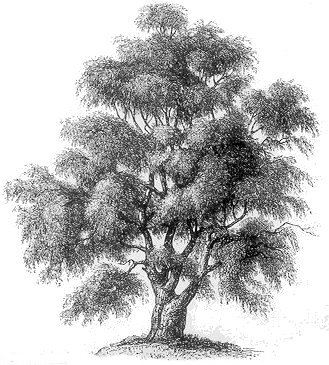
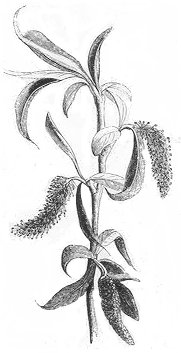
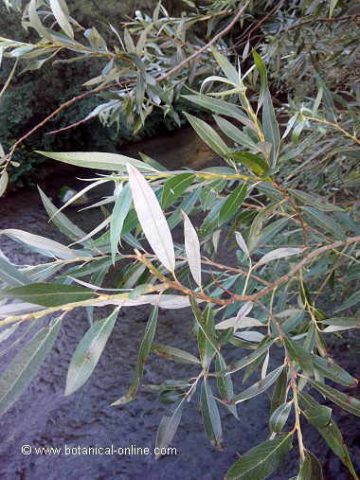
Perennial tree of the Willow family – salicaceae up to 25m. Erect stems, dark grayish. Young branches silky. Grey silvery leaves, serrate, till 10 cm long, covered with soft hairs on both sides. Flowers in catkins; male ones, cylindrical, yellow till 8 cm; female ones, till 6 cm, green at the beginning but becoming white when full of seeds.
WHITE WILLOW (Salix alba L.)
Picking-up and storing willow
Either the bark, the leaves or the flowers will be picked up in spring. The first one should be dried in the sun and the rest in the shade. its bark should be obtained from branches a couple of years old and they can only become powdered before being used.
Components of willow
- Fenolic glycosides: Salicin is the most important with many properties such as analgesic, anti inflammatory, sedative, antirheumatic, antipyretic, anti gout and digestive. Some other glycosides are vimalin, triandin, fragilin, saligeni, etc.
- Catechin tanninsod (bark)
- Estrogens
- Rutin (bark)
- Fiber ( bark): Lignin (wood)
- Tannins
- Acids: ascorbic (bark), salicylic (leaves) and p-coumaric (plant)
- Minerals: Potassium, phosphorus, calcium, iron, cobalt, aluminium, magnesium (bark)
- Vitamin B1, vitamin B2 (bark)
MEDICINAL PROPERTIES OF WILLOW
INTERNAL USE REMEDIES WITH WILLOW
- Pain: The Greek physician Hypocrates prescribed remedies with willow leaves to alleviate problems related with pain. Many old cultures have used the leaves of plants that contain salicin for this purpose.
Willows have been used and are being used like an alternative to the aspirin (acetylsalicylic acid) in fact the aspirin was extracted initially from this plant, besides the meadowsweet (Filipendula ulmaria), the gaultheria (Gaultheria sp.), poplars (Populus sp.) and some species of birches (Betula sp.) before it could be synthesized chemically in the year 1890.
Its content in salicin becomes salicylic acid in the organism inhibiting the prostaglandins and reducing the pain sensation, specially if we consider that, besides being analgesic it also presents anti inflammatory properties.
Therefore, it can be used to palliate the pain in all type of manifestations: headache, neck pain, muscular distensions and pains, muscular atrophy, fibromyalgia, sciatica, earaches, rheumatic pains, pains in the menstruation, etc.
The treatments carried out with this plant should be prolonged during some time so that they can have their effect, fsince it doesn’t act as quick as the aspirin, although it really becomes a natural treatment to the use of this product.
White willow and aspirin
It has been said that it presents less contraindications than aspirin, although those that can not use aspirin should not take this plant. Any treatment should be started with very low doses to check the tolerance of the organism to this product, since the proportion of salicylic acid present in the bark of the willows depends on many climatological and seasonal factors.
The dose for the adults is stablished between the 100 and the 250 mg taken in 4 or 6 intakes a day. Children from 4 until 10 should not overcome 60 mg daily, the highest doses being used in rheumatic or muscular pains, and, mainly, with the unbearable pains of gout, arthritis or osteoarthritis
(Decoction of 40 gr. of the dry bark in a liter of water. Drink three glasses a day before the meals. (In many herbalists you can get powder of white sallow. A decoction during 5 minutes in a liter of water can be done to drink it in three takings a day) (20 g a day, as maximum, of fluid extract distributed in 3 or 4 daily takings) (Infusion of 20 g of young leaves in a liter of water. Drink three cups a day)
A similar treatment is used for earache, tendinitis, bursitis, backache, dislocations (Decoction of a pinch – 2 g – of dry bark per cup of water. Take two or three cups a day.)
- Fever: Besides the analgesic properties, salicin also presents antipyretic properties that is to say it helps to diminish fever, in such a way that, until the appearance of the aspirin, it was habitually used and it is still being used in some places as substitute of the chinchona (Cinchona pubescens) whose alkaloid quinine has been a resource to combat malaria and other fevers.
- The substitution of this tree for the willow supposes a cheaper form of treatment. Therefore, we can use this tree in all the feverish manifestations, especially in flu and cold. (Anyone of the previous treatments can be suitable in this case)
- – Circulatory system diseases: Willow presents anticoagulant properties so that it impedes the thrombus formation or blood clots inside the arteries or the veins because of the accumulation of blood platelets. The use of this it plants makes blood more fluid and helps our body to avoid the appearance of certain cardiovascular illnesses, such as brain haemorrhages, arteriosclerosis, angina pectoris, heart attacks or bad circulation in general (Infusion of a small spoonful of bark for a glass of water. Drink a glass every two days)
- Tranquilizer: It can be used as a remedy to combat edginess in situations that prevent us to sleep well or when we feel nervous. The use of the floral catkins can help us to calm the nerves and to sleep better. (Infusion of a small spoonful of dry flowers for a cup of water. Drink two cups a day, one before going to the bed) (Infusion of a spoonful of dry leaves for a cup of water. Two cups a day, one before going to bed
- Its flowers or its leaves can be used to combat the excessive desire in the man or in the woman. So, anyone of the previous preparations will be suitable in those situations when the woman believes to posess an exaggerated desire. It can also be used to combat painful menstruations (dysmenorrhea)
- Digestive tract: Because of its wealth in tannins, the willow is a good astringent, reason why we can use it internally to solve stomach problems caused by the acidity or in diarrhea cases. (Decoction of 20 gr. of bark for a liter of water during ¼ of hour. 3 cups a day) on the other hand, the great content of the bark in tannins, which can reach in some cases to 20%, supposes a risk for the health in a prolongued treatment or with high doses of the drug.
- Acne: Being a good astringent it can reduce grease production on the skin. (3% decoction of the bark, for a quarter on an hour. Take three cups per day)
EXTERNAL USE WILLOW PREPARATIONS
White willow bark tea
- Skin: Used externally we can take advantage of its astringent properties to cure wounds or burnings, improving scaring and impeding them to be infected. (Decoction of 50 gr. of dry bark for a liter of water during 15 minutes. Wash the affected area with the resulting liquid)
- Corns (Calluses), warts and bunions: The external application of a humid bark piece on the corns warts or bunions can eliminate these affections of the skin (Place the the humid part on the affected area. Hold it with a plaster and change it every day. Keep the treatment during one week
- Buccal treatment: The same previous preparation can be used for the inflammations of the mouth caused by infections, in affections like inflammations of the gums, dental problems, wounds in the mouth, tooth decay, etc. (Decoction of 50 gr. of dry bark for a liter of water during 15 minutes. Carry out mouthwashes with the resulting liquid)
- Respiratory system: Equally we can use its analgesic and anti-inflammatory properties to treat the infections of the throat, in illnesses so well-known as sore throat or pharyngitis (Decoction of 50 gr. of dry bark for a liter of water during 15 minutes. Carry out gargles with the resulting liquid)
- Female genital apparatus: A decoction of 60 gr. of the dry bark in a liter of water can be used to carry out irrigations to fight vaginism or painful intercourse that takes place in the woman during penetration.
Other uses of willow
Its wood is strong although flexible and very light. It has been used to make cricket bats, matches and carving. In the rural areas it is used for the construction of poles and to light the fire. The searchers of water use a willow branch in fork form to find the valuable liquid.
Toxicity of willow
People that present allergy to the aspirin or medications with the same principle (acetylsalicylic acid) should not use this plant. Neither those that present adverse stomach reactions to its use, manifested mainly in form of gastric acidity.
In the same way, those that have antecedents of gastric ulcer, intestinal hemorrhage, hemophilia, problems of blood clotting, asthma, hepatic or renal problems and colitis.
The administration of this plant in children with illnesses of viral type, as colds or flu, can develop the syndrome of Reye, an illness that generally affects the children between 4 and 12, with serious results in the liver and in the brain, which is attributed to the use of the aspirin when they have the flu or the chicken pox.
It should not be taken in combination with other anticoagulant or antiinflammatory medications, during pregnancy or in those people that present whistlings or noises in the ears (tinnitus) or hearing loss.
Other species of willow
Similar properties are present in other species of willows, among those we could mention:
- Purple willow (Salix purpurea)
- Silky osier (Salix viminalis)
- Goat willow (Salix caprea)
- Black willow (Salix nigricans)
- Salix pentantra
- Grey willow (Salix cinerea)
- Salix trianda
 More information about medicinal plants.