Contents
MEDICINAL PROPERTIES OF GINGER
Internal use of Ginger
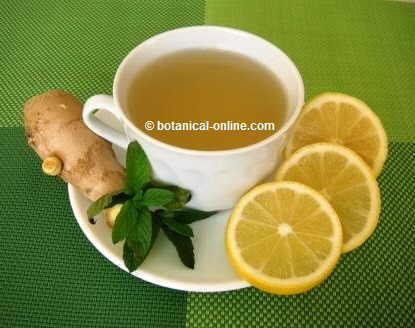 Digestive infusion with ginger, mint and lemon Digestive infusion with ginger, mint and lemon |
– Digestive tract diseases: Traditionally ginger has been used to treat intestinal affections, especially related with digestive problems. It seems that, by stimulating the pancreas, it increases the production of enzymes which favours digestion and avoids the appearance of a series of secondary effects related with a bad absorption of food.
Equally its antibacterial power is effective against preventing numerous intestinal problems that take place as a result of the alteration of the intestinal flora.
- Ideal antiemetic remedy : It has been demonstrated that the ingestion of ginger is one of the best remedies to combat nausea in many ways:
- Dizziness when travelling: A couple of pills or tablets some 3 hours before beginning a trip in a ship, a bus, a car, a train or an airplane can prevent the sickness that takes place because of movement (Kinetosis).For long trips, some specialists recommend to take them a pill an hour before starting the trip and another one some hours before when you begin to get dizzy. An infusion with half a spoonful of grated root can be prepared and drunk before the trip. There are some bags of this root available in pharmacies or herbalists than can be very useful. Another possibility is to eat the root fresh, blended with other fruits and crushed with a blender. In this case a couple of centimeters of the root would combine very well with apples or pears.
- Vomits taken place by the chemotherapy treatment: To ingest the ginger with other foods can be a good way to reduce the vomits that the chemotherapy treatments cause in patients with cancer. In this case one should not eat up ginger with the stomach empty. (Because of its anticoagulant properties one should consult the doctor about the convenience of its use)
- Vomits in the pregnancy: Equally the ingestion of ginger seems to reduce nausea or vomits that take place in the first months of pregnancy. (Infusion of half a spoonful of dry root for a cup of water. Take a couple of cups a day) (Do not prolong the treatment more than two months. Consult the doctor about the convenience of this treatment)
- Postoperative vomits: Ginger seems to reduce the negative effects that accompany medications used in surgery, especially the need for vomiting. This remedy must be taken one day before an operation takes place on the condition that it has been consulted consulted and approved by the doctor.
- Ulcers: Its antibacterial power is ideal to avoid the formation of ulcers by eliminating the Helicobacter pylori, a bacteria whose secretions of ammonia are responsible for many ulcers, especially those of duodene, and for other stomach problems like gastritis. On the other hand it is a plant able to neutralize the excess of gastric acid that is another of the causes that favors the formation of ulcers.
- Diarrhea: It is its capacity to eliminate harmful bacteria, as the Escherichia coli, responsible for most of the diarrhea, especially in children, and its tolerance to respect the necessary microorganisms in the intestine (Lactobacillus) which allows it to enrich gut flora. By eliminating this bacteria and other harmful parasite microorganisms, it is able to avoid the appearance of intestinal rots responsible for abdominal swellings and flatulence. It is also necessary to mention the capacity of gingerols in this plant to increase the intestinal peristaltism favoring the expulsion of the excrement. (Take any treatment of those previously mentioned)
- Liver diseases: with antioxidant properties, it stimulates bile and protects the liver by helping it not to develop cancerous tumors. Useful for hepatitis. (Add ginger to foods)
Ginger for circulatory diseases
Ginger constitutes a good resource for some circulatory diseases because it favours blood circulation. It helps to dissolve blood clots in the arteries and diminish the levels of cholesterol in blood. By making blood more fluid it helps to prevent a series of vascular accidents as:
- Illnesses of the heart: Its use prevents heart attacks, angina pectoris or thrombosis. It can constitute a natural alternative to conventional treatments. (Eat it together with other foods, especially with onion and garlic) (Take 3 capsules of 250 mg a day, distributed among the main meals)
- Circulatory illnesses in the extremities: It favors a good circulation in the extremities helping or preventing circulatory problems in the extremities as arteriosclerosis or intermittent claudication that causes a lot of pain in the legs or the negative symptoms that take place in the fingers of the hand in Raynaud’s disease (The same treatment previously seen)
- Frostbite: Ginger increases circulation to the periphery thus it helps recovery the areas affected by frostbite. Additionally, ginger has anti-inflammatory and analgesic properties so that it can help reduce inflammation and pain that accompanies acute injuries from frostbite. (Eat it with other foods) (Take 3 capsules of 250 mg daily, divided between meals)
– Respiratory diseases: Ginger constitutes a valuable ally for respiratory tract since it helps to prevent some of the illnesses that affect it:
- Against the symptoms of flu or swine flu: Very useful to diminish the nasal congestion and to alleviate the pains that take place in the articulations as a consequence of an accumulation of toxins taken place by the microorganisms of flu. (Infusion of a spoonful of dry root in a glass of water. Drink a couple of glasses a day. Add the juice of half a lemon to increase its value.)
- Cold: This same infusion previously seen can be good in the event of cold to eliminate the congestion that take place in the chest as a consequence of the accumulation of mucosity. Lemon and ginger, served very hot, will help to expectorate a loaded chest, especially if we add them a good spoonful of honey. (*See: Ginger for cold and congestion)
- Sore throat: Gargles with the infusion of spoonful of fresh root in a glass of water. You can add honey or lemon to improve its taste. After gargling, swallow it.
- Sinusitis or laryngitis: Equally it can be used to reduce the nose congested by sinusitis or in case of laryngitis (Use the previous remedy). Apart from gargles you can add some lavender flowers of cinnamon to the infusion and sniff it.
*Related information: How to prepare ginger honey
Ginger for diseases
 Depression: (Eat fresh ginger with meals or take 3 capsules of ginger powder per day divided into 3 doses. On sale in pharmacies and health shops) Also suitable for postpartum depression.
- Alcoholism: With antioxidant properties, it stimulates bile and protects the liver by preventing the development of cancerous tumors. Add ginger to foods.
- Multiple sclerosis: The anti-inflammatory and stimulant properties of this plant, which could help reduce the inflammatory effects on myelin and help increase the vigor of patients with multiple sclerosis, who are often affected by constant fatigue. (Infusion of one teaspoon of dried plant per cup of water. Take one cup a day. You can eat fresh if you cut into very fine pieces)
- Fibromyalgia: Ginger is one of the best anti-inflammatory and analgesic remedies. Its ingestion reduces the pain of fibromyalgia (Swallow a couple of teaspoons of ginger powder spread over a toast twice a day. About 10 g)
- Fever: This plant has antiviral and antibacterial properties that help eliminate the infection and symptoms of many diseases such as influenza, cold, reducing pain and fever. (Infusion of a teaspoon of dried root per cup of water. Take a couple of glasses a day. Add the juice of half a lemon to enhance its value.)
 Depression: (Eat fresh ginger with meals or take 3 capsules of ginger powder per day divided into 3 doses. On sale in pharmacies and health shops) Also suitable for postpartum depression.
External use of Ginger
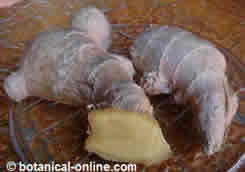
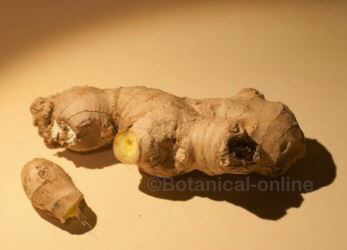 Ginger Ginger |
– Treatment of the pain: The analgesic and anti-inflammatory values of ginger can be used externally to mitigate pain and swelling produced in:
- Arthritis and osteoarthritis: To deflate the articulations of the arthritic patients and mitigate the pain. (Infusion of a handful of root of ginger in a litter of water. Wet a compress and apply it very hot during 15 or 20 minutes on the articulations. Repeat the treatment every 6 hours) (Rub the aching area with oil of blended ginger with oil of almonds) (See: Ginger for arthritis)
- Toothache: The resulting liquid of the previous infusion can be used to carry out compresses that are applied externally on the jaw to alleviate the pain. Equally to chew a slice of ginger can be a simple way to alleviate toothache.
- Bad breath: A very well-known oriental technique consists on using a small piece of ginger pickled with vinegar to remove bad breath and to refresh the mouth after the meals.
- Sjogren’s syndrome: In addition to increase saliva production, it protects and refreshes bad breath mouth. (mouthwashes with the infusion of one teaspoon of dried root per cup of water) (Drink the liquid)
- Chronic fatigue syndrome: Glycyrrhizin of this plant has hypertensive properties which may be indicated to increase blood pressure and lift the spirits of patients with chronic fatigue syndrome or other types of fatigue. On the other hand, we must not forget the antidepressant properties of this plant that can be used to treat depressive symptoms that many patients develop with this disease. (Infusion of half a teaspoon of crushed dried root per cup of water. Take 2 cups a day.) (See toxicity of the plant in the full study of this plant)
Dosage of Ginger
– The maximum dose of powdered ginger is 2 gr. daily.
– The maximum dose of essential oil is 9 daily drops distributed in 3 takings.
– The maximum dose of dry extract is 400 mg daily, distributed in 3 takings
*More information on Ginger remedies
VIDEO OF GINGER HOME REMEDIES
Other uses of Ginger
The common ginger is broadly used in the kitchen a a spice. It presents different forms that go from their fresh variety to the caramelized one.
Some other varieties are the dry one and the powdered. It’s got a strong and piercing flavor, lightly sweet. It provides a very original touch to the foods to those it adds its medicinal properties.
 More information about ginger.