Contents
- 1 How to grow chard
- 1.1 Chard cultivation guide
- 1.2 Characteristics of chard plant
- 1.3 Chard, beetroots or sugar beets, diffents variants of the same species
- 1.4 What is chard used for?
- 1.5 Chard. Irrigation and moisture.
- 1.6 Chard. Temperature and exposure
- 1.7 Chard. Time for planting and cultivation.
- 1.8 Varieties or types of chard
- 1.9 Chard curly leaf varieties
- 1.10 Chard smooth leaf varieties:
- 1.11 How to plant and maintain chard?
- 1.12 When and how to harvest chard?
- 1.13 How to store the chard leaves?
- 1.14 Chard. Types of soil, fertilizer and labor tasks
- 1.15 Main chard maintenance tasks
- 1.16 Chard major mineral deficiencies
How to grow chard
Chard cultivation guide
 Characteristics of chard plant
 Characteristics of chard plant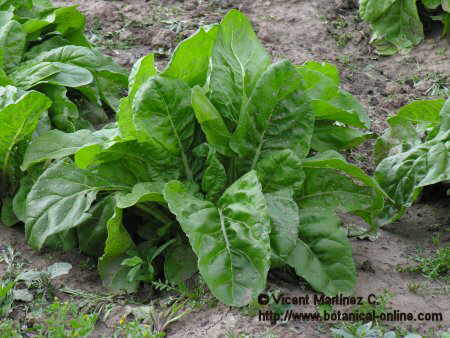
Chard (Beta vulgaris var. Cicla) is a perennial plant of the Chenopodiaceae family (some classifications include it in the family Amaranthaceae).
Large leaves gathered in the rosette-shaped base, glossy dark green, although there are colored varieties. The succulent stems are thick and enlarged .
Chard is a biennial plant grown as an annual because the leaves are collected in the first year of its life, when the plant devotes its energies to the production of leaves. If left to mature, it produces a central stem in the top and grows flowers, 3 to 5 mm in diameter, grouped in a terminal spike.
The green color of the flowers blends with the rest of the plant. It is during its second year when the plant ceases to invest resources in the leaves that are dry and devotes its energies to the production of flowers, fruits (shaped as “nutlets”), and roots which expand by accumulating energy if well never reach the size of beets.
Chard, beetroots or sugar beets, diffents variants of the same species
There are three interesting varieties of Beta vulgaris from the point of view of cultivation:
- Beta vulgaris var. cicla (chard)
- Beta vulgaris var. vulgaris (beetroot) , intended primarily for the cultivation of the root
- Beta vulgaris var. altissima (sugar beet) which is used for sugar production.
It is believed that all these varieties come of the species Beta vulgaris subsp. maritima, an edible wild plant that can be found on the coasts of Europe, northern Africa and western Asia (Caucasus and Middle East)
What is chard used for?
Although most of chard is mainly grown for consumption of its leaves, many people feel that it is also decorative and garden plants can be used to form borders, especially the varieties with colored leaves.
Chard. Irrigation and moisture.
 Chard. Irrigation and moisture.
Chard is a plant that needs high humidity, especially when plants are young during this period should not ever dry land. With older plants can withstand drought but relatively always prefer to have soil moisture.
In summer, plants need even higher humidity. Lack of water will produce specimens with bitter leaves.
Although chard prefers generous watering, the ground should not be flooded as this could produce many diseases.
* Related information: Chard pests and diseases
Chard. Temperature and exposure
 Chard. Temperature and exposure
The chard prefers mild climates but can live in any climate, if it not falls below -5 º C or is higher than 33 º C. The ideal temperature for production is between 15 and 18 º C, although they grow in places with climates between -1 º C and 33 º C. The production is highest when the weather is cool, but it can hold and produce on locations or hot climates.
In places with hot springs or summers, the greens tend to shoot into ears and produce and flowers more than in soft climate places, especially when heat is accompanied by a lack of water. In these places, if you prefer it to produce tender leaves, they should be planted in a cool location. A partial or semisolid diffuse light would be ideal for the plants not bloom in summer.
In tropical or subtropical climates it has to be placed on high ground. In these latitudes the greens behave as perennials.

Chard. Time for planting and cultivation.
We have two types of plantation:
- Summer Crops: If we want to have summer crops, we have to plant chard in the months between spring and summer (between the months of April to July). In this case, we can plant them directly in the field. The production of these plants will occur within seventy days after planting. Those that were planted in April and may be collected about late May or early June.
- Winter Crops: If we want a winter crop, plant chard later (Between October and March). The plants begin to produce after two months of being planted.
In hot climates they can be planted throughout the year, both for summer crops and winter crops. In cold weather, planting is done between the beginning of autumn and early spring.
Although chard takes about 60 to 70 days to develop, it can be collected earlier, when it reached 12 or 13 cm in length. In this case, although we will achieve a smaller production, it is extremely tender and can be eaten in salads.
Varieties or types of chard
There are many varieties of chard, mainly classified by leaf type according to whether that is smooth or curly and the size and color of the leaves. Among the main varieties could mention the following:
Chard curly leaf varieties
- Lucullus. It has white stalks and large leaves of pale green. Very productive and tasty variety.
- Rhubarb: Dark, red and glossy stalks with dark green leaves with reddish undersides.
- Yellow Lyon: It is the variety of chard most widely grown. This variety produces abundant leaves with white stalks and green yellow leaves.
- Brightlights: Named for the variety of colors of the leaves which can be red, yellow, white, orange, green or violet. It is very tasty and decorative in the garden as much as on the plate.
- Bright yellow: It has bright yellow leaves that are very prominent in the garden.
- Fordhook giant: light green leaves and yellow-green stalks. It grows quickly and adapts to many climates.
- Giant Crimson: glossy dark green leaves. Crimson stems. Especially valuable to eat, very tender.
Chard smooth leaf varieties:
- Bressane: It has dark green leaves and very wide stalks.
- Carde Blanche:French French variety with dark green leaves and white stalks.

How to plant and maintain chard?
Before planting the greens we have to prepare the ground properly. Chard need a well tilled, cleared, and loose soil in order to germinate.
Therefore, before planting, we would have worked in the field, shredding it and, after smoothing, we would have made the necessary furrows to plant seeds in them.
Chard planted in spring or summer can be placed directly in the field. For this, we should make furrows in the field and directly place the seed in them.
Chard prefers to be planted shallow so you can just enter a seed at each point, located between 1.3 and 1.8 cm deep and a dot pitch of about 22 to 30 cm. Furrows must be spaced from 40 to 50 cm.
If planting is done late, the seeds should be planted in a hot nursery. When plants are large enough to handle, they should be clarified by making a single point, because each seed planted usually occurs more than one plant. The clear lack of time, combined with a lack of moisture, may be responsible for flowering in the first season.
When the seedlings have developed four or five sheet, they should be transplanted to their final destination according to the conditions seen before.
When and how to harvest chard?
The leaves are harvested when they are old enough to eat, which usually occurs between 50 and 65 days after planting. Harvesting the greens when they are at their best, allows the highest quality and at the same time encourages the plant to produce new leaves.
If you pick the outer leaves before they become hard and yellow, the greens can go on producing young leaves up to one year. It is appropriate to perform this task, even if one does not need the plant as food, to encourage its growth.
For harvesting, just cut the outer leaves, which are the largest. Harvesting is done by hand using a sharp knife. We must be careful when cutting to avoid damaging the inner leaves.
In intensive plantations the entire plant is usually harvested when it has reached the size and weight for selling well. The leaves are cut in the same field and, after cleaning and arranging them in bundles of a dozen or two dozen, they are put into boxes and placed in the refrigerator ready for distribution in various markets.
How to store the chard leaves?
If you keep a constant temperature of 0 º C and a relative humidity of 90 to 95 º C, the greens can last from 10 to 14 days.

Chard. Types of soil, fertilizer and labor tasks
Chard develops quite well in all types of soil provided that they are very fertile, acidic and with proper drainage. They prefer soils which are alkaline in nature with pH between 5.5 and 8.
When preparing the ground it is important to provide organic fertilizer in the form of manure. The proper ratio would be about 2 to three kilos per square meter. This fertilizer should be mixed well with the soil and penetrate to a depth of 30 to 35 cm. Later, the younger plants might need an extra liquid fertilizer from time to time.
Main chard maintenance tasks
Among the maintenance tasks, we have to keep the soils free of weeds. These have to be removed manually. Weed removal will also allow ventilation and oxygenation of the soil.
If you want to skip this task, it is interesting to cover the soil with plastic mulch, straw or sand. Mulch will hold moisture and prevent herb growth.
Chard major mineral deficiencies
- Magnesium deficiency: It produces pale older leaves or redness in the young. Apply magnesium sulfate (20 g per liter) a couple of times every 15 days.
- Deficiency of manganese causes the leaf margins rolled inward. In the nerves appear yellow spots. The solution is to spray the leaves with manganese sulfate at the rate of 2.5 g per liter of water.
 More information on chard.