Contents
- 1 Properties of Brussels sprouts (Brassica oleracea var. Gemmifera)
- 1.1 Characteristics of Brussels sprouts
- 1.2 PROPERTIES OF BRUSSELS SPROUTS
- 1.3 Brussels sprouts to prevent cancer
- 1.4 Brussels sprouts are very detoxifying
- 1.5 Brussels sprouts, rich in vitamins and minerals
- 1.6 Brussels sprouts, very light and diuretic
- 1.7 NUTRITIONAL COMPOSITION OF BRUSSELS SPROUTS
- 1.8 People who should not eat brussels sprouts. Contraindications
Properties of Brussels sprouts (Brassica oleracea var. Gemmifera)
Characteristics of Brussels sprouts
Brussels sprouts or Brussels (Brassica oleracea var. Gemmifera) are varieties of cabbage belonging to the cabbage family –Brassicaceae– to which some other food plant belong, such as cabbage, cauliflower, kohlrabi, etc, or other important food crops such as radishes.
It appears as a cultivated plant in many places of the world during the winter season. Being a variety of cabbage, it is similar in its early stages to cabbage.
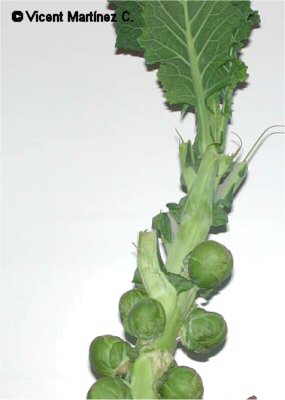
However, as it grows, it will differ from it by the appearance of a central stem that can grow to about 1 m high. All around it, we can find what is usually known as brussels sprouts, but they actually are a set of buds.
PROPERTIES OF BRUSSELS SPROUTS
Brussels sprouts to prevent cancer
The importance of cabbages in preventing the appearance of cancerous tumors has been proved. Of all the cabbages, brussels sprouts are the most appropriate ones to prevent cancer development in the digestive system.
It has been demonstrated that people who eat brussels sprouts usually have lower rates of cancer. This has been found in populations such as Norway, where people usually make use of this food.
The reason for this can be attributed to the presence of a series of anti-cancer elements, such as, carotenoids (see information on these components), chlorophyll and glucosinolates.
Brussels sprouts are very detoxifying
Among the latter the most important ones are glucoraphin which is converted into sulforaphane (a sulfurous component). Glucobrassicin is also converted into indole-3-carbino. Both of them are converted by the action of the enzyme myrosinase which acts when we chew this food.
They all are powerful stimulating detoxifying enzymes in the liver, neutralizing the cancerous power of many cancerous toxins, such as aflatoxins. This prevents the appearance of tumors in the colon, stomach and urinary bladder.
(More information on Cruciferae against cancer)
Brussels sprouts, rich in vitamins and minerals
They contain a lot of folic acid (Folate) which is very suitable for pregnancy, since this element is required for delivery to be carried forward normally. It is involved in the formation of bones. It is necessary for the formation of red blood cells, in combination with vitamin B12 (cobalamin), and cells of the body in general.
Recent studies have linked the ingestion of this component with a lower incidence of heart disease or cancer, especially colon cancer. The depression is quite connected with low rates of this element. Other properties are: anti-gout, because it facilitates the removal of uric acid through the urine (uricosuric) and inmunoestimulant, increasing natural defenses and protect against disease.
It has also been noted the importance of folic acid for a healthy nervous system. So eating brussels sprouts is recommended for a wide spectrum population: children who are growing up, seniors with calcium deficiency problems, students with great intellectual labor, gout, arthritic, nervous people, etc. A dish of this vegetable practically guarantees the daily needs of this element which is estimated at 200 mcg (micrograms).
They are quite rich in vitamin A which is very essential for good vision, leading to produce blindness when this vitamin deficiencies are very important. It also plays an important role in healthy skin and membranes of the respiratory system and bones growth. Without reaching the levels of spinach, Brussels sprouts can be another alternative to acquire this healthful vitamin.
They contain much vitamin C – more than oranges or lemons – although inferior to peppers or spinach. This vitamin is also important for the proper absorption of calcium, iron, or some amino acids. Similarly, it helps in healing wounds. Its deficiency causes a general weakness in the body, manifested in symptoms such as brittle hair, bleeding gums, wounds that will not heal, loss of appetite etc. It is especially interesting to eat this fruit in times of convalescence after an illness because it helps increase the defenses.
Brussels sprouts, very light and diuretic
They are a very suitable food for those who suffer water retention, so they should usually be eaten by obese or arthritic people or those seeking to reduce weight.
Its richness in potassium is involved in the removal of body fluids and other interesting processes such as bone calcification, proper functioning of the heart, nervous system or building muscle mass. Its fiber wealth can be used to prevent constipation.
In order not to spoil its medicinal properties, it is advised not to boil brussels sprouts for too long. Boiling them for 7 minutes will be enough. Longer boiling periods is also responsible for sinigrin liberation, a kind of component which is responsible for cabbages bad odor.
Related information: Diuretic plants, obesity
NUTRITIONAL COMPOSITION OF BRUSSELS SPROUTS
| Per 100g: | Brussels sprouts |
| Water (g.) | 86 |
| Calories (Kcal.) | 43 |
| Fat (g.) | 0, 3 |
| Protein (g.) | 3,38 |
| Carbohydrates (g.) | 8,96 |
| Fiber (g.) | 3,8 |
| Potassium (mg.) | 389 |
| Phosphorus (mg.) | 69 |
| Iron (mg.) | 1,4 |
| Sodium (mg.) | 25 |
| Magnesium (mg.) | 23 |
| Calcium (mg.) | 42 |
| Vitamin C (mg.) | 85 |
| Vitamin A (UI.) | 883 |
| Vitamin E (mg.) | 0,88 |
| Folic acid (mcg.) | 61 |
| Thiamin (mg.) | 0,14 |
| Riboflavin (mg.) | 0,09 |
| Niacin (mg.) | 0, 75 |
| Pantothenic acid (mg.) | 0, 09 |
| Pyridoxine (mg.) | 0,31 |
| Copper (mg.) | 0,07 |
| Zinc (mg.) | 0,42 |
| Manganese (mcg.) | 0,42 |
People who should not eat brussels sprouts. Contraindications
In spite of its beneficial properties, those people who have a tendency to suffer of problems of bad digestions or flatulence should reduce its ingestion.
 More information on Brussels sprouts.