Contents
Health benefits of onion (Allium cepa)
MEDICINAL PROPERTIES OF ONION
Internal use preparation with onions
- Circulation: The presence of allicin, although in less proportion than in garlic, gives this plant antithrombotic properties (avoids the formation of blood platelets) so, it becomes very interesting to make blood fluid, which prevents much of the following circulatory diseases: arteriosclerosis, cholesterol, hypertension, angina pectoris, heart attack and some other ones related with a bad blood flow such haemorrhoids or hearing loss (Macerate 300 gr. of onion with a litre of water during 12 hours. Drink 3 glasses a day.)
- Diuretic: It favours the removal of body liquids, being very suitable in case of obesity, rheumatism, gout, arthritis, dropsy, diabetes, edemas, swollen eyes, and bladder (3 little cups a day of the maceration of 50 gr. of smashed onion in a litre of wine)
Its diuretic properties gives it power to get rid of body toxins, something that is very useful to treat some anomalies as urticaria.
In case of cellulite, you can eat raw onions or make a medicinal wine (150 g grind onion and mixed with 600 ml of dry white wine and 75 g of honey. Take 4 tablespoons daily )
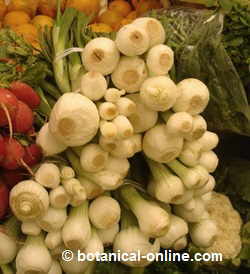
- Natural antibiotic: Because of its highly sulphurous contents, it becomes together with garlic, in one of the best natural remedies to fight infectious processes of respiratory tract (common cold, influenza, bronchitis, sinusitis, pharyngitis, etc..) digestive tract diseases (intestine decomposition, diarrhea, etc…)
(Onion syrup : Decoction for one hour of the same quantity of onion and water. 1/5 of honey and ⅓ of sugar is added to the previous resulting preparation. Stir it well till it attains a good consistency and drink three cups a day (Inhalation of onion in boiling water) Used externally, it is considered a good disinfectant.
Being one of best natural antibiotics, the habitual ingestion of onion can prevent the bacterial infections or many inflammations of the excretory system (cystitis, nephritis, etc) It can be useful in the treatment of gonorrhea.
For hoarseness treatment onion juice mixed with equal parts honey clears voice. (Drink 3 tablespoons of onion juice daily mixed with the same amount of honey)
- Digestive: It helps digestion by stimulating the liver, the bladder and pancreas, although it should be avoided when having hyperchlorhydria stomach acidity) as well as in fragile stomachs. Because of its content in quercetin, it helps to reduce inflammation in those people affected by celiac disease. (Decoction of an onion skin in a liter of water. Drink the water that throughout the day)
- Hay fever: It helps you breathe better by means of decongesting your nose (maceration of a peeled onion for a couple of minutes in water. Drink the liquid)
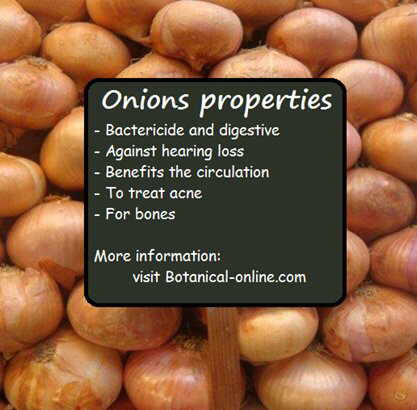
Main curative properties of onions
Last studies about onion medicinal properties
- Anti-cancer: Recent studies attempt to associate the consumption of onion with cancer inhibition. Among the sulphurous products, diallyl disulfide seems to be responsible ft the inhibition of cancerous cells in stomach. Flavonoid quercetin, because of its antioxidant properties, seems to play the same role in this sense.
- Osteoporosis: Studies accomplished in mice, seem to prove, according to some investigations performed in Switzerland, that the daily intake of this food favours the bone tissue growing, diminishing the risk of osteoporosis in a 20 %.
- Stimulant: Read more.
External use preparation with onions
- Insect stings: Its bactericide properties make it a good disinfectant against animal bites of stings, specially those of insects. (Soak the affected zone with the liquid of a fresh smashed onion)
- Warts: Warts can be eliminated by applying a plaster with the juice of an onion smashed in vinegar twice or three times a day.
- Chilblains: To eliminate itching, very common in the presence of chilblains, as well as for its wealth of alliin, one of the best natural antibiotics, using raw onion can be very appropriate (Rub a raw onion on chilblains) (Make a poultice with sautéed onions)
- Hair lotion: Besides stimulating the hairy follicle, sulphur gets rid of dandruff and helps to preserve hair. Quercetin is fundamental in this subject (Make daily friction with the juice of a fresh onion)
EDIBLE PROPERTIES OF ONIONS
Onion as food
Onion is a vegetable that should never be lacking in our tables. It always should be eaten raw, since boiling destroys its essential components. One can eat onion soup, onion broth or cooked with other vegetables.
It is advised to prepare raw salads which keep all the plant properties.
However, there are some people whose stomachs can not stand onions. Stomach refusal of onions can be solved by leaving them in maceration with olive oil during the night. The onion can be “softened” if we introduce it in a water container with some lemon juice. (More information about edible properties in the listing below)
Nutritional composition of onions
| Composition of onions per 100g | |
| Water | 89gr. |
| Calories | 38 kcal |
| Lipids | 0.16gr. |
| Carbohydrates | 8.6gr. |
| Fiber | 1.8gr. |
| Potassium | 157mg. |
| Sulphur | 70mg |
| Phosphorus | 33mg |
| Calcium | 20mg. |
| Vitamin C | 6.4mg. |
| Vitamin E | 0,26mg. |
| Vitamin B6 | 0,116mg. |
| Folic acid | 19mcg. |
| Glutamic acid | 0.118g. |
| Arginine | 0,156g |
| Lysine | 0,055g. |
| Leucine | 0,041g. |
Toxicity of onion
There are no studies pointing to a possible toxicity.
Cultivation of onion

 More information about onions.