Contents
Health benefits of chaste tree (Vitex agnus-castus L.)
MEDICINAL PROPERTIES OF CHASTE TREE
(Internal use preparations with chaste tree)
Vitex for women disorders
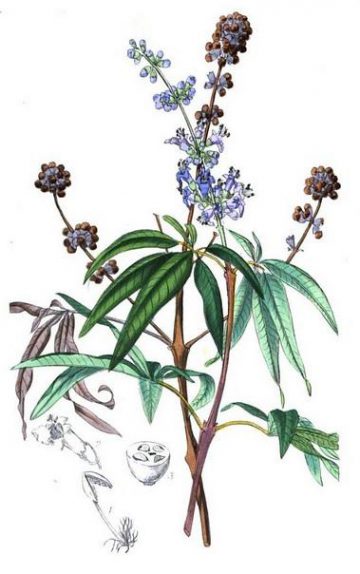
The main uses of this plant are related with problems of the menstruation and the consequences that they produce in woman’s health. No hormones that could justify the role that this plant plays in balancing the hormonal disorders related with the menstruation have been found so far.
Most of the studies carried out up to now seem to determine that the agnuside contained in the fruits is responsible for the neutralization of the exceeding estrogens, due to Premenstrual Syndrome, and for the increase in progesterone which is interesting to palliate the negative effects that menopause imposes.
This happens because this plant acts on the hypophysis helping it to produce the luteinizaning hormone and to diminish the follicle stimulating hormone.
Definitely, its use is very positive to balance the female hormonal system. All these properties are possible whenever they are done with a continuous prolonged treatment. The effects produce after 6 months of treatment are permanent although this may be given up completely.
Benefits of Vitex
Among the main medicinal uses of vitex, we can point out the following:
- Premenstrual syndrome: This plant was already used by the old people from Greece or Rome to calm the pains of the menstruation. It diminishes the prolactin production, the hormone in charge of the the production of maternal milk and one of the main responsible factors for breast swelling and pain during menstruation.
Besides, it has been demonstrated that the constant use of this plant during a prolonged period alleviated many symptoms of PMS: bad mood, swelling, headaches, sweet craving, lack of concentration, etc. (Infusion of a spoonful of berries for cup of water. Three cups a day) (Administration of powder pills of chaste tree in a daily intake of 450 mg distributed in two doses) (Do not to take if high levels of depression are presented because the use of this plant could increase them)
- Menopause: It exercises a oestrogenic balance in the body, so that it is appropriate for the treatment of menopause. It has been proved that administering it produces a regularization of menstruation especially in relation to quantity or timing.
It also helps to reduce hot flushes or other symptoms (The habitual intake is about 450 extract mg a day distributed in two doses) It can be taken in form of capsules or pills. It is considered that the first improvements take place in 2 months time and that the regulation of the menstruation takes place after half a year of treatment.
- Amenorrhoea: (Temporal ceasing of menstruation) The use of the tincture of this plant is effective to combat amenorrhoea, produced by a too high level of prolactin that this plant helps to diminish. (The habitual dose is of 20 daily mg)
Postoperative vomiting: Ginger seems to reduce the negative effects that accompany medications used in surgery, especially the need for vomiting. This remedy must be taken one day before an operation takes place on the condition that it has been consulted consulted and approved by the doctor.
- Infertility: Chaste tree, according to some studies, is very appropriate to increase female fertility because it regulates the woman’s hormones, reducing oestrogens, and, at the same time, increasing breast milk production.
It is very helpful for those women that take birth control pills and decide to abandon them and become pregnant. After a period of treatment, they may become fertile again. (40 drops of extract liquid) (Do not to take if you are already pregnant or if you believe you might be)
- Fibromas: Its action on the fibrous cysts is quite effective. (The habitual dose is about 450 extract mg a day distributed in two takings)
- Breast inflammations and breast lumps: The administration of supplements of this plant before menstruation can help balance the hormonal imbalance. (Normally a daily dose of 225 mg) (Never use in case of pregnancy or lactation)
- Endometriosis: By stabilizing the hormones, it diminishes the painful pains of endometriosis. The habitual dose is about 600 extract mg a day distributed in three takings.
- Juvenile acne: The use of this plant has been positive in the treatment of juvenile acne so much in boys as in girls. (Infusion of a spoonful of dry fruits for a cup of water during 10 minutes. Take two cups a day)
Other uses of Vitex
- Spice: The fruits of this plant have been used as spice to season foods. They possess a slight spicy flavour and they are lightly bitter. Its essential oils also give food a slight aroma.
Is vitex a safe plant
Vitex has some contraindications and side effects that have to be taken into account before undertaking any treatment.
 More information on vitex toxicity, contraindications and side effects.