Contents
- 1 What is a herb and how does it differ from other plants?
- 1.1 What is a herb?
- 1.2 Characteristics of herbaceous plants
- 1.3 What are medicinal herbs?
- 1.4 Classification or types of herbs
- 1.5 What do we call weeds?
- 1.6 Weeds in orchards and crops
- 1.7 Uses of herbs
- 1.8 Weeds or not, it depends on where you look
- 1.9 Weeds and pharmaceuticals
- 1.10 Why is Aspirin called that?
- 1.11 Research on medicinal plants
What is a herb and how does it differ from other plants?
What is a herb?
From a purely botanical point of view, any plant lacking a woody stem is considered a herb or herbaceous plant. This woodiness or lignification of the stem is what differentiates herbs or herbaceous plants from trees and shrubs.
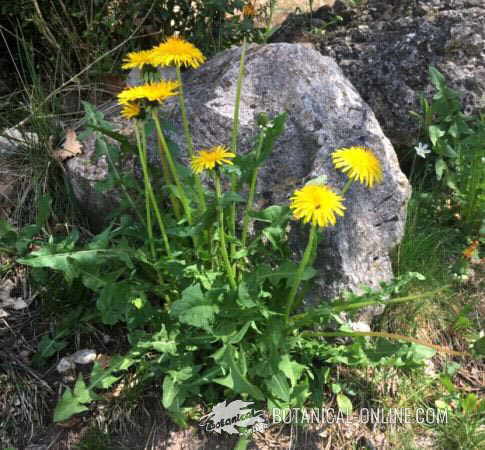
Photo of a well-known herbaceous plant, the dandelion ( Taraxacum officinale W.).
Characteristics of herbaceous plants
Herbaceous plants typically do not manage to live permanently, at least the external part of it. Herbs are born, grow, flower, reproduce, and then die.
What are medicinal herbs?
From a medicinal point of view, healing herbs are plants used for therapeutic purposes, regardless of whether they have a more or less woody body, as long as the most tender parts of them are used for these purposes, that is, the leaves or non-woody stems.
Classification or types of herbs
From this botanical point of view, herbs or herbaceous plants can be classified into the following three types or large groups:
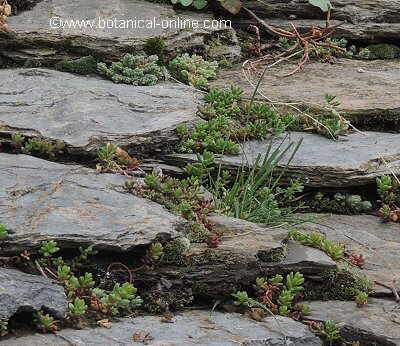
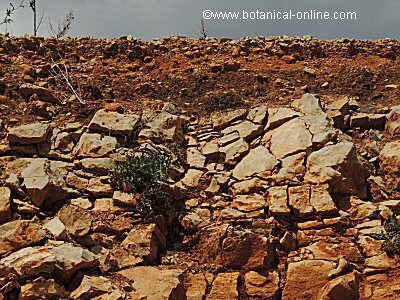
The ability of herbs to live in difficult places is clearly seen in the photo, where it is seen covered with slate with the herbs rooting between them
- Annual herbs: They are those that only live for one season. Their growth is rapid, as it takes less than a year from germination to seed production. A classic example of annual plants are cereals, such as corn or wheat, which germinate and bear fruit in the same year.
- Biennial herbs: They are those that need two seasons to complete their life cycle. The first season is when growth occurs. In the second, flowers and fruits appear. An example is angelica, which only produces shoots in the first year, and it is in the second year that its flowers and fruits appear.
- Perennial herbs: They are those that produce new stems each year from perennial underground organs. This group includes bulbs such as onions; tubers as potatoes; and rhizomes such as sugar cane.
What do we call weeds?
Any herbaceous plant that grows in places where it is not desirable for it to grow is considered a weed, either because it prevents other plants from growing properly or because it is considered to aesthetically impoverish the place where it should not be. These plants require constant weeding in the garden.
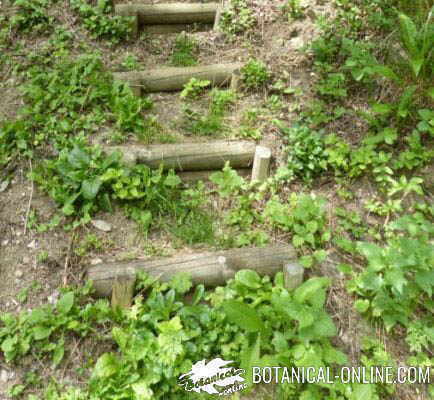
Weeds usually appear in abundance in fertile and moist soils, such as vegetable gardens and flower gardens. (Note: Did you know that many of them are edible?)
Weeds in orchards and crops
In agriculture, weeds include thistles, such as the spear thistle (Cirsium vulgare) and the creeping thistle (Cirsium arvense), as both are invasive and require continuous work by farmers to eliminate them. Other weeds include pigweed amaranth, amaranth, pigweed, chickweed, and a multitude of other plants, that in reality, had long ago been food for our ancestors.
Uses of herbs
From a therapeutic point of view, there are no weeds. Some plants that were considered so have proved very useful later.
This is the case, for example, with the dandelion (Taraxacum officinale), a herb with rosette-shaped leaves and which its yellow flowers transform into pappus in the form of white feathers that are scattered by the wind. The dandelion is a real nightmare for gardeners who want a neat lawn. However, as its name suggests, it is one of the most prized natural remedies, a powerful liver tonic, and a staunch ally for those who want to lose weight.
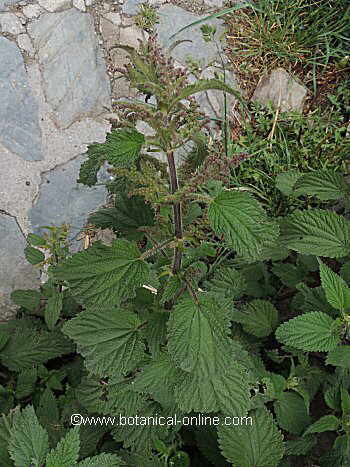
Another classic example is nettles, considered by many to be a disturbing, stinging and ugly herb, but which has actuality been part of vegetables of a lifetime (as in the traditional nettle soup). This food has appreciated properties both nutritionally and medicinally.
To give more examples of weeds, which are actually useful plants, we recommend looking at the properties of borage, thistles, or watercress, although the list would be very long.
Weeds or not, it depends on where you look
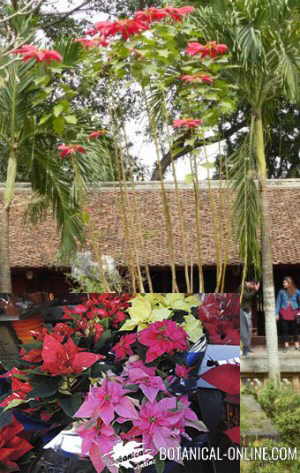
Other plants are considered weeds in some places, and in others they are “garden, indoor, or patio flowers.” Such is the case of the poinsettia (Euphorbia pulcherrima), also called Christmas star or Easter flower. Although many people know it as a small flower, it can actually reach over a meter in height.
The poinsettia is a veritable weed in Mexico, its place of origin, where it grows spontaneously and reproduces vigorously. Outside its place of origin, this plant is one of the most appreciated indoor flowers and a symbol of Christmas.
In the United States, there is even a National Poinsettia Day, celebrated on December 12th to commemorate the death of Joel Roberts Poinsett, an American ambassador to Mexico who is supposed to have introduced the poinsettia to the country. Interestingly, this plant belongs to the Euphorbiaceae family, which also includes spurges, weeds from the Mediterranean fields.
* More information: Weeds
Weeds and pharmaceuticals
Weeds are not only a source of therapeutic resources for natural medicine. Official medicine is also nourished by many components obtained from the exploitation of these plants. It is believed that there are approximately a quarter of a million plant species. Of these, some 7,500 are herbs. Although they represent only 3% of the total, weeds constitute more than 30% of the total plant species that the pharmaceutical industry uses to extract pharmaceutical components.
Among them are well-known compounds such as morphine. They are extracted from the opium poppy, and vinblastine, a component obtained from the periwinkle plant used in cancer treatment (breast cancer, testicular cancer, and lymphoma). This is because this principle inhibits the growth of cancer cells and, therefore, hinders tumor growth. The following plant species are also used for medicines: meadowsweet (a precursor to aspirin), mistletoe…
Why is Aspirin called that?
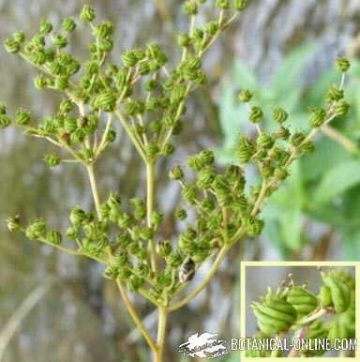
The drug Aspirin owes its name to a medicinal plant: Meadowsweet (Filipendula ulmaria). This plant is rich in salicylic acid, a precursor to the drug acetylsalicylic acid (Aspirin). The fruits of this plant are spiral-shaped, which is why it was formerly known as “Spiraea,” from which the name “Aspirin” is derived.
Research on medicinal plants
In addition to the products tested, there is a lot of research that is being carried out in numerous universities or biotechnology research centers in the search for principles that may be useful in the treatment of most diseases.
The list is almost endless, but the table below shows some of them:
| Some plants used to extract pharmaceutical ingredients in the experimental phase | ||
| Plants | Principle | Application |
| Duckweeds (Lemna subsp.) | Alpha-interferon | Cancer, hepatitis B and C |
| Spinach (Spinacia oleracea) | Vaccine | Rabies, anthrax |
| Corn (Zea mays) | Trypsin | Diabetes, Wounds |
| Lactoferrin | Herpes, hepatitis, intestinal problems | |
| Antibodies | Cancer | |
| Gastric lipase | Cystic fibrosis | |
| Rice (Oryza sativa) | Alpha-interferon | Cancer, hepatitis B and C |
| Lactoferrin | Herpes, hepatitis, intestinal problems | |
| Tobacco (Nicotiana tabacum) | Vaccines | Hepatitis, lymphomas, Norwalk virus |
| Potatoes (Solanum tuberosum) | Vaccines | Hepatitis, Escherichia coli, Norwalk virus |
* Related information:
– Medicinal properties of aromatic herbs
 More information on herbs