Contents
Health benefits of orange tree (Citrus X sinensis (L.) Osbeck)
MEDICINAL PROPERTIES OF ORANGE TREE
REMEDIES WITH ORANGE TREE IN INTERNAL USE
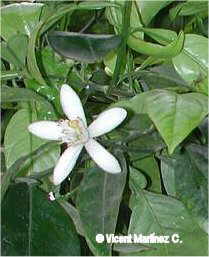
- Tranquilizer: Leaves in infusion for nervous disorders (Infusion for 5 minutes of two leaves per cup) With the flowers of bitter almonds it is prepared the orange blossom water, also known as ” Carmen water ” which is used as a sedative to sleep better and to revive in case of fainting, palpitations, etc. The infusion studied above would be suitable in this case, too.
- Stomachic: Flowers of orange tree should be used to fight stomachic spasms (6 flowers for each cup in an infusion of 3 minutes. Drink 3 or 4 cups every day) The rind can be used for this purpose, although bitter oranges are more suitable in this case. (Decoction of 60 gr. per litre of water for ¼ of an hour. Drink a cup after meals.)
- Diuretic: Because the stimulation power of caffeine and the ascorbic acid, oranges can be used as a diuretic in obesity treatment, by increasing micturition which will get rid of undesirable water. Lemons, oranges, grapefruits, limes and other citrus contain a high amount of citric acid. It has been proved that this acid is able to dissolve little kidney stones or prevent their formation. Eating this type of fruit protect us against forming new kidney stones. (Eat oranges ofr drink orange juice at will)
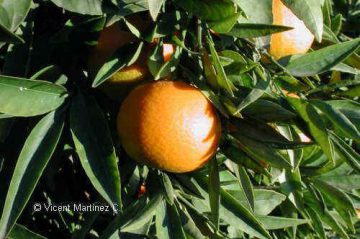
- Cholesterol: Studies carried out in United States showed that the orange peel, rich in flavonoids tangeritin and nobilitin, got a 40% reduction in cholesterol levels in a group of rats submitted to diets rich in this component. The study suggested the possibility of using this food as a way to reduce cholesterol in humans.
- It also showed that the orange peel contains up to 20 times more flavonoids than the juice of this fruit because the flavonoids do not dissolve in the liquid, so juice flavonoids become less asimilable than those in the cortex. (Perhaps a piece of orange rind in our meals from time to time can help us lower our cholesterol level)
- Flu: Although vitamin C does not cure flu, it can relieve symptoms and reduce the duration of it. Citrus fruits (oranges, lemons, grapefruits, limes, mandarins, etc.) are good sources of this vitamin.
- Cold: Although vitamin C does not cure common cold, it can relieve symptoms and reduce its duration. Citrus fruits like oranges, lemons or grapefruits, peppers, dark green leafy vegetables like cabbage or broccoli, are good sources of this vitamin.
- Carminative: To expel intestinal flatulence (The same decoction seen above)
- Antifebrifugue: To diminish fever (Eat the whole orange smashed with the rind and macerated with sugar in a glass of boiling water.)
- Anti-cancer: Citrus fruits in general, are very rich in vitamin C and pectin. They have a protective power on the digestive system and protect it against the cancers that could affect them. Recently, it has proven that modified pectin and pectin have a beneficial effect in treating prostate cancer and melanoma, favouring the non-appearance of metastasis.
ORANGE TREE PREPARATIONS FOR EXTERNAL USE

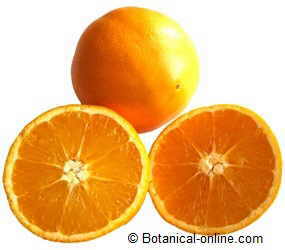
Photo of oranges. A whole orange and one halved is shown Stimulant: The use of essential oil of orange for relaxing massage helps relieve tension, reduce stress, allowing greater communication between partners and increases the desire.
In addition to this plant we can also use: mint, ylang-ylang, jasmine, sandalwood, dog rose, lavender or sage.
Orange essential oil relieves congested skin and depression, anxiety, emotional stress and changing mood.
Edible uses of orange tree
Oranges are a very adequate because of its high value in vitamins (specially vitamin C with an average of 53 mg. per 100 gr.) which make them in one of the best antiscorbutic food. They also have a big quantity in sugars, particularly rich in fructose, easily assimilable by the body, so that it can be eaten by diabetics.
Because their high content in mineral salts, outstanding potassium, they have a great diuretic power. Their caloric content – about 47 per 100 gr.- allow people to eat with no fear to obesity. They provide with a good quantity of calcium – 40 mg per 100 gr.
 More information about oranges and the orange tree.