What is a nutmeg plant?
Characteristics of nutmeg (Myristica fragrans)
Common English names: Nutmeg, Nutmeg tree, pala
Scientific name: Myristica fragrans Houtt.
– Taxonomic synonym: Myristica moschata Thun.
Family: Miristicaceae
Habitat:Where to find nutmeg trees?
Tree native to the Moluccas in Indonesia, and grown in most of the tropics.
Distribution. Where does nutmeg live?
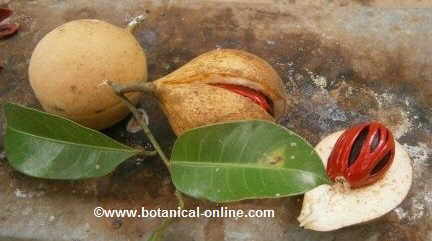
Nutmeg, leaf, fruit, nut and aryl (red). Freshly picked from a nutmeg tree (Myristica fragrans)
It is very abundant in Brazil and in South Asia. Indonesia and the island of Granada are the largest producers. The Guianas, Sumatra, the island of San Mauritius, India, Malaysia and Papua New Guinea are also large producers. Nutmeg production starts when trees reach the age of 9, being productive for about 20 years.
Description of nutmeg tree
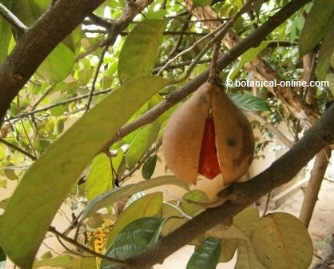
Nutmeg fruit on the tree
Dioecious evergreen tree of the Myristicaceae family up to 20 m. height. Erect stems grayish brown.
Alternate, elliptical, dark green leaves, entire and sharp, with strong pinnate venation.
Flowers yellow, little showy. In male trees they are grouped in tops; on the female trees, often isolated.
The fruits are produced in the female trees. These are drupes of about 5 cm in diameter. As they mature, they are opened in two halves or shells. Inside, there is the nutmeg, a kind of nut about 3 cm long surrounded by an aryl, a purple or bright red coat, very aromatic and juicy.
Inside the aryl, there is a seed, similar to an almond that we we grind and eat as a spice.
Mace and nutmeg, spices in the kitchen
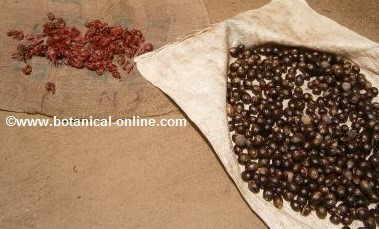
Photo of nutmeg and mace drying in the sun. Both are used as a spice in cooking.
Both wraps, the nut and the aryl, are medicinal and aromatic spices. They are placed in the sun dried and separated from each other. A spice called mace is obtained by crushing the aryl, and the nut, what is known as nutmeg.
Uses of nutmeg
The fruit is used for:
- The pulp or fleshy part that covers the nutmeg, is used for making jam and other sweet preparations. It is very rich in fiber, but it is very astringent, so it is not possible to eat it raw.
- Mace: The aryl covering the nutmeg, with an intense red color, is called mace or macee. It is used as an aromatic spice. In Southeast Asia is added to coconut milk, which together with other spices, served as the basis for curry sauce to accompany rice, meat, etc.
- The nutmeg is the seed kernel. It is dried in the sun like mace. If you break it, you will see inside a nut we know and we add too food dishes.
Components of nutmeg
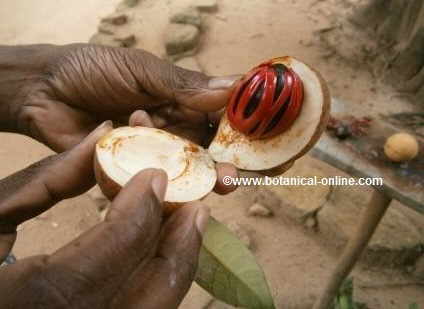
Photography of a transversely open nutmeg.
- Essential oils (1015%): mainly it contains terpenes (sabinene, alphapinene, betapinene, limonene, alphabergamotene, alpha farnesene, alphaphellandrene, alpha thujene, alphaterpinene, alphaterpineol, gammaterpinene, betabisabolene, delta3carene), camphor, eugenol, borneol, geraniol, linalool, nerol, terpineol, vanillin, alkenyl benzenes (elemicin, safrole and myristicin) (seed).
- Fat (3040%) Acids: oleic acid, linolenic, palmitic, myristic, butyric, caprylic, formic, lauric, oleanolic (seeds), gentisic (leaves).
- Fiber (seed): Pectin (seed)
- Catechins
- Minerals: calcium, phosphorus, iron, manganese, magnesium, potassium, sodium, zinc, chromium, copper, cobalt (seed)
- Vitamins: Vitamin C, thiamine, riboflavin.
History of nutmeg
Traditional uses of nutmeg
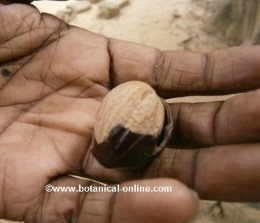
Photography of nutmeg seed, which is ground and used as a spice.
The use of nutmeg as a medicinal plant is documented in the first century D. C by the Romans, who used this plant for the production of spice and as a component of incense.
It was the Portuguese who monopolized the cultivation until the seventeenth century when it passed into the hands of the Dutch. Although it was consumed in Europe during the previous century, the Dutch were precisely those who foster their consumption during the XVII when they widely used for flavoring different types of foods and beverages.
In the nineteenth century, the British removed the monopoly to the Dutch and the French introduced it in Indochina, so that the production was extended to most tropical areas of the world, which diversified its trade and cheapened the price of this spice.
While this species was monopolized by only a nation value was very high, to the point where it is said that a few nuts could be enough to ensure the livelihood of a person throughout his life.
How nutmeg spice is produced?
In the West nutmeg it is imported from the producing countries after being subjected to a process of drying in the sun for about 5 or 6 days. They are then dried to smoke until they are completely dry, so that the seed sounds like a whistle bone when moving the fruit.
Right now, they are open and covered with quicklime or a mixture of lime and water. This allows to keep them dry and protected from rot and insects attack. The main importing countries are the Netherlands, United States, Japan and India.
 More information on nutmeg