Contents
MEDICINAL PROPERTIES OF NUTMEG
Traditional uses of nutmeg (Remedies with nutmeg)
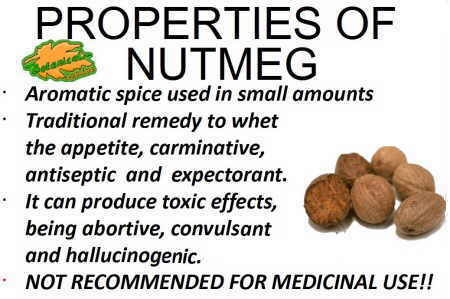
Sheet summary of the main properties of nutmeg. Because of its toxicity, it should not be used as a remedy or medicine. It is only recommended for food use, as aromatic spice in recipes
This spice has been used and is used in Ayurvedic Medicine in India to reduce fever and headache, halitosis, asthma and heart problems.
In many parts of the world it has been used as a stimulant. For a long time it was utilized internally in the West for its digestive and sedative properties. In external use, such as haemorrhoids and antirheumatic.
In higher doses, it has been taken as a strong hallucinogen and psychedelic, although there is a high associated toxicity (more information in the listing below).
Current uses of nutmeg: not recommended medicinal use
Currently, nutmeg is only used or allowed as an aromatic spice in very small quantities in food. The medicinal use of this plant is strongly discouraged because it is too toxic, being more convenient to use other safer plants to achieve the same purpose.
However, only as information, this spice is commonly used with the following properties:
- Digestive system diseases: Nutmeg has carminative properties, provided by camphor, eugenol, and safrole. Bisabolene gives stomachic properties. Pectin fiber, sabinene or zinc are potent antiulceric. Nutmeg contains over 20 ingredients with sedative properties. The digestive properties of this plant lies in its ability to relax the abdominal muscles and to expel gases from the intestine. These virtues have been profited for the treatment of digestive abnormalities such as:
- Aerophagia: Its use can remedy digestive flatulence. (3 g of powdered nutmeg spread over after meals three doses)
- Difficult digestions: Its components allow to stimulate gastric acid and promote the breakdown of food which aids digestion. (3 g of powdered nutmeg divided in three doses. Spread on food after the three main meals)
- Gastritis: The same remedy has been used in the treatment of inflammation of the stomach.
- Loss of appetite: Nutmeg, because of its special flavor, stimulates digestion and whets the appetite being appropriate in cases of poor appetite or anorexia. Sprinkle a little nutmeg on the food after preparation and before being served)
- Vomiting: This spice has been used to treat vomiting (Take one capsule sold in herbal stores)
- Diarrhea: The astringent properties of this spice have been used to stop diarrhea. (Take one capsule sold in herbal stores)
- Dry mouth: Same as above remedy, to treat the lack of saliva in the mouth.
- Respiratory diseases: Due to its antibacterial (it has almost 40 principles with this property), expectorant (over 10 principles) and antiinflammatory properties (more than 20 principles), the essential oil of nutmeg is used in external use to treat respiratory abnormalities such as bronchitis, cold or cough. (Apply a compress on the breast with some drops of diluted essential oil)
- Rheumatic pains: We used the diluted essential oil for rubbing on the joints of rheumatic people in order to lessen pain and reduce inflammation.
- Caries: The same essential oil has been used to reduce teeth pain from a decayed tooth. (Apply a drop on the area affected by pain)
- Difficult menstruation: Nutmeg helps regulate menstruation, being suitable for dysmenorrhea (3 g of powdered nutmeg divided into three doses)
- Hemorrhoids: The antiinflammatory properties of nutmeg can be used to reduce swelling and pain of hemorrhoids. (Make a mixture with butter and 5 g of powdered nutmeg and applied as ointment on the hemorrhoids)
- Stimulating: Nutmeg is considered in parts of Latin America as a powerful stimulant.
OTHER USES OF NUTMEG
In addition to its medicinal uses, we have to emphasize other very important uses:
Nutmeg and aromatic spice
As a spice it is extensively used in the kitchen for pastries, cakes, jams, rice, meat, fruit and vegetable salads, boiled and roasted fruits. (More information on “nutmeg as a spice”.)
How to preserve nutmeg
Nutmeg should be stored in tightly closed containers in a cool, dry place protected from light.
Nutmeg in the industry
The industry uses nutmeg for its antifungal and antibacterial properties. The essential oil of nutmeg, which is obtained by distilling the ground powder of this fruit, appears in the composition of numerous industrial products, related to cosmetics and soaps.
The pharmaceutical industry makes use of it mainly in the composition of toothpaste, as well as in the manufacture of cough syrups.
Myristic acid is obtained from nutmeg butter for the production of lubricating oil.
The food industry uses this oil to flavor many products such as cookies, cakes, breads, drinks, candy, etc. The flavor and aroma of this oil is similar to nutmeg.
Nutmeg butter is obtained by pressing the fruit and subsequent distillation of this paste. It is an oily substance white or yellowish, very rich of a saturated fatty acid called trimyristin, from which this butter contains around 80%. From this paste myristic acid is produced, that can be employed as a substitute for other saturated fats, such as coconut oil or palm oil.
(* See more nutritional properties of nutmeg).
Toxicity of nutmeg
How secure nutmeg as a spice is? Is it a hallucinogenic?
Nutmeg has a very high toxicity when not used in appropriate doses. You must also bear in mind a number of contraindications and side effects, since, if consumed in excess, it can produce hallucinogenic effects, convulsions and it is likely abortive and dangerous for the fetus because it contains safrole.
Is it dangerous to eat nutmeg in large quantities?
Yes, it is dangerous to eat a lot of nutmeg. Ingestion of about 5 grams of nutmeg can cause serious toxic effects. If you happen to ingest such amount of nutmeg, you should contact a doctor or go to a hospital.
 More information on nutmeg.