Importance of cereals in the world
What are cereals?
Cereals are grains or fruits (fruits with seeds in its interior) of the Poaceae family.
This family is very extensive and it is supposed to have approximately 5000 species.
The species can produce flour that have been used since ancient times to feed the man known as cereals.
Which are the main cereals?
The main cereals are:
THE FALSE CEREALS From an alimentary point of view, cereals are also considered another series of plants whose seeds are edible, but whose plants have botanical characteristics different from the real cereals described on this page. Within this group we have a series of cereals considered exotic in the West but quite used in certain areas of the world and increasingly present in Western countries. Among them, we have, for example, buckwheat, amaranth and quinoa |
History of cereals
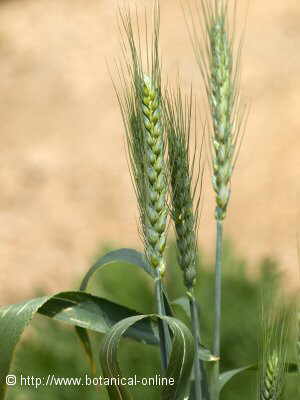
Photo of wheat ears
The word cereal comes from the name “Cerealia” that were the holidays celebrated by the Romans in honor of Ceres, the goddess of agriculture. In this festival the goddess was granted with the best of the harvest, which is mainly what we now call cereals.
However, the importance of cereals in ancient civilizations comes from much earlier. It is known that wheat was a sacred food for the Egyptians and the Greeks based their power in wheat with barley.
For the Greeks, Demeter – the goddess mother- was the most revered of all goddesses. She had taught men agriculture and the cultivation of wheat.
North African civilizations, like the ancient Ethiopian, fed especially with millet. The main source of food in Asia was rice and, in America, corn .
Where are cereals cultivated?
The use of different grains in different parts of the world responds to climatic conditions that each of these plants initially required to thrive. For example, wheat, oats or barley prefer temperate climates, and is therefore the most widely grown cereal in Europe. Maize, millet and rice need warm climates hence the prime importance in such areas.
However, at present, more resistant and adaptable cereals to other types of climates have been found . Maize, for example, initially from the warm parts of America is allowed to be planted intensively in much colder Atlantic climates.
The use of cereals is still today the food base of the cultures in development. In rich countries, many of these foods are eaten mainly in an indirect manner through the animals that feed on them, which is being increasingly seen as an unsustainable process, given the energy lost in this process. Thus, for example, it has been found that, to produce a kilo of pork, 3 or 4 kilos of grain are necessary.
Barley in rich countries is practically dedicated to animal consumption.
Characteristics of cereals
Although there are various cereals, all have a number of common characteristics.
They are herbaceous plants with round hollow stems and narrow leaves embracing it.
Flowers on inflorescences (spikes, panicles or clusters) Each stem has several flowers together in spicules.
Cereal flowers usually have three stamens and a single ovary with two feathery stigmas. They lack petals and, instead, the stamens or stigmas are surrounded by two pairs of opposing parts placed one above the other. called bracts – glumella glumella higher or lower or palea and lemma.
They have dry fruits , caryopsis type, indehiscent, that is to say, they do not open when ripe.
What are the grains?
A cereal fruit it is normally called grain or seed
How is a grain formed?
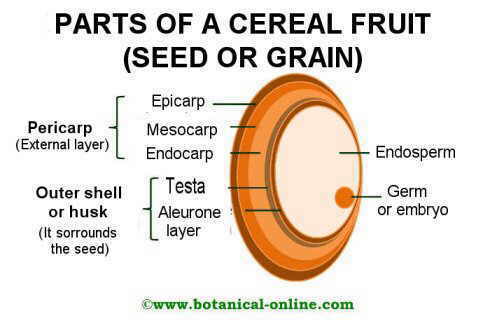
The different parts of a cereal grain
A cereal grain consists of the following parts, as shown in the picture below (wheat grain):
- Germ or embryo: formed by minerals, enzymes, proteins, essential fatty acids and vitamins, especially vitamin B and vitamin E. From this part of the seed the new plant is originated. This part of the grain is usually eliminated in the refining process, mainly to remove the flour the essential oils that can decay with time.
- Endosperm or albumen: The germ or embryo, the endosperm is separated by a permeable layer. The endosperm is the most abundant of a cereal grain and is the reservoir from which will feed the new plant until it can extract minerals and water from the soil with their roots. It is almost 80% of grain weight. This consists of carbohydrates (starch) for the most part and a few proteins. The albumen is, in practice, all that remains after the grain refining.
- Aleurone layer: The endosperm is surrounded by an aleurone layer. This layer contains proteins and fats.
- Testa: It is a layer located above the aleurone and contains many vitamins and other nutrients.
- Pericarp: It is the outer layer. It’s a very hard layer, consisting of cellulose, which contains abundant minerals and consists of three layers from the outside in are called exocarp, mesocarp and endocarp. This layer, along with the head, is also removed when the grain is refined, constituting the bran.
- The outer shell or husk: commonly called husks. It is formed by a kind of husk around the grain membrane and extending an edge.
Cereals are part of most world culturesCereals have been important in most cultures. The photo shows a hit or sac of skin where the Scandinavian peoples kept the flour or grain to keep it in good condition and protect from moisture. (Ethnological Museum Voss. Norway) 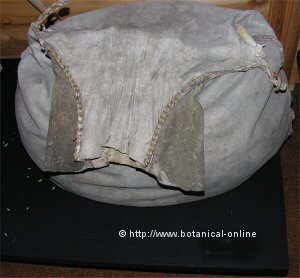 Storing grain in good condition has been a constant concern of the different communities of the world. The discovery of fire allowed the firing of clay. In this way they could make it possible to store containers for planting seeds or eat them later during the year. It was also very important to have measures to calculate the value of cereals. The photo shows a container called “Aske” has been used in Norway to measure corn. (Ethnological Museum Voss. Norway) 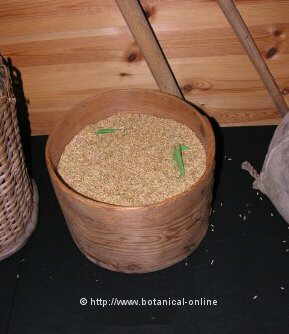 Different cultures have used different tools for growing and handling of grain. In the photo on the right you can see a Norwegian screening used to separate the wheat from the chaff. It is made with birch wood trim and a woven plant. (Ethnological Museum Voss. Norway) 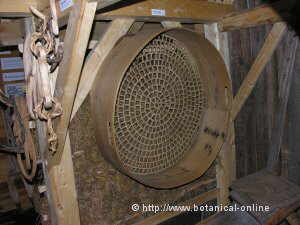 |
Importance of cereals in agriculture, livestock and industry
It was probably the domestication of grasses that produce grains, which facilitated the birth of new civilizations. Surely these plants were chosen either because they excelled in quantity above the other, either because it was very easy to separate the seeds from the plant, perhaps because its richness in carbohydrates they might get a huge energy source or because they were easier to preserve in their clay containers.
The truth is that grains formed the basis for the birth of agriculture. They learned to save seeds of wild plants for planting in place that suited them, by selection were increasingly choosing more resistant varieties, producing more grain, and better taste, until he found the enormous variety of species and varieties cereals available today.
Part of the seeds collected were intended to produce new plants, the rest was used for food. It was a revolution to discover how crushing the seeds between two stones was obtained a powder, called flour, that , mixed with water, led to a paste, that , once baked, become very nutritious and tasty. Thus, it was born what we know today as bread, staple food of many cultures.
Do not forget the importance of cereals in animal feed are both dry seeds in the manufacture of feed and the young plant in the production of forage. Straw is obtained from the dried stems of plants separated from the grain in the past had great importance in feeding ruminants. Today its uses are different and much wider.
Cereals food industry uses the numbers in the manufacture of foods such as starch, gluten or dextrose, alcohol, syrup, etc.. The chemical industry gets from them, especially corn products such as biofuels, plastics and other products such as rubber, resins and insecticides.
Recently the use of cereals for the production of biofuels has caused a great stir throughout the world. The rising price of cereals by higher demand in the production of these new fuels or possible speculation in financial markets has led to a lack of these basic foods to the most disadvantaged sectors of our planet.
 More information on cereals.