Contents
- 1 Importance of rice as food
- 1.1 NUTRITIONAL PROPERTIES OF RICE
- 1.2 Rice is very rich in carbohydrates
- 1.3 Rice, low in proteins and fats
- 1.4 Rice, a cereal without gluten
- 1.5 ADVANTAGES OF WHOLE RICE VERSUS WHITE RICE
- 1.6 Whole rice contains more fiber than white rice
- 1.7 Whole rice contains more vitamins than white rice
- 1.8 Does rice make you fat?
- 1.9 Composition of rice per 100 gr.
- 1.10 RICE IN THE KITCHEN
- 1.11 How to cook rice
- 1.12 Rice in macrobiotic Zen kitchen
- 1.13 Other products derived from rice
- 1.14 Rice drink
- 1.15 Other natural prescriptions with rice
Importance of rice as food
Rice constitutes a basic food for almost half of population of the world. Extensive regions of Asia, Africa and America depend on this cereal to be able to survive.
The three main cereals in the world are rice, wheat and corn.
According to FAO (Organization of the United Nations for Agriculture and feeding), rice provides the 20% of the total of energy in the form of food that the world-wide population consume, compared with the 19% of wheat and 5% of corn.
In some countries, like Bangladesh, it represents 70% of the total, in the Philippines 50% and China 40%.
NUTRITIONAL PROPERTIES OF RICE
Rice is very rich in carbohydrates
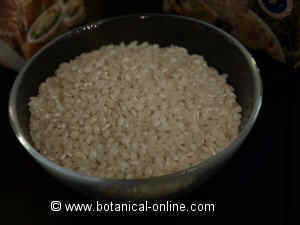
Photo of white rice. Rice contains a lot of carbohydrates
The rice is a very valuable energy “source”. High in carbohydrates, it provides more than 300 calories per 100 g (More than 100 when cooked).
These hydrates become the necessary energy to replace the energy the organism has worn out through its own metabolism and by physical efforts. In addition, this type of energy is generated quickly and it stays during time, so that the organism can be satiated for a few hours after ingesting it.
Rice provides glucose to the blood in a controlled way, what maintains the sugar levels in the blood constant. This means that this food is adapted for the diabetics.
The main source of its energy is the starch, the white part of the rice or what is left of the grain after the descaling (white rice)
Rice, low in proteins and fats
Both white rice and whole rice provide proteins in a similar proportion, a little higher in whole rice. Compared with the rest of cereals, it contains an inferior amount of fat and protein.
Rice, a cereal without gluten
Rice, unlike other cereals, does not contain gluten. For this reason, it can be eaten by people who suffer from celiac disease, who do not tolerate this component. Also for those ones with an irritable colon, who have to avoid gluten because it makes the symptoms worse.
ADVANTAGES OF WHOLE RICE VERSUS WHITE RICE
Whole rice contains more fiber than white rice
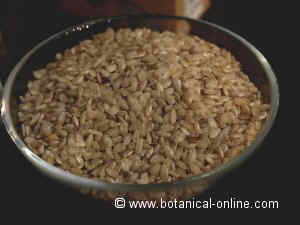
Photo of whole rice. Whole rice is richer in nutritional components than white rice
Besides energy, rice provides fiber. In this case we must choose the whole rice since most of the fiber is concentrated in the external layers of the grain formed by cellulose.
Cellulose cannot be digested and it expelled with the other dragging products from the intestine. 100 g of whole rice contain approximately 1’9 g of fiber. This proportion is 5 times smaller when we speak of white rice.
For those inclined to constipation, it is better to eat whole rice because it favors the expulsion of feces.
Whole rice contains more vitamins than white rice
Whole rice is rich in vitamins, minerals and trace elements that are lost with the descaling, since these principles were in the germ or embryo and in a layer, call aleurone, that surrounded the starch.
The germ of the whole rice is rich in Vitamins of group B, especially thiamin or B1 vitamin, riboflavin or B2 vitamin and niacine or B3 vitamin.
The substitution of whole rice by white rice, was what produced in many Asian countries the appearance of the Beriberi, a disease characterized essentially by muscular weakness, nervous inflammations, cardiac, lacking of appetite and clumsiness in the members. It is a very serious disease that can produce the death of the patient.
Riboflavin is necessary for the formation of red blood cells and to obtain a suitable growth. Niacine is tremendously necessary to reduce the cholesterol levels in the blood.
Does rice make you fat?
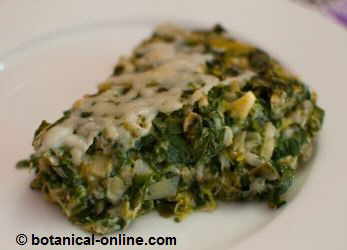
Dandelion quiche. This quiche is an excellent source of fiber, magnesium and beta-carotene from dandelion leaves, combined with healthy energy from complex carbohydrates from brown rice, and minerals such as calcium from cheese .
A diet rich in whole rice can perfectly be recommendable for those people who own an excess of weight and decide to start a diet.
Its little containt in fats, its high content in potassium and its low proportion of sodium make it ideal to eliminate the excess of water of the organism and to collaborate in those diets to lose weight.
In this case they must consider the caloric properties of the rice and avoid adding those foods that have many calories in its diet. Rice, in this sense combines very well with other vegetal foods, especially with legumes, like beans and lentils, which complement rice, providing those amino acids that this cereal does not have. This combinations let us to get high-quality proteins without eating animal food. (See how to combine vegetal proteins)
Composition of rice per 100 gr.
The main minerals that rice contains are potassium, magnesium and iron. These minerals appear in a greater proportion in the whole rice, as it can be seen in the following table:
| Composition of rice per 100 gr. | ||||
| Raw whole rice | Cooked whole rice | Raw white rice | Cooked white rice | |
| Water | 10,37g | 73 g | 11,6g | 68,44 g |
| Calories | 370 Kcal | 111 Kcal | 365 Kcal | 130 Kcal |
| Fat | 2, 9 g | 0,9 g | 0,66 g | 0,28 g |
| Protein | 7,9 g | 2,5 g | 7,13 g | 2,69 g |
| Carbohydrates | 77,24 g | 22,96 g | 79,95 g | 28,17 g |
| Fiber | 3,5 g | 1,9 g | 1,3 g | 0,4 g |
| Potassium | 223 mg | 43 mg | 115 mg | 35 mg |
| Sodium | 7 mg | 5 mg | 5 mg | 1 mg |
| Phosphorus | 333 mg | 83 mg | 115 mg | 43 mg |
| Calcium | 23 mg | 10 mg | 28 mg | 10 mg |
| Copper | 0,3 mg | 0,1 mg | 0,22 mg | 0,07 mg |
| Manganese | 3,7 mg | 0,9 mg | 1,09 mg | 0,47 mg |
| Magnesium | 143 mg | 43 mg | 25 mg | 12 mg |
| Iron | 1,5 mg | 0,42 mg | 4,3 mg | 1,20 mg |
| Zinc | 2 mg | 0,6 mg | 1,09 mg | 0, 49 mg |
| Selenium | 23 mcg | 9,8 mcg | 15,1mcg | 7,5 mcg |
| Vitamin C | 0 mg | 0 mg | 0 mg | 0 mg |
| Vitamin B1 (Thiamin) | 0,4 mg | 0, 1 mg | 0,58 mg | 0, 16 mg |
| Vitamin B2 (Riboflavin) | 0,09 mg | 0, 03 mg | 0,05 mg | 0, 01 mg |
| Vitamin B3 (Niacin) | 5, 09 mg | 1,53 mg | 4,19 mg | 1,48 mg |
| Vitamin B5 (Pantothenic acid) | 1,5 mg | 0,3 mg | 1,01 mg | 0,39 mg |
| Vitamin B6 (Pyridoxine) | 0,5 mg | 0, 14 mg | 0,16 mg | 0, 09 mg |
| Vitamin B9 (Folacine) | 20 mcg | 4 mcg | 231 mcg | 58 mcg |
| Vitamin A | 0 mg | 0,14mg | 0 mg | 0 mg |
| Vitamin E | 0,72mg | 0, 21 mg | 0,13mg | 0,05mg |
RICE IN THE KITCHEN
How to cook rice
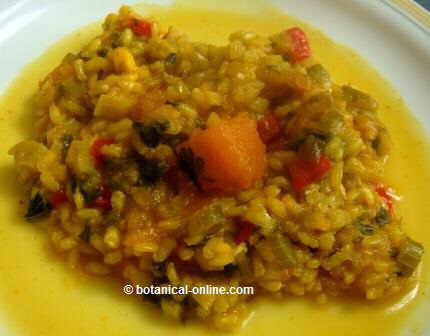
Whole rice with vegetables, a perfect recipe
Rice can be prepared in many ways: boiled, fried, steamed, in the oven, etc.
At the time of cooking it, one has to consider that whole rice needs longer cooking than white rice, unless we left it soaking in water during all night, in which case the cooking time becomes shorter.
Any type of rice can be used to prepare numerous plates.
This food is presents many uses in the international kitchen. Spanish paella, Chinese “three delights” rice, , Italian risotto or international rice with milk are very famous plates.
When we decide to prepare it in a way or another, we must consider that rice must be combined with other foods rich in proteins and amino acids, so that we have a nutritive diet. In this sense it combines very well with vegetables and, as we have stated, especially, with legumes.
Dishes as rice with lentils constitutes a very complete meal of high nutritious power and with balanced nutrients.
Rice in macrobiotic Zen kitchen
The importance that rice has in the macrobiotic Zen kitchen must be pointed out.
Here, the rice constitutes the food par excellence, the king of yang foods, or recommendable foods. It is for this reason that it appears in a multitude of Eastern plates. (sakura, gomuku, etc.)
Other products derived from rice
Some products derived from rice are heavily used in the kitchen. For example, rice flour is ideal to prepare soups, especially recommended for the children.
Pies or creams can also be prepared with it. Often, inflated rice is used to make rice cakes. By its content in hydrates and its little value in fats it turns out to be very suitable for thinning regimes.
Rice drink
Rice drink is the lightest vegetable drink on the market. This is very poor in fats, proteins and rich in sugars, so it is mainly taken as a restorative.
Easy to digest, this drink does not weigh on the stomach and it is easy to drink for unappetizing people. Very suitable for people with gastritis or heartburn.
Other natural prescriptions with rice
Rice is used as a medicinal food to treat diffent anomalies. For example:
- Rice water to stop diarrhea and hydrate your body.
- Rice with milk and cinnamon, to quench thirst and provide you energy.
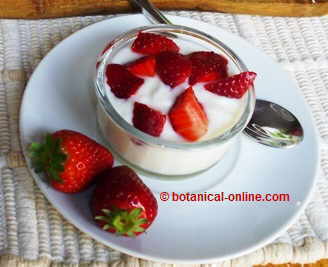
- Rice with strawberries and yogurt, as a good way to improve your intestinal flora
 More information on rice.