Contents
Foods high in fat
Sources of lipids and their recommended frequency of consumption
We can find fat in many foods of different origins and characteristics. They also reside in different proportions, and the quality of the fat can vary greatly from one to another.
For this reason, the recommendations and portions for different types of food diverge from one to another.
Vegetable fats
 Nuts: They have a high concentration of polyunsaturated fatty acids, mostly in the form of omega 6, with the exception of walnuts, which also stand out for their omega 3 content, or cashews for their concentration of saturated fat.
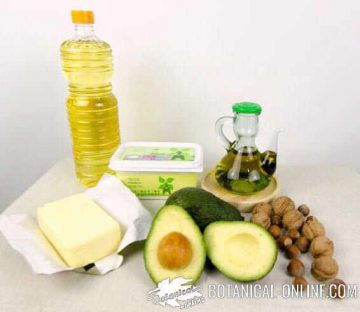
We must keep in mind that these foods, in some cases, are marketed fried so their saturated fat content can increase significantly. Preferably, we can choose toasted ones to minimize this unwanted fat intake.
The recommended frequency of consumption for nuts is 3-7 times per week. The recommended serving is about 20 grams per day, or 18-20 units. In the case of walnuts, it’s 4 units.
- Vegetable oils: Their composition is completely lipid, although depending on the type of oil we choose, its composition and quality of fatty acids will vary greatly.
The frequency of consumption of oils can vary between 3-6 tablespoons spread throughout the day.
Animal fats
- Dairy products: We find milk, as a food in itself and as a raw material used to make a wide variety of different foods.
As a food in itself, it has a high lipid intake in its presentation as whole milk, preserving 100% of its original fat, which is mostly saturated.
But if we want to reduce the fat intake, we can choose semi-skimmed forms, which contain 50% of their fat content, or even the skimmed form, from which practically all of its fat content has been removed.
The recommended frequency of milk consumption is 2-4 servings spread over a day. One serving of dairy products, that comes from milk intake, is a large glass or 200-250ml of milk.
- Processed foods with a high content of animal fats derived from milk: We find, for example, butter, lard, yogurt, cheese, and cream. They have different consumption frequencies, due to their nutritional content.
- Margarines, although mostly of vegetable origin, also contain a high amount of fat, probably fully or partially hydrogenated. The frequency of consumption of foods made with high fat content, such as butter, margarine, lard, and cream, should be limited to occasional consumption, with 10g considered a serving, assuming 10 grams as the portion of the food.
- Yogurts can be skimmed, and the fresher, the lower the fat content, and the less cured thy are, the less saturated fat we will ingest. Dairy products should be consumed in 2-4 servings spread throughout the day. One serving of dairy is equivalent to two yogurts, 80-125g of fresh or low-fat cheeses, and 40-60g of aged cheese.
- At the level of foods with high protein-fat content, we find red meats, oily fish and processed derivatives of both, such as sausages or surimi, respectively.
The fact that they have a high lipid content does not mean they have the same effects, since the quality of the fat they contain differs greatly and their repercussions on our body are also different:
- Foods high in protein and mostly saturated fat include red meat, sausages and cold cuts, processed foods like hot dogs and hamburgers, and pre-prepared fried foods. When consuming these foods, it’s recommended to limit red meat to occasional or once a week. White meat and poultry should be consumed 3-4 times a week. A serving is defined as a 100-125g piece of meat per day.
- Foods high in protein and mostly unsaturated fat include oily fish, and to a lesser extent, white fish and its derivatives. Surimi has a high sodium and fat content from various fish and, while not recommended as much as oily fish, is an option for increasing fish consumption. For foods high in protein and mostly unsaturated fat, it is recommended that fish be consumed 3-4 times a week . A serving is defined as a 125-150g piece of fish per day. We should alternate our consumption of both white fish and oily fish.
- Foods with high protein and mixed fat content include eggs, specifically the yolk and all egg products made from it. Eggs contain saturated fat, cholesterol, and unsaturated fat.
The recommended frequency of egg consumption is 3-4 times per week. A serving is defined as one whole egg.
* More information: Types of fats – Table of food fats – Healthy fats – Unhealthy fats
 More information on fats