Contents
EDIBLE PROPERTIES OF POTATOES
Apart from these considerations that always compels us to use this food cooked, we should think that tubers of potato plant, the potatoes, constitute a very appropriate food that should habitually be present in our meals. Let’s see what are the main edible properties of potatoes.
Composition of potatoes
Composition of potatoes per 100 g | ||
| Boiled without skin and with salt | Fried | |
| Water | 77,4 g | 65 g |
| Energy Kcal | 86 | 156 g |
| Fat | 0,10 g | 5,9 g |
| Carbohydrates | 20 g | 24 g |
| Fibre | 2 g | 3 g |
| Potassium | 328 mg | 326 mg |
| Sodium | 241 mg | 23 mg |
| Phosphorus | 40 mg | 64 mg |
| Magnesium | 20 mg | 17 mg |
| Calcium | 8 mg | 6 mg |
| Vitamin C | 7,4 mg | 9,8 mg |
| vitamin A | 0 IU | 0 IU |
| Vitamin B 6 | 0.26 mg | 0,25 mg |
| Niacin | 1,3 mg | 1,7 mg |
| Folic acid | 9 mg | 12 mg |
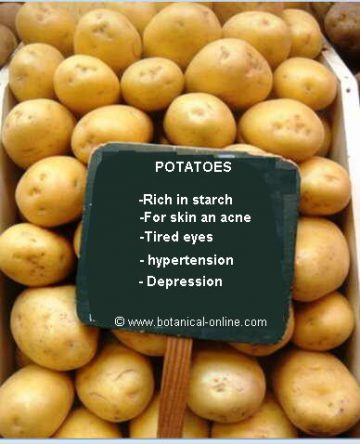
Potatoes contain a lot of potassium
They are very rich in potassium, component that is very good to combat high blood pressure for its vasodilator and diuretic properties. Equally it has been proved to be a good help in the treatment of the depression and especially very interesting to those people who present rheumatic problems, gout, acidosis, cystitis (inflammation of the urinary bladder), prostatitis (inflammation of the prostate) or lithiasis (formation of calculus).
Eating potatoes favors a gentle dream and they help to calm the spasms and cramps, exercising a sedative function of the organism. Equally it is very useful to alleviate cough, when this has a nervous origin.
Potatoes with a lot of vitamin C, calcium, vitamin A and, specially, carbohydrates
Potatoes are rich in vitamin C with antiscorbutic and detoxifying properties, although, since this vitamin is located under the skin, many of it gets lost after cooking.
It contains calcium and phosphorus and smaller quantities of betacarotenes whose properties were already highlighted in the study of the carrot.
But, they are specially rich in carbohydrates that are, together with sugar, the energy source for the correct working of our body.
How to eat potatoes
For a correct assimilation of all these properties, the should be eaten boiled, or steamed cooked. Always using a slow cooking that avoids the destruction of the vitamin C to the minimum. It is very appropriate to drink the liquid resulting from boiling potatoes because most of the minerals are found in it.
Many of the alimentary properties of this food are in the skin. Whenever possible they should be cooked without peeling them, keeping in mind that this should only be done in case of potatoes recently harvested, also called new potatoes.
A good form of preparing them is baking them during 20 minutes with the skin, after having cleaned them appropriately or cook them roasted in the oven, with some drops of oil.. Other recommended combinations are the following ones:
- Puree of potatoes and carrots.
- Potatoes and onion.
- Potatoes with cauliflower and onion.
- Potatoes grated in the oven with aromatic herbs, especially parsley, basil or oregano.
Some potato recipes:
Contraindications of potatoes
In spite of its advantages, one has to keep in mind that eating potatoes makes us eliminate a lot of water so that people with hypotension problems or renal affections should use cautiously. Equally, considering it has a big amount of carbohydrates, people with problems of obesity and diabetics should not abuse of its consumption.
It is not appropriate to combine potatoes with other starchy foods as legumes, cereals, bread or pastas, to avoid ingesting too many calories. The best combination is potatoes with other vegetables.
How to preserve potatoes
To maintain their alimentary properties in good state they should be stored under certain conditions. The main conditions to keep in mind when storing potatoes are the following:
- Not to pile them too much to avoid them to germinate. The heaps should never overcome a height of 50 cm.
- Maintain them fresh.
- Provide them a good ventilation,
- Avoid to store them in a totally dark place, a fact which would make them germinate, neither they should be placed in full light. The best thing is to provide them a certain degree of dimness.
- Those that are in not well state should be removed to avoid them to ruin the rest.
 More information about potatoes