Contents
Health benefits of dandelion (Taraxacum officinale F.H. Wigg.)
Medicinal properties of dandelion in internal use
What is dandelion used for?

- Hepatic: It is a good stimulant for liver and gall bladder, being very useful in cases of hepatitis or cirrhosis, with or without jaundice (Decoction of 100 gr. of roots in 1500 ml of water. Drink 3 cups a day) (Food green leaves in salad or boiled. It is an edible wild plant) (10-minute infusion of leaves. Take 2 or 3 glasses per day)
- Diuretic: It is one of the plants that stimulates most the urine production, up to a point that one of his common nouns in Catalan is ” pixallits ” (bed pisser) So, it is very suitable when it is recommended to get rid of water – – water retention, cellulite, gout and obesity – or when it is advised to eliminate blood toxins – psoriasis, cholesterol, uric acid, diabetes, acne, urticaria, swollen eyes, etcIt helps to expel kidney stones or gallstones and it is very useful for urinary tract disorders, such as cystitis, nephritis kidney failure or gallbladder inflammation (Infusion of dry leaves. Drink 3 cups a day. The same infusion can be made by mixing leaves with roots)
- Cholesterol: (Infusion of dried leaves. Take 3 cups a day. The same infusion can also be done with a mixture of leaves roots.)
- Laxative: It is a good remedy for constipation, since it is a soft laxative (5 gr. a day of fluid extract)
- Skin: Applied as a plaster, made with tender smashed leaves, helps us to heal skin affections, such as wounds or scars, even tumors. Very suitable to treat skin spots, black eyes, etc.
- Varices and hemorrhoids: Being very rich in tannins, may be considered a good friend for skin. It also has relaxing properties for peripheral circulatory diseases (Local baths with the plant decoction)
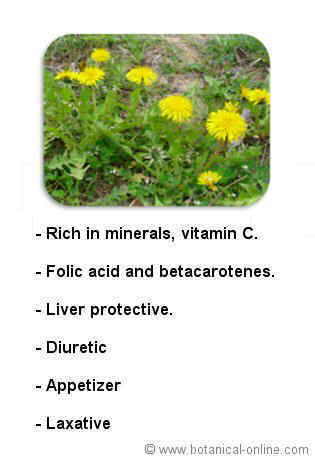
- Blood clots: Dandelion is one of the best remedies to increase urine output. By removing fluids, we improves blood circulation (infusion of dried leaves. Take 3 cups a day. The same infusion can also be done with the mixture of leaves with roots.)
- Hair loss: for their richness in iron, dandelion leaves help maintain good health of our hair, treating seborrhea or dandruff , preventing baldness or dry hair. (Eat fresh leaves in salad)
- Night blindness: Because of its helenin content and vitamin A, it stimulates the absorption of light. (Infusion for a quarter of an hour of a handful of flowering tops in half a liter of water. Take a couple of cups a day.)
- Anemia: Dandelion is a good appetizer to back the urge to feed the sick of anemia. Since, moreover, the plant species that contains in its most amount of iron, is understood as can be used to increase the levels of this mineral into the body. (Infusion of a spoonful of dried plant per cup of water. Drink 3 cups a day)
- Liver depurative : It is a good stimulant for liver and biliary function and is very useful in cases of hepatitis. Besides being one of the best diuretics, it increases urine output and cleanses the body of toxins by helping the liver to perform its function without having to working so hard.Very appropriate for alcoholism (Decoction of 100 g of roots in a liter of water. Take three cups a day) It is a very bitter plant (In fact this plant is also known as “amargon” in Spanish, which means “really bitter”), so it can be combined with previous or other plants such as mint, fennel or boldo.
For its cleansing and hepatoprotective properties, dandelion can be used to purify the blood of toxins and protect the liver from a possible degeneration in case of chemical poisoning. (Decoction of 100 gr of roots in 1.5 liters of water. Take three cups a day)
- Anorexia: In addition to its diuretic properties, dandelion is an edible wild plant with outstanding very appetizing bitter properties, when taken in combination with other vegetables or wild plants in salads. The flower buds before opening, and dressed in vinegar, are delicious and are also open appetite.
- Ovarian cysts: (Infusion of a spoonful of dry leaves. Three cups per day).
Edible properties of dandelion

Dandelion is very rich in beta-carotene
Dandelion is the richest vegetable in vitamin A, in the form of beta carotene. Vitamin A is one of the best antioxidant, able to neutralize free radicals that are the cause of many degenerative diseases.
It has been shown that vitamin A is necessary for good vision, preventing the onset of diseases such as night blindness, cataracts or glaucoma. No less important is this vitamin for the preservation of the skin, preventing the emergence of numerous anomalies such as eczema, acne, psoriasis, dry skin, herpes, cuts, wounds, burns, etc..
Although spinach are very famous for having a lot of beta-carotene, they are surpassed dandelion. (9900 IU/100 g spinach and 14000 IU / 100 g dandelion). About 30 fresh grams of this plant cover the daily needs of an adult.
Dandelion is a vegetable rich in vitamin C and folic acid
Dandelion contains large amounts of vitamin C and folic acid. Vitamin C, is along with vitamin A, one of the best antioxidants and folic acid, among other properties, helps protect against fetal malformations.
Dandelion contains many minerals
We should specially refer to its potassium content which counteracts sodium and contributes to its diuretic properties. Equally interesting for blood circulation and control of hypertension is its high content of magnesium and especially its high proportion of calcium. It was found that patients with hypertension had low levels of magnesium.
Calcium, besides its known value for bone development and prevention of osteoporosis, has great importance in the prevention of circulatory diseases as the formation of thrombi in arteries or hypertension. Dandelion is after spinach (210 mg per 100 g fresh weight) one of vegetables containing more calcium (187 mg mg/100g fresh weight). Although it should be noted that not all the calcium is absorbed well because both spinach and dandelion, are rich in oxalates that inhibit absorption of this mineral. Still, they can be considered as good sources of calcium.
Dandelion, along with calcium, contains enough phosphorus, so, eating this vegetable help us keep our teeth, bones and hair in better condition.
This vegetable is also a good source of copper. This mineral is also involved in the formation of bones and on the health of nerves and defenses. Along with iron it has the key role in maintaining red blood cells and the health of our arteries.
Dandelion, a very light and diuretic food
Dandelion, like most green leafy vegetables, is a food with few calories because it is low in fat and carbohydrates and high in water. This makes it one of the less caloric food (only 16 calories per 100 g of fresh plant). Besides being one of the main diuretic food, it is ideal for people who want to do diet to lose weight or those who have problems of obesity, as well as being very convenient for those who have water retention problems as mentioned above.
It is very convenient to mix the plant with a group of plants with similar cleansing properties, such as celery, onions or carrots or other natural foods. You can also cook them all in a broth, which contains many valuable vitamins and tonifying components.
Preparations of dandelion
How to prepare infusions or recipes with dandelion?
In addition to flowers and leaves, dandelion tisanes are taken frequently. Being very rich in vitamin C and folic acid, two water-soluble vitamins and very susceptible to heat, you should consume dandelion as a fresh vegetable in salads.
Thus we retain all the vitamins and all the properties previously seen. In addition, it provides a touch of very interesting bitterness, so we should mix it with other edible wild herbs such as watercress, for example.
In health food stores we can acquire this plant juices that are ideal for spring cures.
Nor should we forget that this is a vegetable that can be found in the wild but with increasing frequency it is sold in food stores and greengrocers’. Being so easy to collect in the field or cultivated in our garden, it’s a pìty not to include it as a more commonly used vegetable in our healthy daily diet.
Dandelion as coffee substitute
The roots of the dandelion can be roasted and ground to make a coffee substitute, quite delicious but without the drawbacks of the original drink.
 More information on dandelion